 Back
BackSeparable Differential Equations and Initial Value Problems
Study Guide - Smart Notes
 Tailored notes based on your materials, expanded with key definitions, examples, and context.
Differential Equations
Definition and General Solution
A differential equation is an equation involving an unknown function and its derivatives. The solution to a differential equation is a function that satisfies the equation, often containing arbitrary constants.
Order: The order of a differential equation is determined by the highest derivative present.
General Solution: The general solution typically includes arbitrary constants, representing a family of solutions.
Differential Equation | General Solution |
|---|---|
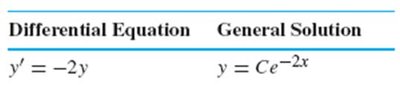
Linear Differential Equations: A differential equation is linear if it can be written in the form , where the coefficients are functions of only.
Differential Equation | Type |
|---|---|
First-order, linear |

Separable Differential Equations
Definition and Identification
A differential equation is separable if can be written as a product of a function of and a function of . The equation then takes the form:
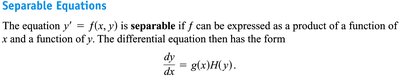
Rewriting and Separation of Variables
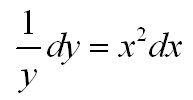
To solve a separable equation, rewrite it so that all terms involving are on one side and all terms involving are on the other:
where

Integration and Implicit Solution
Integrate both sides to find the solution:

After integration, the solution is often defined implicitly as a function of .
Example: Solving a Separable Equation
Consider the equation:
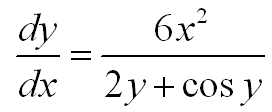
To solve, separate variables and integrate:
Move all terms to one side and terms to the other.
Worked Example:
Step 1: Separate variables:
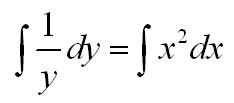
Step 2: Integrate both sides:
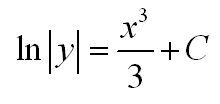
Step 3: Solve for :
, where

Initial Value Problems
Definition and Solution
An initial value problem consists of a differential equation and an initial condition specifying the value of the solution at a particular point. This allows us to determine a unique solution from the general family.
Initial Condition:
Example: Solve ,
General solution:
Apply initial condition:
Particular solution:
Summary Table: Separable Differential Equations
Step | Description |
|---|---|
Separate Variables | Rewrite equation so all terms are on one side and terms on the other. |
Integrate | Integrate both sides with respect to their respective variables. |
Solve | Find the general solution, often implicitly. |
Apply Initial Condition | Determine the particular solution using the given initial value. |
Key Concepts
Separable equations can be solved by separating variables and integrating.
General solutions contain arbitrary constants; initial value problems yield unique solutions.
Integration is central to solving separable differential equations.
Additional info:
Separable equations are a fundamental class of first-order differential equations, often encountered in calculus and physics applications.
Linear equations may not always be separable, but separable equations are always first-order.
