 Back
BackSequences and Infinite Series: Foundations and Properties
Study Guide - Smart Notes
 Tailored notes based on your materials, expanded with key definitions, examples, and context.
Sequences
Definition and Representation
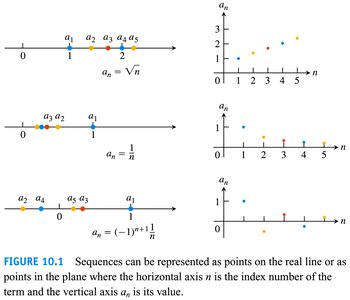
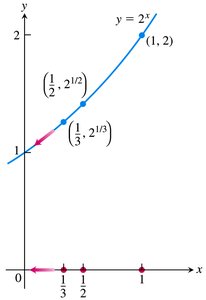
A sequence is an ordered list of numbers, typically denoted as {an}, where each term an corresponds to a positive integer n. Sequences can be represented as points on the real line or as points in the plane, where the horizontal axis is the index n and the vertical axis is the value an.
Infinite sequence: A sequence with infinitely many terms, each having a successor.
Notation: {an} or {an}∞n=1
Convergence and Divergence of Sequences
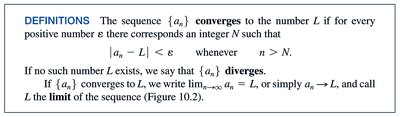
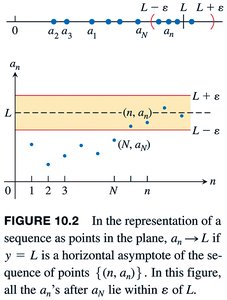
A sequence {an} converges to a number L if, for every positive number ε, there exists an integer N such that:
whenever
If no such L exists, the sequence diverges.
Divergence to Infinity
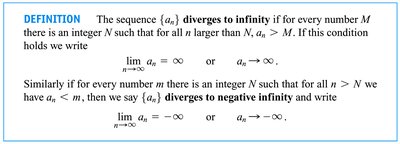
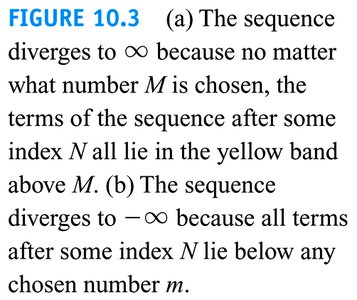
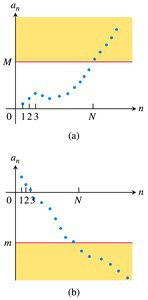
A sequence {an} diverges to infinity if, for every number M, there is an integer N such that for all n > N, an > M. Similarly, it diverges to negative infinity if for every number m, there is an integer N such that for all n > N, an < m.
or
or
Limit Laws for Sequences
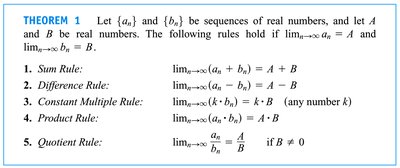
If and , then:
Sum Rule:
Difference Rule:
Constant Multiple Rule:
Product Rule:
Quotient Rule: (if )
The Sandwich (Squeeze) Theorem for Sequences
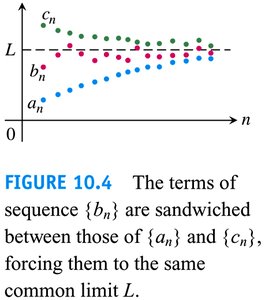
If for all beyond some index , and , then as well.

Continuous Function Theorem for Sequences
If and is continuous at and defined at all , then .

Limits Involving Functions
If for and , then .
Important Limits of Sequences
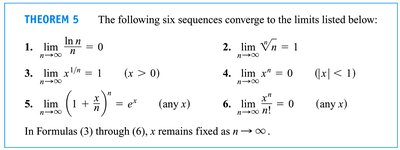
(for )
(for )
(for any )
(for any )

Bounded and Monotonic Sequences
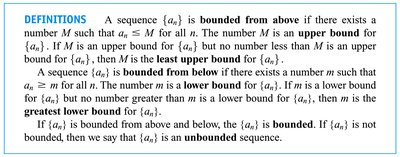
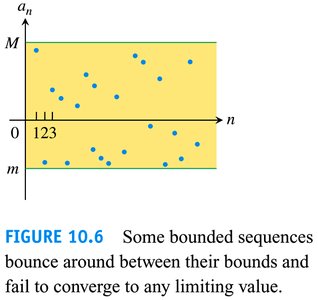
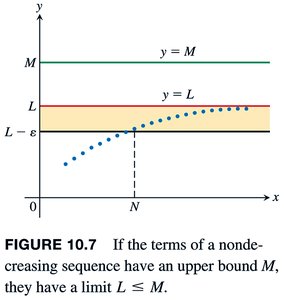
A sequence is bounded from above if there exists such that for all , and bounded from below if there exists such that for all . If both, it is bounded; otherwise, it is unbounded.
A sequence is nondecreasing if for all , nonincreasing if for all , and monotonic if it is either nondecreasing or nonincreasing.
The Monotonic Sequence Theorem
If a sequence is both bounded and monotonic, then it converges.


Infinite Series
Definition and Partial Sums
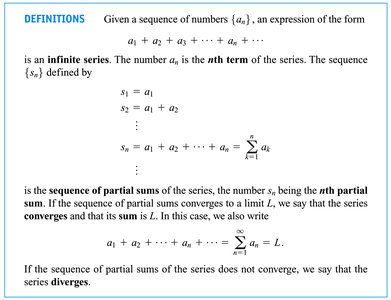
An infinite series is an expression of the form . The nth partial sum is defined as . The sequence is the sequence of partial sums.
Convergence and Divergence of Series
If the sequence of partial sums converges to a limit , the series converges and its sum is :
If does not converge, the series diverges.
Examples and Visualizations
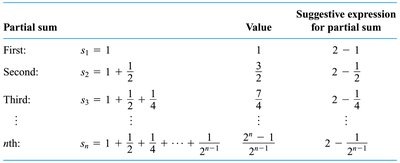
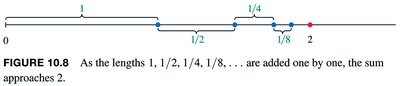
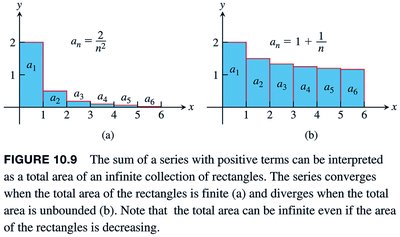
Geometric Series
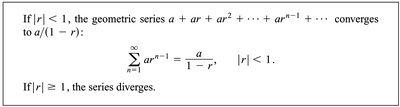
A geometric series with first term and common ratio is . The series converges if and diverges otherwise:
for
The nth-Term Test for Divergence
If fails to exist or is not zero, then diverges.


Properties of Series
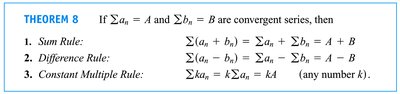
If and are convergent series, then:
Sum Rule:
Difference Rule:
Constant Multiple Rule: (any number )

Every nonzero constant multiple of a divergent series diverges.
If converges and diverges, then and both diverge.
