Back
BackSequences and Their Limits: Chapter 11.1 Study Notes
Study Guide - Smart Notes
 Tailored notes based on your materials, expanded with key definitions, examples, and context.
Sequences and Their Limits
Definition of Infinite Sequence
An infinite sequence of numbers is a function whose domain is the set of positive integers. Each term in the sequence is associated with a unique positive integer index.

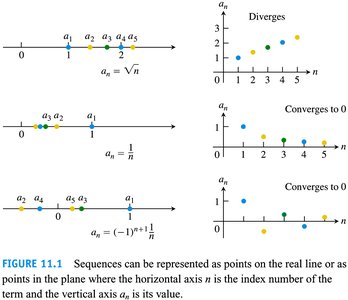
Visual Representation and Types of Sequences
Sequences can be represented as points on the real line or as points in the plane, where the horizontal axis is the index number and the vertical axis is the value of the term. Sequences may diverge or converge to a specific value.
Divergent Sequence: The terms do not approach a finite value.
Convergent Sequence: The terms approach a specific value, often zero.
Convergence, Divergence, and Limit of a Sequence
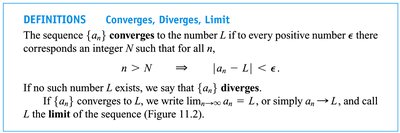
A sequence {an} converges to the number L if for every positive number ε there exists an integer N such that for all n > N, the following holds:
If no such number L exists, the sequence diverges.
If {an} converges to L, we write or .
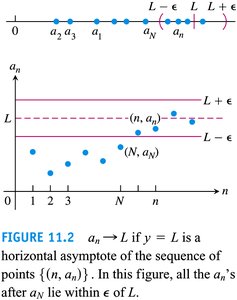
Graphical Interpretation of Sequence Limits
If , then y = L is a horizontal asymptote of the sequence of points . All terms after a certain index lie within ε of L.
Divergence to Infinity and Negative Infinity
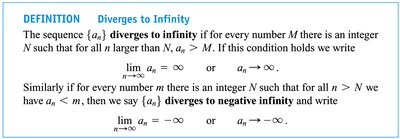
A sequence {an} diverges to infinity if for every number M there is an integer N such that for all n > N, . This is written as:
or
If for all n > N, then or
Limit Laws for Sequences
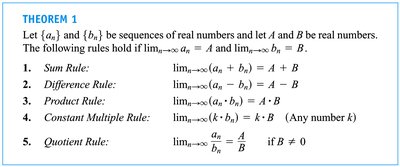
If and , the following rules apply:
Sum Rule:
Difference Rule:
Product Rule:
Constant Multiple Rule: (for any number k)
Quotient Rule: if
The Sandwich Theorem for Sequences
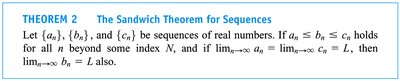
If for all n beyond some index N, and , then also.
Example: Applying the Sandwich Theorem
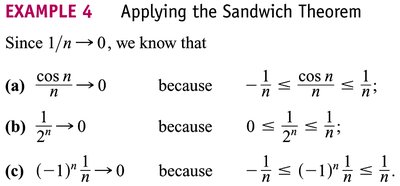
Since , we know:
(a) because
(b) because
(c) because
The Continuous Function Theorem for Sequences
If and f is a function that is continuous at L and defined at all , then .

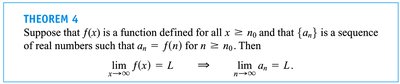
Limits of Sequences Defined by Functions
If is defined for all and for , then:
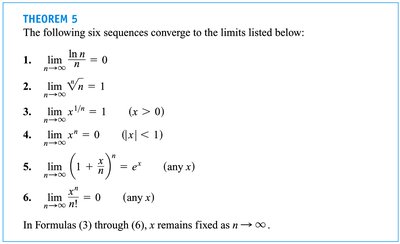
Common Sequence Limits
The following sequences converge to the listed limits:
1.
2.
3. (x > 0)
4. (|x| < 1)
5. (any x)
6. (any x)
Nondecreasing Sequences
A sequence {an} is nondecreasing if for all n.

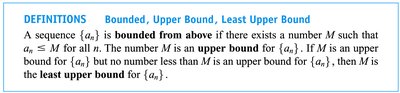
Bounded Sequences, Upper Bound, and Least Upper Bound
A sequence {an} is bounded from above if there exists a number M such that for all n. M is an upper bound. If M is an upper bound but no number less than M is an upper bound, then M is the least upper bound.
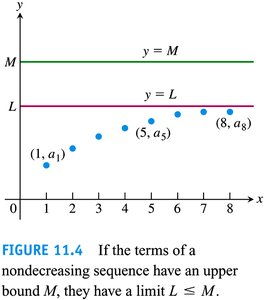
Graphical Representation of Bounded Nondecreasing Sequences
If the terms of a nondecreasing sequence have an upper bound M, they have a limit L such that .
The Nondecreasing Sequence Theorem
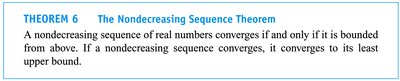
A nondecreasing sequence of real numbers converges if and only if it is bounded from above. If it converges, it converges to its least upper bound.