 Back
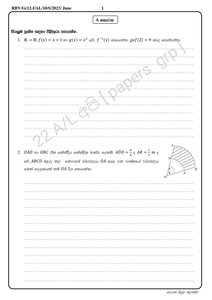
BackStep-by-Step Guidance for Advanced Level Calculus Exam Questions
Study Guide - Smart Notes
 Tailored notes based on your materials, expanded with key definitions, examples, and context.
Q1. Let and . If exists, find and .
Background
Topic: Functions, Inverse Functions, and Composition
This question tests your understanding of function composition, evaluating functions, and finding the inverse of a function.
Key Terms and Formulas
Function composition:
Inverse function: is the value such that
Step-by-Step Guidance
First, evaluate by substituting into .
Next, use the result from to evaluate by substituting into .
To find , first evaluate by substituting into .
Set and solve for to find .
Try solving on your own before revealing the answer!
Q2. In triangle OAB, and . Find the area of the shaded sector and the area of triangle OAB in terms of and .
Background
Topic: Geometry – Sectors and Triangles
This question tests your ability to use formulas for the area of a sector and the area of a triangle given two sides and the included angle.
Key Terms and Formulas
Area of a sector: (when is in radians)
Area of a triangle (SAS):
Step-by-Step Guidance
Write the formula for the area of the sector using and .
Write the formula for the area of triangle OAB using , , and .
Substitute the given values (, ) into the formulas.
Try solving on your own before revealing the answer!
Q3. The coordinates of points A and B are and . Find the equation of the perpendicular bisector of AB.
Background
Topic: Coordinate Geometry – Perpendicular Bisector
This question tests your ability to find the midpoint of a segment and the equation of a line perpendicular to a given segment.
Key Terms and Formulas
Midpoint formula:
Slope of AB:
Slope of perpendicular bisector:
Point-slope form:
Step-by-Step Guidance
Find the midpoint of AB using the midpoint formula.
Calculate the slope of AB.
Find the negative reciprocal of the slope to get the slope of the perpendicular bisector.
Write the equation of the perpendicular bisector using the midpoint and the new slope.
Try solving on your own before revealing the answer!
Q4. Solve the quadratic equation and the cubic equation .
Background
Topic: Algebra – Solving Quadratic and Cubic Equations
This question tests your ability to solve quadratic equations using the quadratic formula and to find roots of cubic equations.
Key Terms and Formulas
Quadratic formula:
Cubic equations: May require factoring, synthetic division, or the rational root theorem.
Step-by-Step Guidance
Identify , , and in the quadratic equation and substitute into the quadratic formula.
Simplify under the square root and set up the two possible solutions for .
For the cubic equation, look for possible rational roots using the rational root theorem.
Test possible roots by substitution or synthetic division to factor the cubic equation.
Try solving on your own before revealing the answer!
Q5. A particle moves along a straight line so that its displacement at time is given by . Find the velocity and acceleration at any time .
Background
Topic: Calculus – Differentiation and Kinematics
This question tests your ability to find velocity and acceleration by differentiating the displacement function with respect to time.
Key Terms and Formulas
Velocity:
Acceleration:
Step-by-Step Guidance
Differentiate with respect to to find .
Differentiate with respect to to find .
Try solving on your own before revealing the answer!
Q6. If , show that .
Background
Topic: Calculus – Higher Order Derivatives
This question tests your understanding of differentiation rules and how to find the second derivative of a power function.
Key Terms and Formulas
First derivative:
Second derivative: is the derivative of
Step-by-Step Guidance
Differentiate with respect to to find the first derivative.
Differentiate the result again with respect to to find the second derivative.
Try solving on your own before revealing the answer!
