Back
BackStep-by-Step Guidance for Calculus Final Exam Review
Study Guide - Smart Notes
 Tailored notes based on your materials, expanded with key definitions, examples, and context.
Q1. Evaluate the following limits:
Background
Topic: Limits and Continuity
This question tests your understanding of how to evaluate limits, including using algebraic manipulation and limit laws.
Key Terms and Formulas:
Limit: is the value that approaches as gets closer to .
Limit Laws: Sum, product, quotient, and power rules for limits.
Factoring and simplifying expressions to resolve indeterminate forms.
Step-by-Step Guidance
Identify the form of the limit (e.g., , , etc.).
If the limit is indeterminate, try factoring or simplifying the expression.
Apply limit laws to break down the expression if possible.
Substitute the value after simplification to see if the limit can be evaluated directly.
Try solving on your own before revealing the answer!
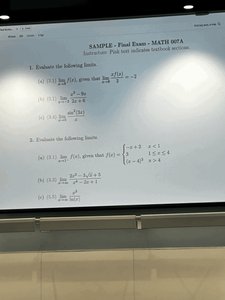
Q2. Evaluate the following limits (piecewise function):
Background
Topic: Limits of Piecewise Functions
This question tests your ability to evaluate limits for functions defined differently on different intervals.
Key Terms and Formulas:
Piecewise Function: A function defined by different expressions for different intervals.
One-sided limits: and .
Step-by-Step Guidance
Identify which piece of the function applies as approaches the given value from the left and right.
Evaluate the left-hand and right-hand limits separately using the appropriate expression.
Compare the two one-sided limits to determine if the overall limit exists.
Try solving on your own before revealing the answer!
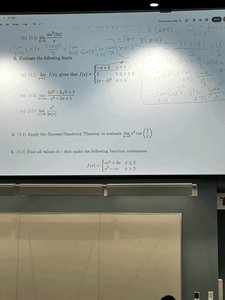
Q3. Apply the Squeeze/Sandwich Theorem to evaluate
Background
Topic: Squeeze Theorem
This question tests your understanding of the Squeeze Theorem, which is used to evaluate limits of functions that are bounded between two other functions.
Key Terms and Formulas:
Squeeze Theorem: If and , then .
Bounded functions: for all .
Step-by-Step Guidance
Recognize that is bounded between and $1$.
Set up inequalities: .
Evaluate the limits of the bounding functions as .
Try solving on your own before revealing the answer!
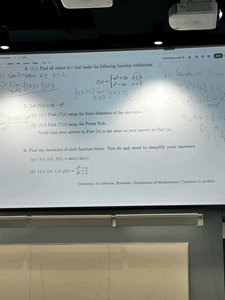
Q4. Find all values of that make the following function continuous:
Background
Topic: Continuity of Piecewise Functions
This question tests your ability to determine values that make a piecewise function continuous at a point.
Key Terms and Formulas:
Continuity: A function is continuous at if .
Piecewise function: Different expressions for different intervals.
Step-by-Step Guidance
Set up the condition for continuity at the point where the function changes definition.
Equate the left-hand and right-hand limits at the transition point.
Solve for so that the limits and function value match.
Try solving on your own before revealing the answer!
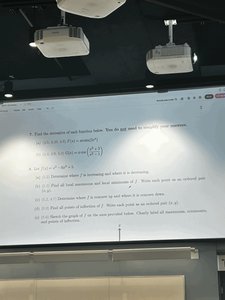
Q5. Find the derivative of each function below. You do not need to simplify your answers.
Background
Topic: Differentiation
This question tests your ability to apply differentiation rules to various functions.
Key Terms and Formulas:
Derivative:
Power Rule:
Product Rule:
Quotient Rule:
Step-by-Step Guidance
Identify which differentiation rule applies to each function (power, product, quotient, chain).
Apply the rule to write the derivative expression for each function.
Leave the answer unsimplified as instructed.
Try solving on your own before revealing the answer!
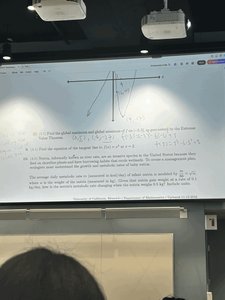
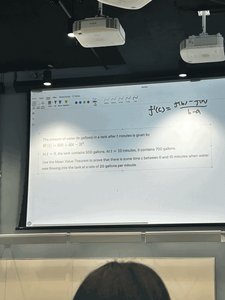
Q6. The amount of water in the garden is measured at two times. Find the average rate of change of water volume.
Background
Topic: Average Rate of Change
This question tests your understanding of how to calculate the average rate of change of a function over an interval.
Key Terms and Formulas:
Average Rate of Change:
Function values at two points: and .
Step-by-Step Guidance
Identify the values of and (the two time points).
Find the function values and (the water volume at each time).
Set up the formula for average rate of change and plug in the values.
Try solving on your own before revealing the answer!