 Back
BackStudy Guidance for College Calculus: Functions, Domain, Range, and Related Concepts
Study Guide - Smart Notes
 Tailored notes based on your materials, expanded with key definitions, examples, and context.
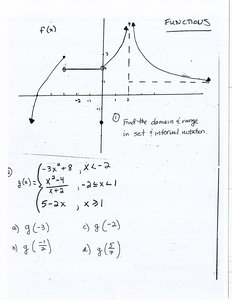
Q1. Find the domain and range in set & interval notation for the given function graph.
Background
Topic: Domain and Range of Functions
This question tests your understanding of how to determine the domain (all possible input values) and range (all possible output values) of a function from its graph, using set and interval notation.
Key Terms:
Domain: The set of all possible values of for which is defined.
Range: The set of all possible values of (outputs).
Interval Notation: A way to describe sets of numbers as intervals (e.g., , ).
Step-by-Step Guidance
Examine the graph and identify the leftmost and rightmost points for the domain. Look for any breaks, holes, or arrows indicating the function continues indefinitely.
Check for any restrictions (such as open circles or vertical asymptotes) that would exclude certain values from the domain.
Identify the lowest and highest points on the graph for the range. Consider whether the function approaches certain values but never reaches them (horizontal asymptotes).
Express the domain and range using set or interval notation, based on your observations.
Try solving on your own before revealing the answer!
Q2. For the piecewise function , evaluate , , , and .
Background
Topic: Piecewise Functions
This question tests your ability to evaluate a function defined by different expressions depending on the value of .
Key Terms:
Piecewise Function: A function defined by multiple sub-functions, each with its own domain.
Evaluation: Substituting a specific value of into the appropriate piece of the function.
Step-by-Step Guidance
For each value of , determine which piece of the function applies by checking the domain restrictions for each case.
Substitute the value of into the corresponding expression for .
Perform the arithmetic operations required to simplify the expression (do not compute the final value yet).
Repeat for each value: , , , .
Try solving on your own before revealing the answer!
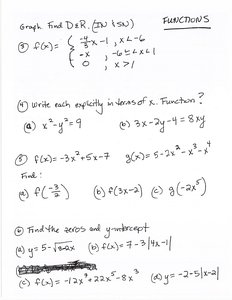
Q3. Graph and find the domain and range in set notation.
Background
Topic: Graphing Functions and Domain/Range
This question tests your ability to interpret a function's graph and express its domain and range using set notation.
Key Terms:
Set Notation: Describes sets using curly braces and conditions (e.g., ).
Graph Interpretation: Understanding how the graph relates to the domain and range.
Step-by-Step Guidance
Analyze the graph to determine the intervals where the function is defined (domain).
Identify the corresponding output values (range) from the graph.
Write the domain and range using set notation, based on your observations.
Try solving on your own before revealing the answer!
Q4. Write each equation explicitly in terms of . Is it a function?
Background
Topic: Solving for and Function Identification
This question tests your ability to solve equations for and determine whether the resulting expression defines a function.
Key Terms:
Explicit Form: An equation solved for one variable in terms of another.
Function: A relation where each input has exactly one output.
Step-by-Step Guidance
For each equation, isolate on one side using algebraic manipulation.
Check if the resulting expression defines a function (does each yield only one ?).
Consider whether the equation passes the vertical line test (if graphed).
Try solving on your own before revealing the answer!
Q5. Find , , for the given functions.
Background
Topic: Function Evaluation
This question tests your ability to substitute values into functions and simplify the resulting expressions.
Key Terms:
Function Evaluation: Substituting a value for and simplifying.
Step-by-Step Guidance
Identify the correct function expression for each value.
Substitute the given value into the function.
Simplify the expression step by step, showing all intermediate calculations.
Try solving on your own before revealing the answer!
Q6. Find the zeros and y-intercept for the given functions.
Background
Topic: Zeros and Intercepts of Functions
This question tests your ability to find where a function crosses the -axis (zeros) and -axis (y-intercept).
Key Terms:
Zero: A value of where .
Y-intercept: The value of .
Step-by-Step Guidance
Set and solve for to find the zeros.
Substitute into the function to find the y-intercept.
Show all algebraic steps for solving these values.
Try solving on your own before revealing the answer!
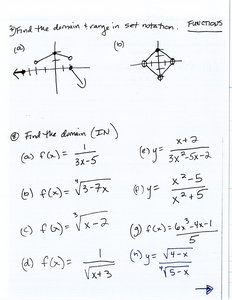
Q7. Find the domain and range in set notation for the given graphs.
Background
Topic: Domain and Range from Graphs
This question tests your ability to interpret graphs and express domain and range in set notation.
Key Terms:
Domain: All possible values.
Range: All possible values.
Set Notation:
Step-by-Step Guidance
Examine the graph for endpoints, breaks, or asymptotes.
Identify the intervals for domain and range.
Write the domain and range in set notation.
Try solving on your own before revealing the answer!
Q8. Find the domain for each function.
Background
Topic: Domain of Functions
This question tests your ability to find the domain for various types of functions, including rational, radical, and composite functions.
Key Terms and Formulas:
Rational Function: (denominator cannot be zero).
Radical Function: (expression under the root must be non-negative).
Composite Function: (denominator cannot be zero).
Domain: The set of values for which the function is defined.
Step-by-Step Guidance
For rational functions, set the denominator not equal to zero and solve for .
For radical functions, set the expression under the root greater than or equal to zero and solve for .
For composite functions, check for any restrictions from the denominator or root.
Write the domain in interval or set notation.
Try solving on your own before revealing the answer!
