 Back
BackStudy Guide: Basics of Functions for Calculus
Study Guide - Smart Notes
 Tailored notes based on your materials, expanded with key definitions, examples, and context.
Functions
Definition of a Function
A function is a mathematical rule that assigns to each input value exactly one output value. This property distinguishes functions from general relations, where an input may correspond to multiple outputs.
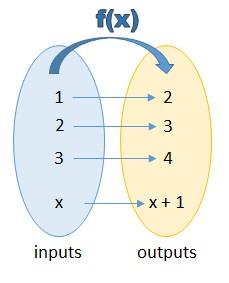
Notation: , where is the function name, is the input (independent variable), and is the output (dependent variable).
Key property: The Vertical Line Test states that a graph represents a function if and only if no vertical line crosses the graph more than once.
Example: , , and are equivalent functions, as they follow the same rule.
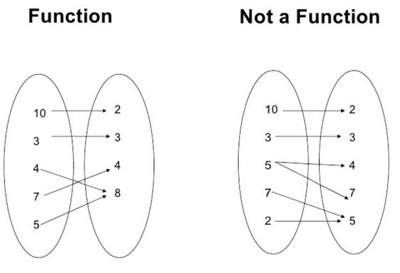
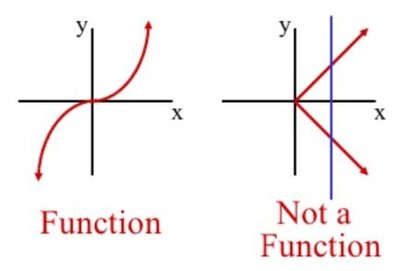
Additional info: The vertical line test is a fundamental graphical method to determine whether a relation is a function.
Ways to Represent a Function
Functions can be represented in several ways:
Symbolic form: Using equations or formulas, e.g., .
Numerical data: Using tables or ordered pairs.
Graphical: Using graphs to visualize the relationship.
Words: Describing the rule in plain language.
Domain and Range of a Function
Domain
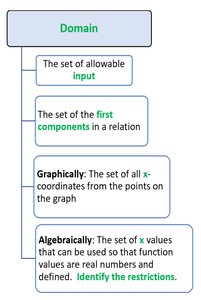
The domain of a function is the set of all allowable input values (usually values) for which the function is defined.
Graphically: The set of all -coordinates from the points on the graph.
Algebraically: The set of values that make the function value real and defined. Restrictions may arise from denominators (cannot be zero), radicands (must be non-negative for real roots), or logarithms (argument must be positive).
Range
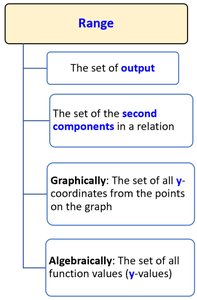
The range of a function is the set of all possible output values (usually values) that the function can produce.
Graphically: The set of all -coordinates from the points on the graph.
Algebraically: The set of all function values (outputs) that result from the domain.
Examples of Domain and Range
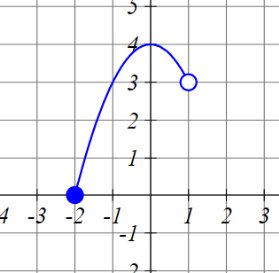
Graphical Example: If the smallest -value is and the largest is approaching $1\text{Domain} = [-2, 1)$.
The smallest -value is $0, so .
Algebraic Example:
: Domain is all real numbers except and .
: Domain is .
: Domain is .
Solving Inequalities for Domain
Tips for Solving Inequalities
To determine the domain of a function, solve inequalities that arise from restrictions (e.g., denominators, radicands, logarithms).
Linear inequalities: Isolate the variable term and solve.
Non-linear inequalities:
Solve the corresponding equation to find boundary values.
Identify possible solution intervals.
Use test numbers from each interval to check validity.
State the solution interval.
Example: Solve .
Step 1:
Step 2: Test intervals , ,
Step 3: Only satisfies the inequality.
Step 4: Solution is .
Piecewise-Defined Functions
Definition and Graphing
A piecewise-defined function is a function that behaves differently on different intervals of its domain. Each interval has its own rule.
When graphing, follow the rule for each interval.
Use open circles for or , and filled circles for or at the "switch over" points.
Example:
Evaluating and Solving Functions
Evaluating a Function
To evaluate a function, substitute the input value into the function rule.
Example: ;
Solving a Function
To solve a function, set the function equal to a given output and solve for the input.
Example: , find so that :
Creating New Functions
Operations on Functions
New functions can be created by combining existing functions using addition, subtraction, multiplication, division, and composition.
Addition/Subtraction:
Constant Multiplication: , where is a constant
Multiplication:
Division:
Composition:
Example: If , , , then
Difference Quotient
The difference quotient is a fundamental concept for calculus, used to define the derivative.
Formula:
Example: For :
Divide by :
Additional info: The difference quotient is the basis for the definition of the derivative in calculus.
Composition and Decomposition of Functions
Composition of Functions
Function composition involves applying one function to the result of another. The notation is used.
Inner function:
Outer function:
Example: , ,
Real-life Example: If you receive a x$ be the original price:
(coupon)
(store discount)
(coupon first, then discount)
(discount first, then coupon)
For , ,
Applying the store discount first gives a better deal.

Decomposing Composite Functions
Decomposition is the reverse process of composition, breaking a complex function into simpler parts.
Example: can be decomposed as ,
as ,
as ,
as ,
