 Back
BackStudy Guide: Common Functions and Their Properties
Study Guide - Smart Notes
 Tailored notes based on your materials, expanded with key definitions, examples, and context.
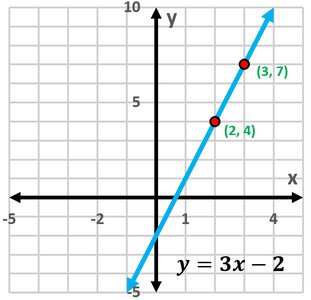
Q1. A certain function is defined as a line passing through the points (2, 4) and (3, 7). Solve for its equation and graph it.
Background
Topic: Linear Functions
This question tests your understanding of how to find the equation of a line given two points, and how to represent it graphically.
Key Terms and Formulas
Slope (m): The rate of change between two points on a line.
Point-slope form:
Slope formula:
Slope-intercept form:
Step-by-Step Guidance
Label your points: and .
Calculate the slope using the formula: .
Substitute one point and the slope into the point-slope form: .
Rearrange the equation to the slope-intercept form .
Once you have the equation, match it to the correct graph from the options provided.
Try solving on your own before revealing the answer!
Final Answer:
The equation of the line is . The correct graph is option (a), which shows the line passing through the points (2, 4) and (3, 7).
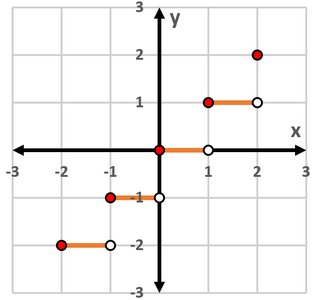
Q2. Sketch the graph of the following greatest-integer function: , for .
Background
Topic: Step Functions (Greatest Integer Function)
This question tests your understanding of the greatest-integer (floor) function, which maps a real number to the largest integer less than or equal to it.
Key Terms and Formulas
Greatest-integer function:
Definition: is the greatest integer less than or equal to .
Step-by-Step Guidance
For each integer value of from to $2f(x)$ by applying the floor function.
For non-integer values, remember that is the integer just below (e.g., ).
Plot the points and draw horizontal segments for each integer interval, using closed circles at the left endpoint and open circles at the right endpoint of each segment.
Continue this process for all intervals in the given domain.
Try solving on your own before revealing the answer!
Final Answer:
The correct graph is option (a), which shows the stepwise nature of the greatest-integer function for .
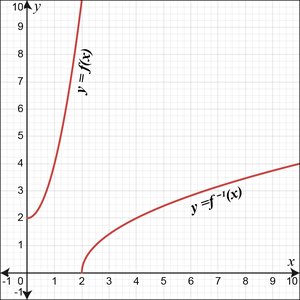
Q3. Given the function for , identify its inverse function from the following options. Then, graph the function and its inverse.
Background
Topic: Inverse Functions
This question tests your ability to find the inverse of a function and understand the graphical relationship between a function and its inverse.
Key Terms and Formulas
Inverse function: If is a function, its inverse satisfies and .
Finding the inverse: Swap and in the equation , then solve for $y$.
Step-by-Step Guidance
Start with and restrict to ensure the function is one-to-one.
Swap and to get .
Solve for in terms of to find the inverse function.
Compare your result to the given options to identify the correct inverse.
Graph both and on the same axes, noting that they should be reflections across the line .
Try solving on your own before revealing the answer!
Final Answer:
The inverse function is for . The correct graph is option (a).
Q4. Find the inverse function of .
Background
Topic: Inverse of Logarithmic Functions
This question tests your ability to find the inverse of a logarithmic function, which often involves exponentiation and algebraic manipulation.
Key Terms and Formulas
Natural logarithm: is the logarithm base .
Inverse of :
Finding the inverse: Swap and in , then solve for $y$.
Step-by-Step Guidance
Start with .
Swap and to get .
Isolate the logarithmic term: .
Divide both sides by 2: .
Exponentiate both sides to solve for in terms of .
Try solving on your own before revealing the answer!
Final Answer:
The inverse function is .
