 Back
Study Guide: Differentiability and Continuity in Calculus
Study Guide - Smart Notes
 Tailored notes based on your materials, expanded with key definitions, examples, and context.
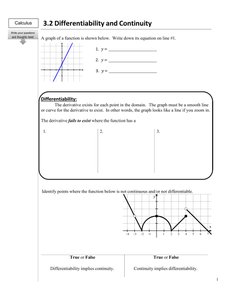
Q1. Write the equation of the graph shown on line #1.
Background
Topic: Linear Functions and Graph Interpretation
This question tests your ability to recognize and write the equation of a straight line from its graph, a foundational skill for calculus.
Key Terms and Formulas
Slope-intercept form:
Where is the slope and is the y-intercept.
Step-by-Step Guidance
Observe the graph and identify two points on the line.
Calculate the slope using .
Determine the y-intercept by seeing where the line crosses the y-axis.
Write the equation in the form using your values for and .
Try solving on your own before revealing the answer!
Final Answer:
The equation is .
This is a straight line passing through the origin with a slope of 1.
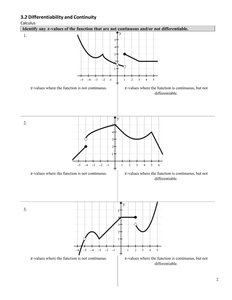
Q2. Define differentiability and identify points where the function is not continuous and/or not differentiable.
Background
Topic: Differentiability and Continuity
This question tests your understanding of what it means for a function to be differentiable and how to identify points of discontinuity or non-differentiability on a graph.
Key Terms and Formulas
Differentiability: A function is differentiable at a point if it has a defined derivative there.
Continuity: A function is continuous at a point if the limit as you approach the point equals the function's value at that point.
Key formula: for continuity.
Step-by-Step Guidance
Look for jumps, holes, or vertical asymptotes in the graph to identify discontinuity.
Check for sharp corners or cusps, which indicate non-differentiability.
Mark the x-values where these features occur.
Compare the points of discontinuity and non-differentiability to see if any overlap.
Try solving on your own before revealing the answer!
Final Answer:
Points where the function is not continuous: x = -2, x = 1.
Points where the function is continuous but not differentiable: x = 0, x = 3.
Discontinuity occurs at jumps or holes; non-differentiability occurs at sharp corners.
Q3. True or False: Differentiability implies continuity. Continuity implies differentiability.
Background
Topic: Relationship Between Differentiability and Continuity
This question tests your understanding of the logical relationship between differentiability and continuity.
Key Terms and Formulas
If a function is differentiable at a point, it must be continuous at that point.
Continuity does not necessarily imply differentiability (e.g., at a sharp corner).
Step-by-Step Guidance
Recall the definitions of differentiability and continuity.
Think about whether a function can be differentiable without being continuous.
Consider examples of continuous functions that are not differentiable (e.g., absolute value at x = 0).
Try solving on your own before revealing the answer!
Final Answer:
Differentiability implies continuity: True.
Continuity implies differentiability: False.
A function must be continuous to be differentiable, but not all continuous functions are differentiable.
Q4. Identify x-values of the function that are not continuous and/or not differentiable (for each graph).
Background
Topic: Analyzing Graphs for Continuity and Differentiability
This question tests your ability to interpret graphs and identify where functions fail to be continuous or differentiable.
Key Terms and Formulas
Discontinuity: Jump, hole, or vertical asymptote.
Non-differentiability: Sharp corner, cusp, or vertical tangent.
Step-by-Step Guidance
For each graph, scan for jumps, holes, or vertical lines (discontinuity).
Look for sharp corners or cusps (non-differentiability).
Record the x-values where these features occur.
Separate the x-values into two categories: not continuous, and continuous but not differentiable.
Try solving on your own before revealing the answer!
Final Answer:
For each graph:
Graph 1: Not continuous at x = -2, x = 1; continuous but not differentiable at x = 0, x = 3.
Graph 2: Not continuous at x = 2; continuous but not differentiable at x = 0.
Graph 3: Not continuous at x = 1; continuous but not differentiable at x = -1, x = 2.
Discontinuity is shown by jumps or holes; non-differentiability by sharp corners.
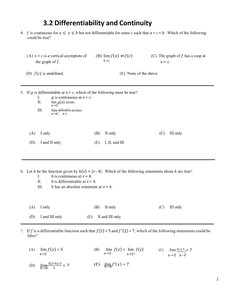
Q5. If a function is continuous for x = c but not differentiable for some c such that x = c, which of the following could be true?
Background
Topic: Differentiability vs. Continuity at a Point
This question tests your understanding of the conditions under which a function can be continuous but not differentiable at a specific point.
Key Terms and Formulas
Vertical tangent, cusp, or corner can cause non-differentiability.
Continuity means no jump or hole at the point.
Step-by-Step Guidance
Recall that a function can be continuous but not differentiable at a sharp corner or cusp.
Consider the options: vertical asymptote, limit existence, graph of a line, etc.
Eliminate options that require discontinuity.
Try solving on your own before revealing the answer!
Final Answer:
(B) exists.
The function is continuous, so the limit exists, but it may not be differentiable due to a corner or cusp.
Q6. If is differentiable at , which of the following must be true?
Background
Topic: Differentiability at a Point
This question tests your understanding of the necessary conditions for differentiability at a point.
Key Terms and Formulas
Differentiability implies continuity.
Derivative exists at .
Step-by-Step Guidance
Recall that differentiability at a point means the function is continuous there.
Check which statements are always true for differentiability.
Eliminate statements that do not follow from differentiability.
Try solving on your own before revealing the answer!
Final Answer:
(A) is continuous at .
(B) exists.
Both must be true for differentiability at a point.
Q7. Let be the function given by . Which of the following statements about is not true?
Background
Topic: Absolute Value Functions and Differentiability
This question tests your understanding of the differentiability of absolute value functions, especially at the point where the expression inside the absolute value equals zero.
Key Terms and Formulas
Absolute value function:
Not differentiable at (sharp corner).
Step-by-Step Guidance
Recall the graph of and note the sharp corner at .
Check which statements refer to differentiability at .
Eliminate statements that are true for all other points.
Try solving on your own before revealing the answer!
Final Answer:
(C) is differentiable at is not true.
The function has a sharp corner at , so it is not differentiable there.
Q8. If is a differentiable function such that and , which of the following statements could be true?
Background
Topic: Differentiable Functions and Derivatives
This question tests your understanding of the relationship between a function and its derivative at a specific point.
Key Terms and Formulas
is the slope of the tangent line at .
is the value of the function at .
Step-by-Step Guidance
Recall the meaning of and .
Check which statements are consistent with and .
Eliminate statements that contradict these values.
Try solving on your own before revealing the answer!
Final Answer:
(B)
This is the definition of the derivative at .
