 Back
Techniques of Differentiation: Chain Rule, Power Rule, and Tangent Lines
Study Guide - Smart Notes
 Tailored notes based on your materials, expanded with key definitions, examples, and context.
Techniques of Differentiation
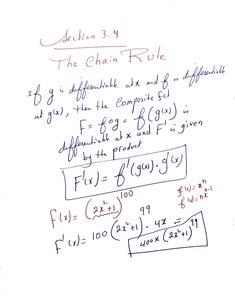
The Chain Rule
The Chain Rule is a fundamental technique in calculus used to differentiate composite functions. If g is differentiable and f is differentiable at g(x), then the composite function F = f \circ g is differentiable, and its derivative is given by:
Formula: $F'(x) = f'(g(x)) \cdot g'(x)$
Application: Used when differentiating functions nested within other functions.
Example: If $F(x) = (2x^2 + 1)^{100}$, then $F'(x) = 100 (2x^2 + 1)^{99} \cdot 4x$
Power Rule Combined with the Chain Rule
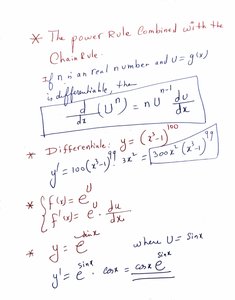
The Power Rule can be extended using the Chain Rule for functions of the form $y = [U(x)]^n$, where $U(x)$ is a differentiable function and $n$ is a real number.
Formula: $\frac{d}{dx} [U^n] = n U^{n-1} \frac{dU}{dx}$
Example: $y = (2x^2 + 1)^{100}$, $y' = 100 (2x^2 + 1)^{99} \cdot 4x$
Exponential Functions: If $f(x) = e^{U}$, then $f'(x) = e^{U} \cdot \frac{dU}{dx}$
Example: $y = e^{\sin x}$, $y' = e^{\sin x} \cdot \cos x$
Differentiation of Exponential and Logarithmic Functions
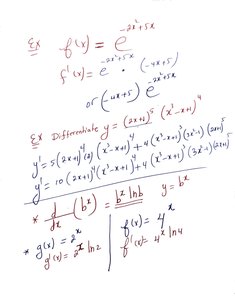
Exponential and logarithmic functions have specific differentiation rules, often used in combination with the Chain Rule.
Exponential Function: $f(x) = e^{-2x + 5x}$, $f'(x) = (-2x + 5) e^{-2x + 5x}$
General Exponential: $\frac{d}{dx} (b^x) = b^x \ln b$
Example: $g(x) = 4^x$, $g'(x) = 4^x \ln 4$
Applications: Tangent Lines to Curves
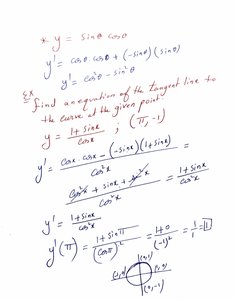
Finding the equation of the tangent line to a curve at a given point is a common application of differentiation. The tangent line has the slope equal to the derivative of the function at the given point.
Example 1: For $y = \sin x \cos x$, find the tangent at $x = \pi$, $y' = \cos x \cos x + (-\sin x)(\sin x)$, evaluated at $x = \pi$.
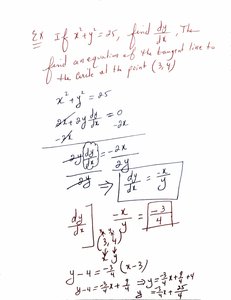
Example 2: For the circle $x^2 + y^2 = 25$, the slope at $(3,4)$ is $-\frac{3}{4}$, and the tangent line equation is $y - 4 = -\frac{3}{4}(x - 3)$.
Implicit Differentiation
Implicit differentiation is used when functions are not given explicitly in terms of one variable. It is especially useful for curves defined by equations involving both $x$ and $y$.
Example: For $x^2 + y^2 = 25$, differentiate both sides with respect to $x$ to get $2x + 2y \frac{dy}{dx} = 0$, so $\frac{dy}{dx} = -\frac{x}{y}$.
Summary Table: Differentiation Rules
Function | Derivative |
|---|---|
$f(x) = e^{U}$ | $f'(x) = e^{U} \cdot \frac{dU}{dx}$ |
$f(x) = b^x$ | $f'(x) = b^x \ln b$ |
$f(x) = [U(x)]^n$ | $f'(x) = n [U(x)]^{n-1} \cdot \frac{dU}{dx}$ |
$f(x) = \sin x \cos x$ | $f'(x) = \cos x \cos x + (-\sin x)(\sin x)$ |
$x^2 + y^2 = 25$ | $\frac{dy}{dx} = -\frac{x}{y}$ |
