 Back
BackTechniques of Differentiation: Product and Quotient Rules
Study Guide - Smart Notes
 Tailored notes based on your materials, expanded with key definitions, examples, and context.
Objectives and Overview
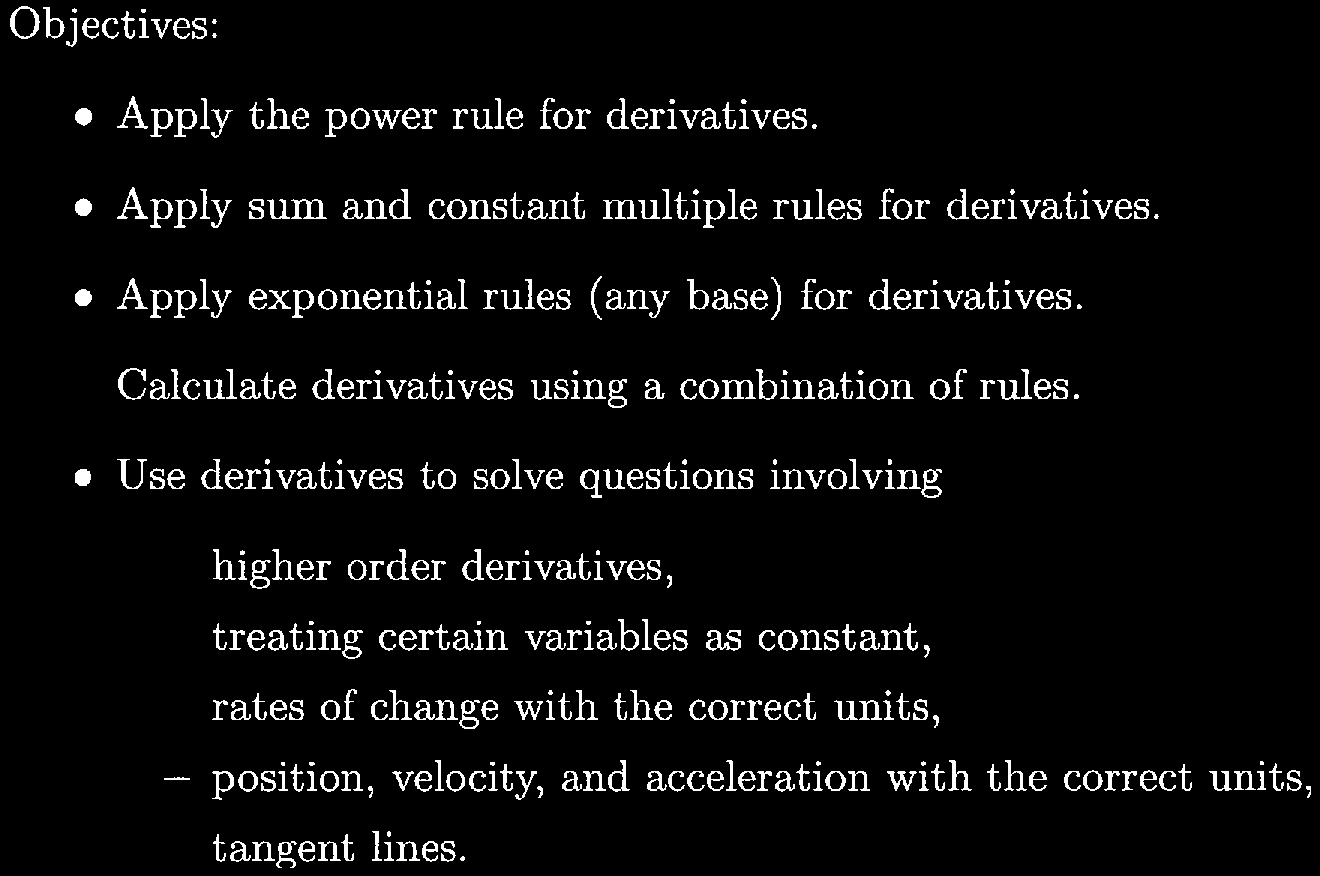
This section covers essential techniques for differentiating functions, focusing on the product and quotient rules. Students will learn to apply these rules, combine them with other differentiation techniques, and solve applied problems involving rates of change and tangent lines.
Apply the power rule for derivatives.
Apply sum and constant multiple rules for derivatives.
Apply exponential rules (any base) for derivatives.
Calculate derivatives using a combination of rules.
Use derivatives to solve questions involving:
Higher order derivatives
Treating certain variables as constant
Rates of change with correct units
Position, velocity, and acceleration with correct units
Tangent lines
Product Rule for Differentiation
Definition and Formula
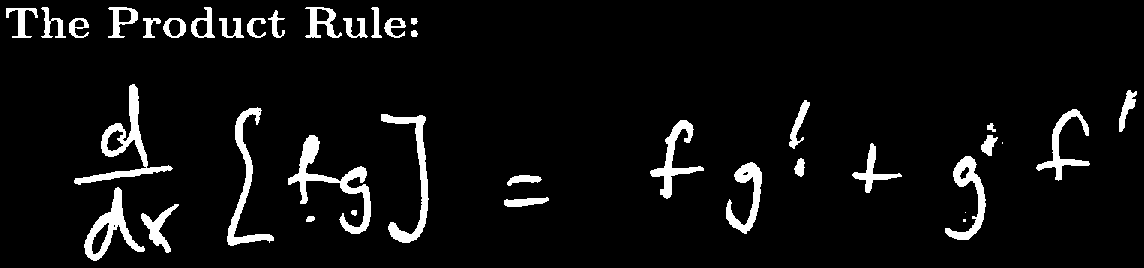
The product rule is used to differentiate the product of two functions. If f(x) and g(x) are differentiable, then:
Applying the Product Rule
Identify the two functions being multiplied.
Differentiate each function separately.
Apply the product rule formula.
Example: Find the derivative of .
Let and .

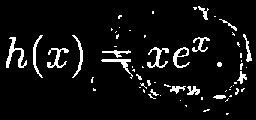
![What is d/dx[x e^x]?](https://static.studychannel.pearsonprd.tech/study_guide_files/calculus/sub_images/8e1597e3_image_7.png)
Practice Problems
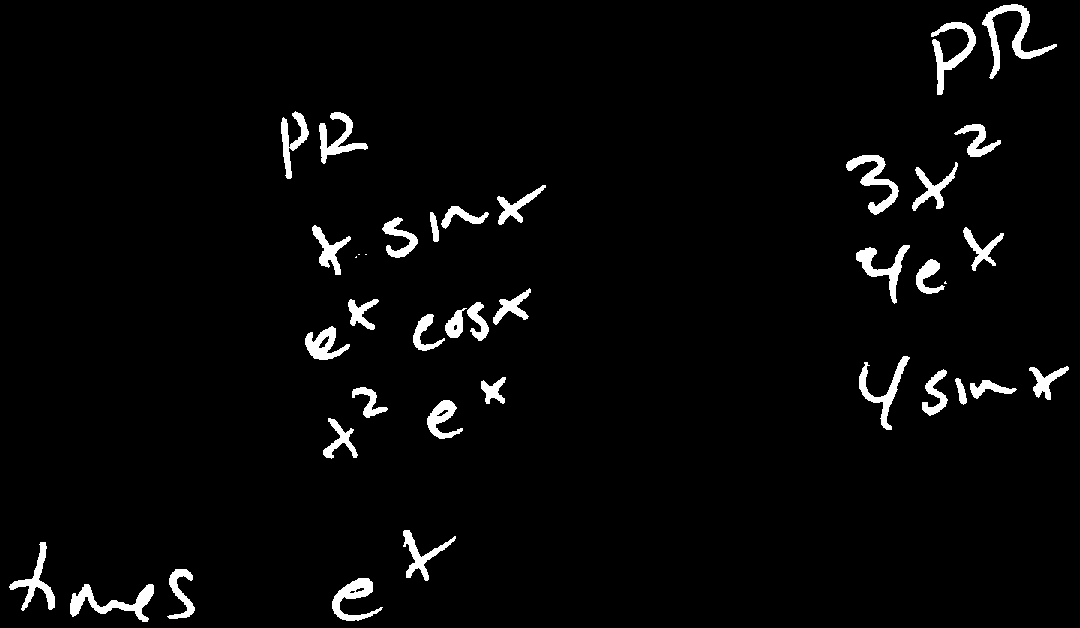
Differentiate
Differentiate
Differentiate
Quotient Rule for Differentiation
Definition and Formula
The quotient rule is used to differentiate the quotient of two functions. If and are differentiable, then:
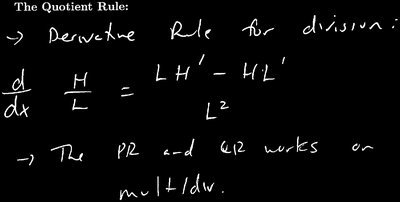
Note: The product and quotient rules work for multiplication and division of differentiable functions.
Applying the Quotient Rule
Identify the numerator and denominator .
Differentiate both and .
Apply the quotient rule formula.
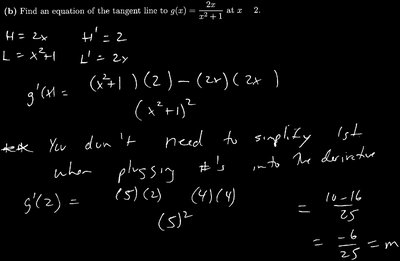
Example: Differentiate .
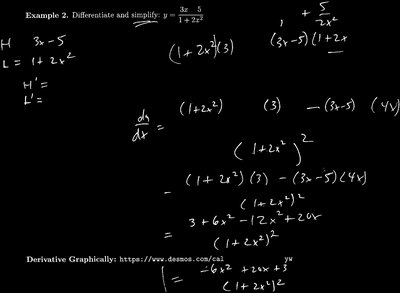
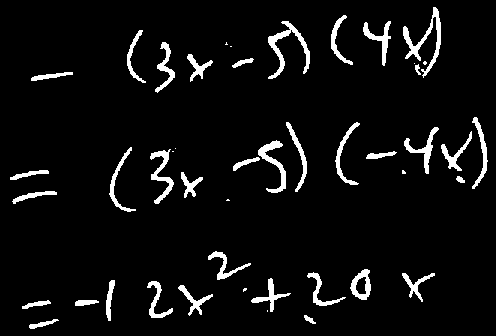
Practice Problem
Differentiate .
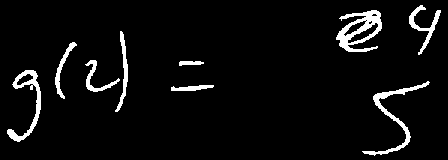
Applications of the Product and Quotient Rules
Tangent Lines and Rates of Change
Derivatives can be used to find the equation of the tangent line to a curve at a given point and to compute rates of change in applied contexts.
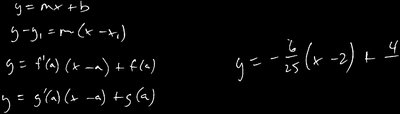
The slope of the tangent line at is .
The equation of the tangent line at is .
Example: Find the tangent line to at .

Applied Example: Revenue Rate of Change
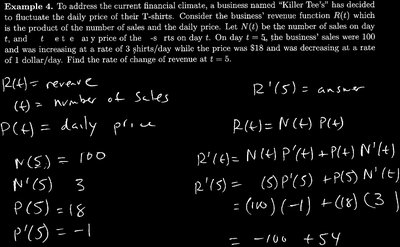
Suppose a business's revenue is the product of the number of sales and the daily price . The rate of change of revenue is found using the product rule:
Example: If , , , , then:
Additional Practice and Examples
Differentiate using the quotient rule.
Summary Table: Product and Quotient Rules
Rule | Formula | When to Use |
|---|---|---|
Product Rule | When differentiating a product of two functions | |
Quotient Rule | When differentiating a quotient of two functions |
Additional info: The notes also reference using derivatives for higher order derivatives, treating variables as constants, and interpreting rates of change in applied contexts such as velocity and acceleration. These are standard applications in calculus and are foundational for further study in mathematics, physics, and engineering.
