Back
Techniques of Differentiation: The Chain Rule and Applications
Study Guide - Smart Notes
 Tailored notes based on your materials, expanded with key definitions, examples, and context.
Techniques of Differentiation
The Chain Rule
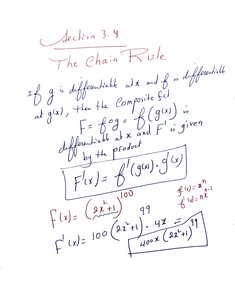
The Chain Rule is a fundamental technique in calculus for finding the derivative of composite functions. If a function is composed of two differentiable functions, the derivative of the composite function is the product of the derivative of the outer function evaluated at the inner function and the derivative of the inner function.
Definition: If g is differentiable at x and f is differentiable at g(x), then the composite function F(x) = f(g(x)) is differentiable at x and its derivative is given by:
Example: For , the derivative is:
The Power Rule Combined with the Chain Rule
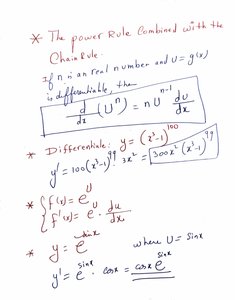
When differentiating a power of a function, the Power Rule can be combined with the Chain Rule. If is differentiable and is any real number, then:
Example: Differentiate :
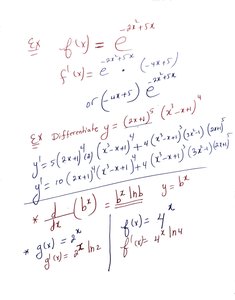
Exponential Functions: For ,
Example: ,
Applications: Tangent Lines and Implicit Differentiation
Finding the equation of the tangent line to a curve at a given point is a common application of differentiation. This often involves evaluating the derivative at a specific point and using the point-slope form of a line.
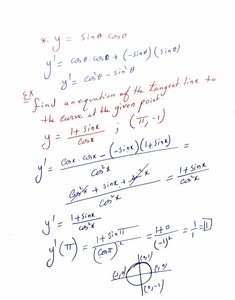
Example: Find the equation of the tangent line to at .
First, compute the derivative using the product rule:
Evaluate at :
Use the point and the slope $1$ to write the tangent line:
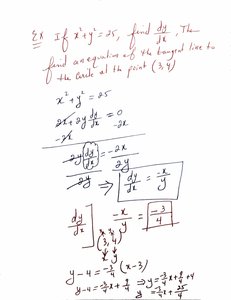
Implicit Differentiation and Tangent Lines to Circles
Implicit differentiation is used when a function is not given explicitly as , but rather as a relation involving both and . To find , differentiate both sides with respect to $x$, treating $y$ as a function of $x$.
Example: For the circle , differentiate both sides:
At the point , the slope is .
The equation of the tangent line at is:
Further Examples: Exponential and Logarithmic Differentiation
Exponential and logarithmic functions often require the use of the Chain Rule and properties of logarithms for differentiation.
Example:
General Rule: For ,
Example: If , then