 Back
BackTechniques of Integration: Numerical Methods
Study Guide - Smart Notes
 Tailored notes based on your materials, expanded with key definitions, examples, and context.
Techniques of Integration
Numerical Integration
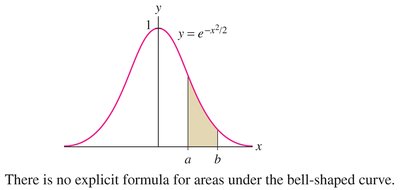
Numerical integration is a set of techniques used to approximate the value of definite integrals when an explicit antiderivative cannot be found or when only discrete data points are available. This is especially important for functions whose integrals are impossible to express in terms of elementary functions, such as or .
Impossible Integrals: Some functions, like , do not have explicit formulas for their definite integrals. In such cases, numerical methods are used to estimate the area under the curve.
Applications: Numerical integration is essential in scientific and engineering contexts where only measured data is available, or the function is too complex for analytical integration.
Key Methods: The most common numerical integration techniques are the Trapezoidal Rule, Simpson's Rule, and the Midpoint Rule.
Trapezoidal Rule
Definition and Formula
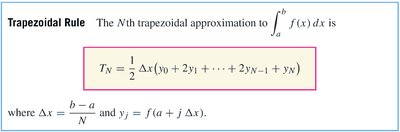
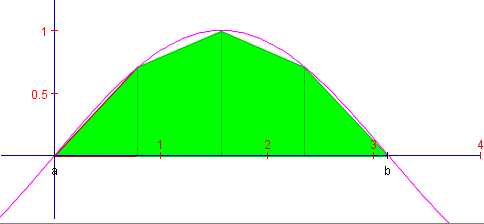
The Trapezoidal Rule approximates the area under a curve by dividing the interval into subintervals and using trapezoids instead of rectangles. This method provides greater accuracy than simple rectangular approximations.
Formula: The Nth trapezoidal approximation to is given by:
Where and .
As , the approximation converges to the exact value of the integral.
Graphical Representation
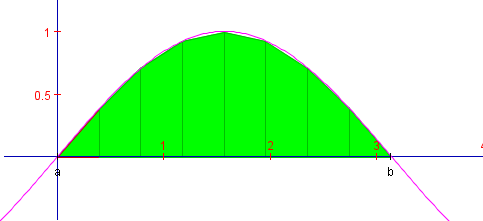
The Trapezoidal Rule visually connects points on the curve with straight lines, forming trapezoids whose areas are summed to approximate the integral.
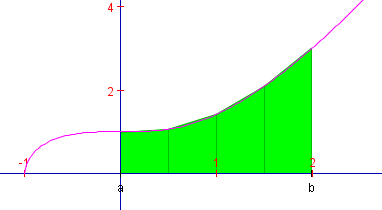
Example: Approximating
Divide the interval into 4 or 8 subintervals.
Calculate and evaluate at each point.
Apply the Trapezoidal Rule formula to obtain the approximation.
Increasing the number of subintervals improves accuracy.
Simpson's Rule
Definition and Formula
Simpson's Rule is a more accurate numerical integration method that approximates the area under a curve using parabolic segments. It requires the number of subintervals, , to be even.
Formula: For even, Simpson's Rule is:
Where and .
Simpson's Rule is especially effective for smooth functions and yields highly accurate results with relatively few subintervals.

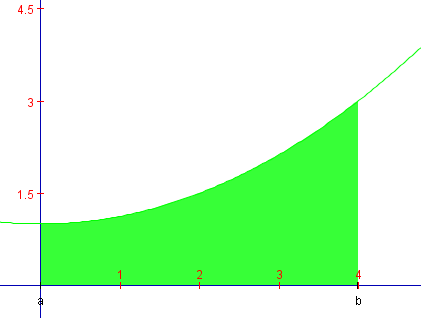
Example: Approximating
Divide the interval into 4 or 8 subintervals (must be even).
Calculate and evaluate at each required point.
Apply Simpson's Rule formula to obtain the approximation.
Simpson's Rule typically provides a better approximation than the Trapezoidal Rule for the same number of subintervals.

Comparison of Numerical Methods
Summary Table
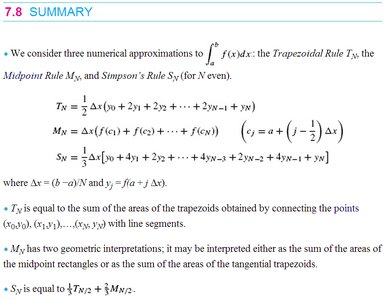
The following table summarizes the formulas for the three main numerical integration methods:
Method | Formula | Notes |
|---|---|---|
Trapezoidal Rule () | Connects points with straight lines; sum of trapezoid areas. | |
Midpoint Rule () | Uses midpoints of subintervals; sum of rectangle areas. | |
Simpson's Rule () | Uses parabolic segments; requires even . |
Applications and Accuracy
Choosing a Method
Trapezoidal Rule: Good for functions that are approximately linear over small intervals.
Simpson's Rule: Best for smooth, continuous functions; provides higher accuracy with fewer subintervals.
Midpoint Rule: Useful for quick approximations and when only midpoints are available.
Increasing the number of subintervals ( or ) improves the accuracy of all methods. Simpson's Rule generally converges faster to the exact value than the Trapezoidal or Midpoint Rules.
Example: Exact vs. Approximate Values
For , the exact value is 2.
Using Simpson's Rule with and yields approximations of 2.005 and 2.003, respectively.
Using the Trapezoidal Rule with and yields approximations of 1.896 and 1.973, respectively.
Simpson's Rule is more accurate for the same number of subintervals.
Conclusion
Numerical integration methods are essential tools in calculus for estimating definite integrals when analytical solutions are unavailable. The Trapezoidal Rule and Simpson's Rule are widely used due to their simplicity and effectiveness. Understanding their formulas, graphical interpretations, and accuracy is crucial for solving real-world problems in science and engineering.
