 Back
BackThe Chain Rule: Derivatives of Composite Functions
Study Guide - Smart Notes
 Tailored notes based on your materials, expanded with key definitions, examples, and context.
Section 3.7: The Chain Rule
Introduction to the Chain Rule
The Chain Rule is a fundamental technique in calculus for finding the derivative of composite functions. It allows us to differentiate functions that are composed of two or more functions, such as f(g(x)). The rule is essential for understanding how changes in one variable propagate through nested functions.
Composite Function: A function formed by applying one function to the result of another, e.g., f(g(x)).
Key Idea: The rate of change of the outer function depends on the rate of change of the inner function.
Applications: Used extensively in physics, engineering, and economics to model systems with multiple dependent variables.
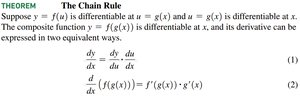
Theorem: The Chain Rule
If y = f(u) is differentiable at u = g(x) and u = g(x) is differentiable at x, then the composite function y = f(g(x)) is differentiable at x, and its derivative can be expressed in two equivalent ways:
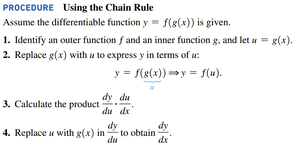
Procedure: Using the Chain Rule
To apply the Chain Rule to a differentiable function y = f(g(x)), follow these steps:
Identify the outer function f and the inner function g, and let u = g(x).
Express g(x) with u to write y in terms of u: y = f(u).
Calculate the product .
Replace u with g(x) in to obtain .

Examples of the Chain Rule
Example: Composition of Three Functions
Calculate the derivative of sin(ecos x). This example demonstrates the use of the Chain Rule for three nested functions.
Inner function: cos x
Middle function: ecos x
Outer function: sin(ecos x)
Apply the Chain Rule twice:
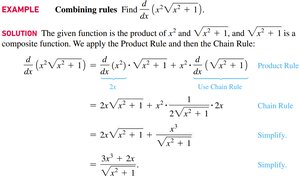
Example: Combining Rules
Find . This example combines the Product Rule and the Chain Rule.
Product Rule:
Chain Rule for :
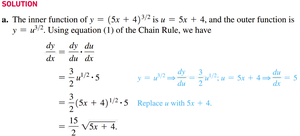
Example: Identifying Inner and Outer Functions
For each composite function, find the inner function u = g(x) and the outer function y = f(u). Use the Chain Rule to find .
a.
b.
c. (interpreted as )
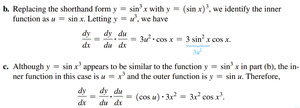
Solution: Applying the Chain Rule
a. Inner function: , Outer function:
b. Inner function: , Outer function:
c. Inner function: , Outer function:
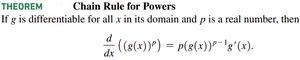
Chain Rule for Powers
Theorem: Chain Rule for Powers
If g is differentiable for all x in its domain and p is a real number, then:
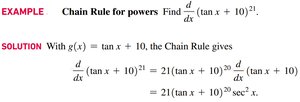
Example: Chain Rule for Powers
Find .
Let
Apply the Chain Rule:
Summary Table: Chain Rule Applications
Function | Inner Function | Outer Function | Derivative |
|---|---|---|---|
