 Back
BackThe Cross Product and Its Applications in 3D Calculus
Study Guide - Smart Notes
 Tailored notes based on your materials, expanded with key definitions, examples, and context.
The Cross Product in 3D Space
Definition and Geometric Interpretation
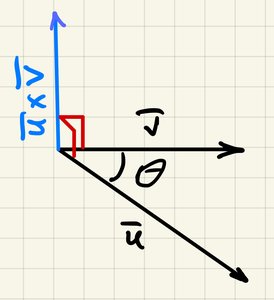
The cross product is an operation defined only in three-dimensional space. Given two vectors \( \vec{u} \) and \( \vec{v} \), their cross product \( \vec{u} \times \vec{v} \) is a vector that:
Is perpendicular to both \( \vec{u} \) and \( \vec{v} \).
Has magnitude \( |\vec{u} \times \vec{v}| = |\vec{u}| \cdot |\vec{v}| \cdot \sin \theta \), where \( \theta \) is the angle between \( \vec{u} \) and \( \vec{v} \).
If \( \vec{u} \) and \( \vec{v} \) are parallel (\( \theta = 0 \) or \( \pi \)), then \( \vec{u} \times \vec{v} = \vec{0} \).
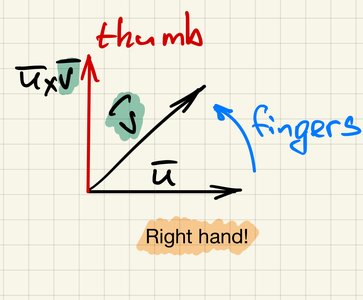
Orientation: The direction of \( \vec{u} \times \vec{v} \) is determined by the right-hand rule: curl the fingers of your right hand from \( \vec{u} \) toward \( \vec{v} \) through the smaller angle; your thumb points in the direction of the cross product.
Properties of the Cross Product
Anticommutativity: \( \vec{u} \times \vec{v} = -\vec{v} \times \vec{u} \)
Distributivity: \( \vec{u} \times (\vec{v} + \vec{w}) = \vec{u} \times \vec{v} + \vec{u} \times \vec{w} \)
Scalar multiplication: \( (k \cdot \vec{u}) \times \vec{v} = k \cdot (\vec{u} \times \vec{v}) \)
Zero vector: \( \vec{u} \times \vec{u} = \vec{0} \)
Orthogonality: \( \vec{u} \cdot (\vec{u} \times \vec{v}) = 0 \) and \( \vec{v} \cdot (\vec{u} \times \vec{v}) = 0 \)
Cross Product of Standard Basis Vectors
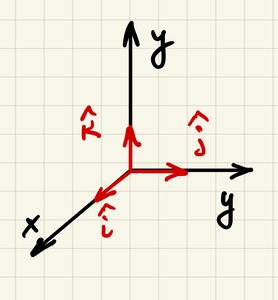
The cross product of the standard basis vectors \( \hat{i}, \hat{j}, \hat{k} \) in 3D is fundamental:
\( \hat{i} \times \hat{j} = \hat{k} \)
\( \hat{j} \times \hat{k} = \hat{i} \)
\( \hat{k} \times \hat{i} = \hat{j} \)
Switching the order reverses the sign, e.g., \( \hat{j} \times \hat{i} = -\hat{k} \)
\( \hat{i} \times \hat{i} = \hat{j} \times \hat{j} = \hat{k} \times \hat{k} = \vec{0} \)
Computing the Cross Product
Given vectors \( \vec{u} = u_1 \hat{i} + u_2 \hat{j} + u_3 \hat{k} \) and \( \vec{v} = v_1 \hat{i} + v_2 \hat{j} + v_3 \hat{k} \), the cross product is:
\( \vec{u} \times \vec{v} = (u_2 v_3 - u_3 v_2) \hat{i} + (u_3 v_1 - u_1 v_3) \hat{j} + (u_1 v_2 - u_2 v_1) \hat{k} \)
This can be computed using the determinant formula:
Example: Compute \( (3\hat{i} - \hat{k}) \times (\hat{i} + \hat{j}) \):
Expand and use properties of the cross product to find the result: \( \hat{i} - \hat{j} + 3\hat{k} \)
Applications of the Cross Product
Area of a Parallelogram
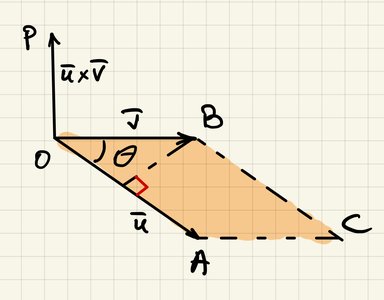
The area of a parallelogram formed by vectors \( \vec{u} \) and \( \vec{v} \) is given by the magnitude of their cross product:
\( \text{Area} = |\vec{u} \times \vec{v}| \)
The area of the triangle formed by the same vectors is half this value: \( \text{Area} = \frac{1}{2} |\vec{u} \times \vec{v}| \)
The Scalar Triple Product
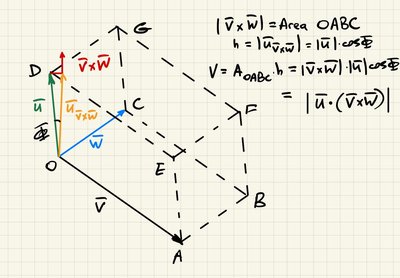
The scalar triple product of vectors \( \vec{u}, \vec{v}, \vec{w} \) is defined as:
The scalar triple product is zero if any two vectors are collinear or if one is a linear combination of the others (i.e., the vectors are coplanar).
It is used to test for coplanarity and to compute volumes in 3D geometry.
Volume of a Parallelepiped
The volume of the parallelepiped formed by vectors \( \vec{u}, \vec{v}, \vec{w} \) is given by the absolute value of the scalar triple product:
Further Applications in Physics and Engineering
Angular momentum: \( \vec{L} = \vec{r} \times m \vec{v} \)
Electromagnetic force: \( \vec{F} = q (\vec{v} \times \vec{B}) \)
Torque: \( \vec{\tau} = \vec{r} \times \vec{F} \)
Additional info: The cross product is essential in vector calculus, physics, and engineering for describing rotational effects, areas, and volumes in three dimensions.
