 Back
BackThe Fundamental Theorem of Calculus: Concepts, Examples, and Applications
Study Guide - Smart Notes
 Tailored notes based on your materials, expanded with key definitions, examples, and context.
5.4 The Fundamental Theorem of Calculus
Introduction to the Fundamental Theorem of Calculus
The Fundamental Theorem of Calculus establishes a profound connection between the two main branches of calculus: differential calculus and integral calculus. It precisely describes the inverse relationship between differentiation and integration, showing that these operations essentially undo each other.
Part 1: Functions Defined by Integrals
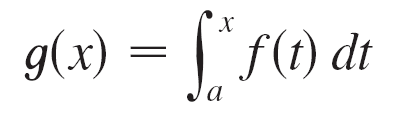
Consider a function defined by an integral:
Definition: If f is a continuous function on [a, b], then the function g defined by depends only on x, which is the variable upper limit of integration.
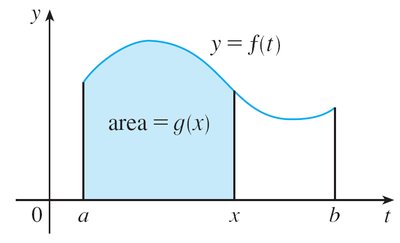
Interpretation: If f is positive, g(x) represents the area under the graph of f from a to x. This is often called the "area so far" function.
Example: Calculating Values of g(x)
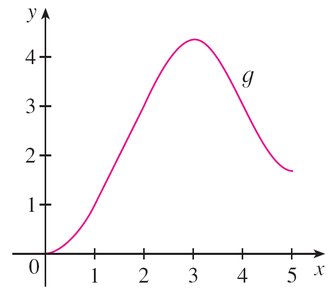
Let f be the function shown below. Calculate g(0), g(1), g(2), g(3), g(4), and g(5), then sketch a rough graph of g.
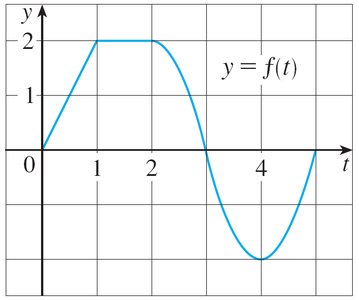
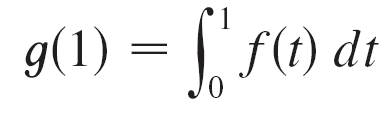
is the area of a triangle:
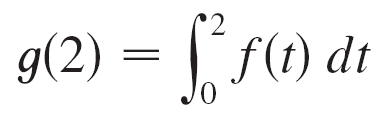
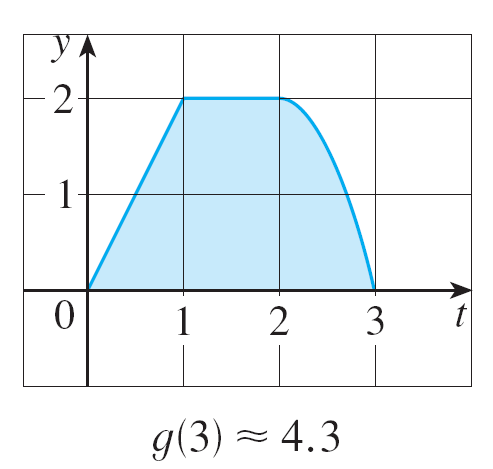
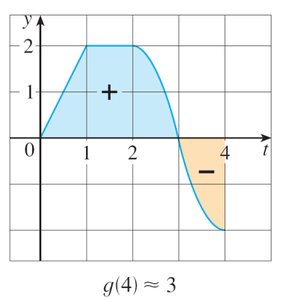
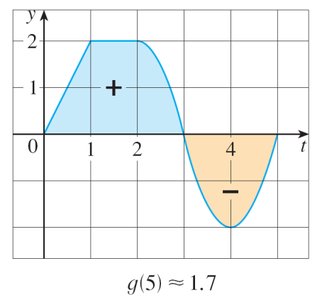
The graph of g increases while f(t) is positive, attains a maximum at x = 3, and decreases when f(t) becomes negative.
Antiderivatives and the Fundamental Theorem
If f(t) = t and a = 0, then:
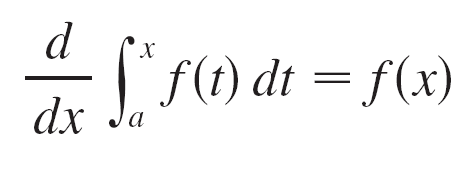
The derivative , which is the original function f.
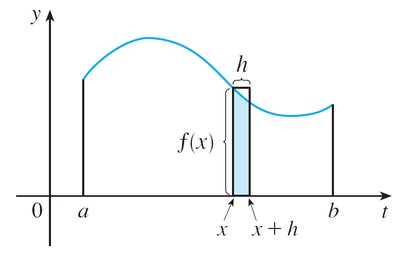

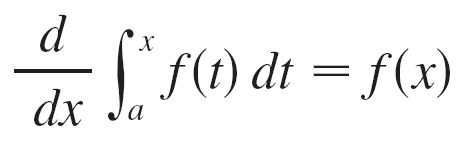
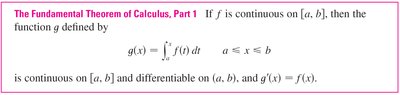
Formal Statement: Fundamental Theorem of Calculus, Part 1
If f is continuous on [a, b], then the function is continuous and differentiable, and .
Example: Differentiating an Integral Function
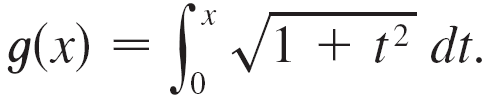
Find the derivative of .
By the Fundamental Theorem, .
Part 2: Evaluation of Definite Integrals
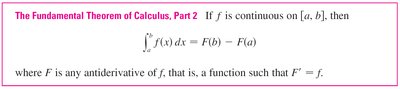
The second part of the Fundamental Theorem provides a practical method for evaluating definite integrals:
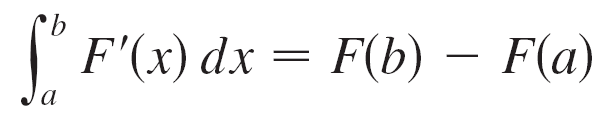
If f is continuous on [a, b], then , where F is any antiderivative of f (i.e., ).
Differentiation and Integration as Inverse Processes
The two parts of the Fundamental Theorem together show that differentiation and integration are inverse processes:
If , then .
If , then .
Summary Table: Fundamental Theorem of Calculus
Part | Statement |
|---|---|
Part 1 | If , then . |
Part 2 | , where . |
Key Formulas

Conclusion
The Fundamental Theorem of Calculus is central to understanding how integration and differentiation are related. It provides the foundation for evaluating definite integrals and for interpreting integrals as antiderivatives.
