 Back
BackTrigonometric Integrals and Trigonometric Substitution
Study Guide - Smart Notes
 Tailored notes based on your materials, expanded with key definitions, examples, and context.
Section 8.3: Trigonometric Integrals
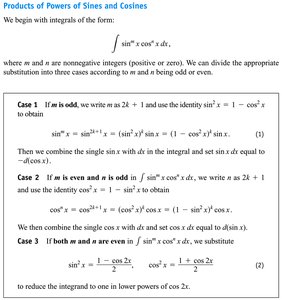
Integrals Involving Products of Sines and Cosines
Integrals of the form are common in calculus. The strategies for evaluating these depend on whether the exponents and are odd or even.
Case 1: If is odd, write and use the identity to reduce the power of sine.
Case 2: If is odd, write and use the identity to reduce the power of cosine.
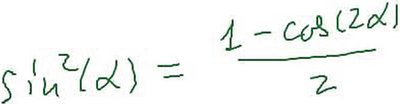
Case 3: If both and are even, use the half-angle identities:
to reduce the integrand to lower powers of or .
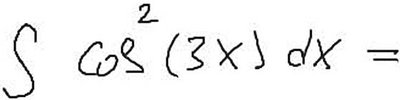
Worked Example:
To integrate , use the half-angle identity:
So,
Integrate term by term:



Reduction Formulas for Powers of Sine and Cosine
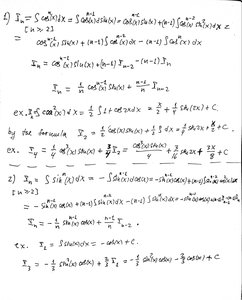
Reduction formulas allow us to express integrals of higher powers in terms of lower powers. For example, for :
These formulas are useful for systematically reducing the power of the trigonometric function until a basic integral is reached.
Integrals Involving Powers of Tangent and Secant
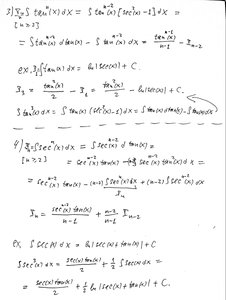
For integrals of the form :
If is even, save a factor and use .
If is odd, save a factor and use .
Reduction formulas also exist for these integrals, allowing for systematic reduction.
Section 8.4: Trigonometric Substitutions
Introduction to Trigonometric Substitution
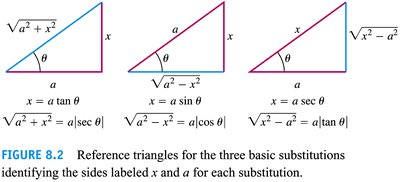
Trigonometric substitution is a technique for evaluating integrals involving square roots of quadratic expressions. The method replaces the variable with a trigonometric function, simplifying the radical.
For , use
For , use
For , use
Procedure for Trigonometric Substitution
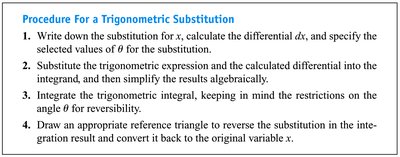
Write the substitution for , calculate , and specify the range for .
Substitute into the integral and simplify.
Integrate with respect to .
Draw a reference triangle to convert back to .
Reference Triangles and Inverse Trigonometric Functions
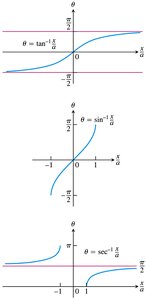
Reference triangles help convert the result back to the original variable. The limits and expressions for are related to the inverse trigonometric functions:
Examples of Trigonometric Substitution
Example: Substitute , , . The integral becomes .
Example: Substitute , , . The integral becomes .
Note: Always check if a simpler substitution is possible before using trigonometric substitution.
Summary Table: Trigonometric Substitutions
Radical | Substitution | Triangle Side |
|---|---|---|
Opposite | ||
Opposite | ||
Hypotenuse |
Additional info: The use of reference triangles and inverse trigonometric functions ensures that the substitution can be reversed and the answer expressed in terms of the original variable.
