 Back
Trigonometric Substitutions in Integration
Study Guide - Smart Notes
 Tailored notes based on your materials, expanded with key definitions, examples, and context.
Trigonometric Substitutions
Introduction to Trigonometric Substitutions
Trigonometric substitutions are a powerful technique used to evaluate integrals involving square roots of quadratic expressions. These integrals frequently arise in applications such as calculating areas, arc lengths, and force fields in physics and engineering. The method involves substituting a trigonometric function for the variable to simplify the integrand.
Key Point: Trigonometric substitutions transform complicated algebraic integrals into simpler trigonometric integrals.
Key Point: The choice of substitution depends on the form of the quadratic expression under the square root.
Common Forms and Substitutions
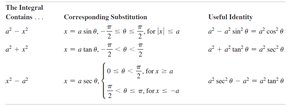
There are three main types of quadratic expressions encountered in integrals, each with a corresponding trigonometric substitution:
Type 1: → Use
Type 2: → Use
Type 3: → Use
Each substitution is based on the Pythagorean identities and simplifies the integrand by eliminating the square root.
Geometric Interpretation of Substitutions
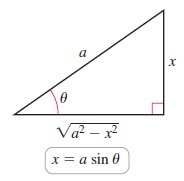
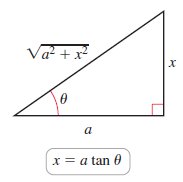
Trigonometric substitutions can be visualized using right triangles, where the sides correspond to the variable and constants in the integral. This geometric approach helps in understanding the origin of the substitution and the resulting identities.
Example: For , the triangle has hypotenuse , opposite side , and adjacent side .
Example: For , the triangle has adjacent side , opposite side , and hypotenuse .
Application: Area of a Circle Using Trigonometric Substitution
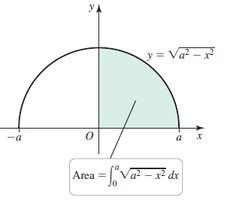
One classic application is finding the area of a semicircle using the integral . By substituting , the integral becomes easier to evaluate.
Key Point: The substitution simplifies the square root and allows the integral to be expressed in terms of trigonometric functions.
Example: Area under from to .
Useful Trigonometric Identities
After substitution, the following identities are often used to further simplify the integrand:
when
when
when
These identities are derived from the Pythagorean trigonometric relationships.
Domain and Inverse Trigonometric Functions
When making substitutions, it is important to consider the domain of the trigonometric function and its inverse. This ensures the substitution is valid and the resulting integral is correctly evaluated.
Example: For , ranges from to .
Example: For , ranges from $0\frac{\pi}{2}\frac{\pi}{2}\pi$.
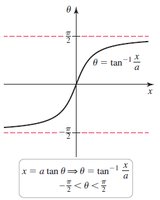
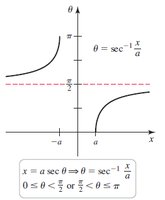
Example: Tangent and Secant Substitutions
Consider the integral . Using the substitution , the integral simplifies and can be evaluated using logarithmic functions.
Key Point: The substitution transforms the integrand into a form where standard integration techniques apply.
Example:

Advanced Example: Secant Substitution and Piecewise Results
For expressions like , the secant substitution leads to a piecewise result depending on the range of . This is important for definite integrals and interpreting the solution.
Key Point: The result may depend on the sign and range of the trigonometric function.
Example: with different cases for .

Summary Table: Trigonometric Substitutions
The following table summarizes the main substitutions and identities used in trigonometric substitution:
The Integral Contains... | Corresponding Substitution | Useful Identity |
|---|---|---|
, for | ||
, | ||
, for ; for |
Additional info: The notes above expand on the brief points in the original material, providing context, definitions, and examples for each substitution type. The images included are directly relevant to the explanation of each substitution and its geometric or algebraic interpretation.
