 Back
Unit 4 Calculus Test Review – Step-by-Step Guidance
Study Guide - Smart Notes
 Tailored notes based on your materials, expanded with key definitions, examples, and context.
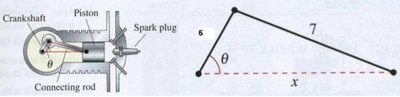
Q14. In the engine shown below, a 7-inch connecting rod is fastened to a crank of radius 3 inches. The crankshaft rotates counterclockwise at a constant rate of 200 revolutions per minute. Find the velocity of the piston when .
Background
Topic: Related Rates (Applications of Derivatives)
This question tests your ability to apply related rates to a mechanical system, specifically an engine with a crankshaft and piston. You need to relate the angular velocity of the crankshaft to the linear velocity of the piston using calculus.
Key Terms and Formulas
Angular velocity (): The rate at which the crankshaft rotates, given in revolutions per minute (rpm).
Linear velocity: The rate at which the piston moves horizontally.
Relationship between crank angle , crank radius , connecting rod length , and piston position .
Key formula:
To find velocity: , use the chain rule:
Step-by-Step Guidance
First, convert the crankshaft's angular velocity from revolutions per minute to radians per second. Recall that $1= 2\pi$ radians.
Write the equation for the horizontal position of the piston in terms of , , and .
Differentiate with respect to to find , using the chain rule and implicit differentiation as needed.
Multiply by (the angular velocity in radians per second) to get , the velocity of the piston.
Plug in the values inches, inches, and into your differentiated expression, but stop before calculating the final numeric value.
Try solving on your own before revealing the answer!
Final Answer: -4018 in/min
After converting angular velocity and differentiating the piston position equation, plugging in the values yields a velocity of approximately -4018 inches per minute. The negative sign indicates the piston is moving in the direction opposite to the crankshaft's rotation at .
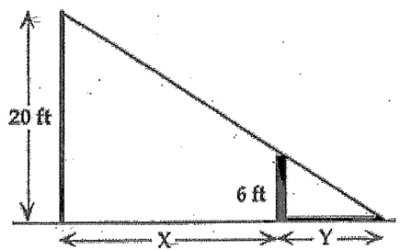
Q13. A man who is 6 feet tall is walking away from a lamp post at a rate of 5 feet per second. The lamp post is 20 feet tall. The person casts a shadow on the ground in front of them. a. How fast is the shadow growing when the person is 30 feet from the lamp post? b. How fast is the tip of the shadow moving when the person is 30 feet from the lamp post?
Background
Topic: Related Rates (Applications of Derivatives)
This question tests your ability to use similar triangles and related rates to determine how the length of a shadow and the tip of the shadow change as a person moves away from a lamp post.
Key Terms and Formulas
Similar triangles: Used to relate the heights and distances of the lamp post, person, and shadow.
Let be the distance from the person to the lamp post, be the length of the shadow.
Key relationship:
To find rates: Use (person's walking rate) and differentiate the relationship to find (shadow's growth rate).
Tip of the shadow moves at rate .
Step-by-Step Guidance
Set up the similar triangles equation relating the person's height, lamp post height, distance from lamp post, and shadow length.
Solve the equation for in terms of .
Differentiate both sides with respect to time to relate and .
Plug in the values ft and ft/s, but stop before calculating the final numeric value.
For part b, add and to find the rate at which the tip of the shadow moves.
Try solving on your own before revealing the answer!
Final Answer:
a. The shadow is growing at a rate of 2.143 ft/s when the person is 30 ft from the lamp post.
b. The tip of the shadow is moving at a rate of 7.143 ft/s when the person is 30 ft from the lamp post.
These rates are found by differentiating the similar triangles relationship and adding the rates for the tip of the shadow.
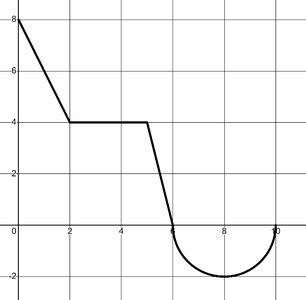
Q16. The velocity function, is given below. a. Find the distance travelled from the time interval . b. Find the displacement from the time interval .
Background
Topic: Definite Integrals and Motion
This question tests your understanding of how to use definite integrals to find distance travelled and displacement from a velocity function. The graph provided shows the velocity as a function of time.
Key Terms and Formulas
Distance travelled: The total length of the path, found by integrating the absolute value of velocity.
Displacement: The net change in position, found by integrating the velocity function over the interval.
Key formulas:
Step-by-Step Guidance
Analyze the velocity graph to identify intervals where is positive and negative.
For distance, break the interval into segments where does not change sign, and set up the integral of over each segment.
For displacement, set up the integral of from to .
Calculate the area under the curve for each segment, but stop before adding up the final values.
Try solving on your own before revealing the answer!
Final Answer:
a. The total distance travelled from is .
b. The displacement from is .
These are found by summing the areas under the velocity curve, taking care to use absolute values for distance and signed values for displacement.
