 Back
Vectors and Vector Operations: Foundations for Multivariable Calculus
Study Guide - Smart Notes
 Tailored notes based on your materials, expanded with key definitions, examples, and context.
Vectors: Definition and Geometric Interpretation
What is a Vector?
Vectors are fundamental objects in mathematics and physics, representing quantities that possess both magnitude and direction. In multivariable calculus, vectors are used to describe points, directions, and physical quantities such as force and velocity.
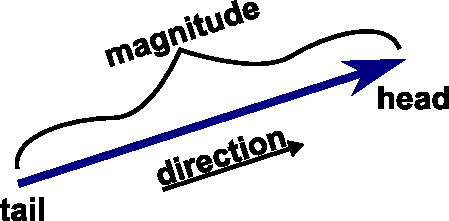
Flawed (but useful) Definition: A vector is a quantity with both magnitude and direction.
Working Definition: A vector is an arrow in space, characterized by its tail (starting point) and head (ending point).
Vector Coordinates: If a vector v is positioned with its tail at the origin and its head at the point (a, b, c), it is written as v = ⟨a, b, c⟩.
Vectors vs. Points
Vectors can be used to describe the displacement between two points in space. If Q:(a, b, c) and P:(d, e, f) are points, the vector PQ pointing from P to Q is:
Formula:
Example: The vector from P(1,2,3) to Q(4,6,8) is
Vector Fields
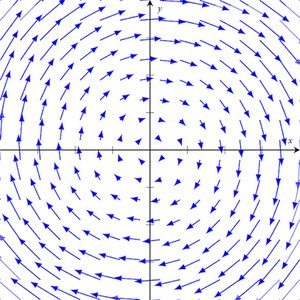
In advanced calculus, vector fields are functions that assign a vector to every point in space. These are crucial in physics and engineering for modeling phenomena such as fluid flow and electromagnetic fields.
Definition: A vector field is a function that maps each point in space to a vector.
Example: The velocity field of a rotating fluid.
Vector Operations
Basic Operations in ℝ2 and ℝ3
Vectors can be added, subtracted, and multiplied by scalars. These operations are essential for manipulating vectors in calculus and physics.
Vector Addition: (in ℝ2), (in ℝ3)
Vector Subtraction: (in ℝ2), (in ℝ3)
Scalar Multiplication: (in ℝ2), (in ℝ3)
Magnitude (Length) of a Vector
The magnitude of a vector represents its length, calculated using the Pythagorean theorem.
Magnitude in ℝ2:
Magnitude in ℝ3:
Example: For ,
Dot Product and Orthogonality
Dot Product
The dot product is a fundamental operation that combines two vectors to produce a scalar. It is used to determine the angle between vectors and to test for orthogonality.
Definition:
Component Formula:
Orthogonality: Two vectors are orthogonal (perpendicular) if their dot product is zero.
Example: , ,
Orthogonal Projections
The orthogonal projection of one vector onto another represents the "shadow" that the first vector casts onto the second. This concept is essential in physics for calculating work and in geometry for decomposing vectors.
Projection Formula:
Scalar Component:
Example: If two vectors are orthogonal, their projection is the zero vector.
Physical Interpretation: Work
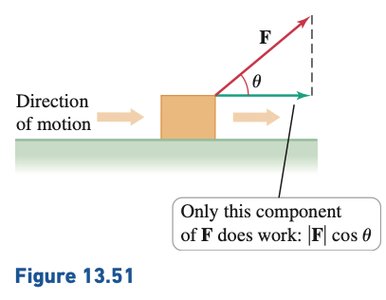
In physics, the work done by a force is the dot product of the force vector and the displacement vector. Only the component of the force in the direction of motion contributes to the work.
Work Formula:
Application: Calculating work in mechanics and engineering.
Cross Product and Areas
Cross Product
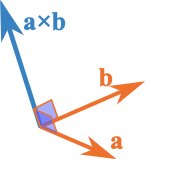
The cross product is an operation defined for vectors in three-dimensional space. It produces a vector that is orthogonal to both input vectors, with magnitude equal to the area of the parallelogram they span.
Magnitude:
Direction: Determined by the right-hand rule; the resulting vector is perpendicular to both u and v.
Component Formula:
Application: Used to compute torque, angular momentum, and area of parallelograms.
Summary Table: Vector Operations
Operation | Formula (ℝ3) | Result | Geometric Meaning |
|---|---|---|---|
Addition | Vector | Combines directions and magnitudes | |
Dot Product | Scalar | Measures alignment; zero if orthogonal | |
Cross Product | Vector | Orthogonal to both; magnitude is area | |
Magnitude | Scalar | Length of vector |
Additional info: These notes cover foundational concepts for multivariable calculus, specifically vector operations, which are prerequisites for understanding lines, planes, surfaces, and vector fields in higher dimensions.
