Back
Vectors, Lines, and Planes in Multivariable Calculus
Study Guide - Smart Notes
 Tailored notes based on your materials, expanded with key definitions, examples, and context.
Vectors and Their Properties
Vector Definition and Notation
Vectors are mathematical objects that have both magnitude and direction. In calculus, vectors are used to represent points, directions, and quantities in space.
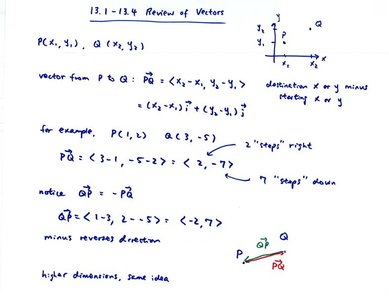
Vector from P to Q: If P = (x1, y1) and Q = (x2, y2), then the vector from P to Q is \( \vec{PQ} = (x_2 - x_1, y_2 - y_1) \).
Direction: The vector points from P to Q, with its components representing the change in each coordinate.
Example: P = (1, 2), Q = (3, 5): \( \vec{PQ} = (3-1, 5-2) = (2, 3) \)
Reverse Direction: \( \vec{QP} = -\vec{PQ} \)
Magnitude (Length) of a Vector
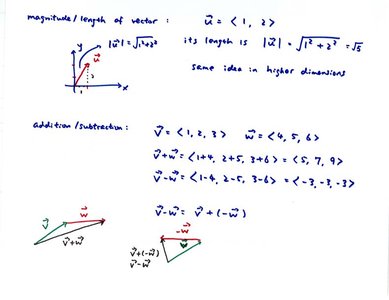
The magnitude or length of a vector \( \vec{u} = \langle x, y \rangle \) is given by the Euclidean norm:
Formula: \( |\vec{u}| = \sqrt{x^2 + y^2} \)
Example: For \( \vec{u} = \langle 1, 2 \rangle \), \( |\vec{u}| = \sqrt{1^2 + 2^2} = \sqrt{5} \)
Higher Dimensions: For \( \vec{v} = \langle x, y, z \rangle \), \( |\vec{v}| = \sqrt{x^2 + y^2 + z^2} \)
Vector Addition and Subtraction
Vectors can be added or subtracted component-wise.
Addition: \( \vec{v} + \vec{w} = \langle v_1 + w_1, v_2 + w_2, v_3 + w_3 \rangle \)
Subtraction: \( \vec{v} - \vec{w} = \langle v_1 - w_1, v_2 - w_2, v_3 - w_3 \rangle \)
Example: \( \vec{v} = \langle 1, 2, 3 \rangle \), \( \vec{w} = \langle 4, 5, 6 \rangle \): \( \vec{v} + \vec{w} = \langle 5, 7, 9 \rangle \), \( \vec{v} - \vec{w} = \langle -3, -3, -3 \rangle \)
Unit Vectors
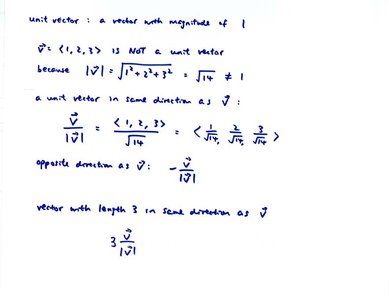
A unit vector is a vector with magnitude 1, often used to indicate direction.
Definition: A unit vector in the direction of \( \vec{v} \) is \( \frac{\vec{v}}{|\vec{v}|} \)
Example: For \( \vec{v} = \langle 1, 2, 3 \rangle \), \( |\vec{v}| = \sqrt{1^2 + 2^2 + 3^2} = \sqrt{14} \), so the unit vector is \( \langle \frac{1}{\sqrt{14}}, \frac{2}{\sqrt{14}}, \frac{3}{\sqrt{14}} \rangle \)
Opposite Direction: \( -\frac{\vec{v}}{|\vec{v}|} \)
Scaling: A vector with length 3 in the same direction as \( \vec{v} \) is \( 3 \frac{\vec{v}}{|\vec{v}|} \)
Shapes in Higher Dimensions
Planes and Spheres in 3D
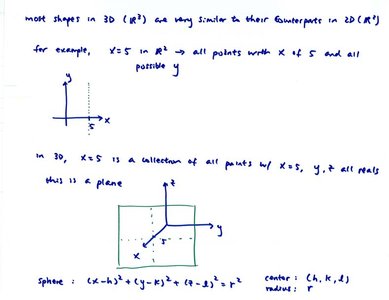
Many geometric shapes in three dimensions are extensions of their two-dimensional counterparts.
Plane: In 3D, the equation x = 5 describes a plane consisting of all points with x = 5 and any y, z values.
Sphere: The equation for a sphere centered at (h, k, d) with radius r is: \( (x-h)^2 + (y-k)^2 + (z-d)^2 = r^2 \)
Vector Cross Product
Definition and Calculation
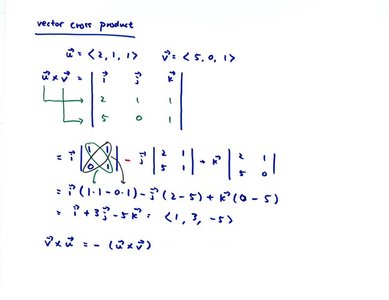
The cross product of two vectors in three dimensions produces a vector perpendicular to both.
Formula: For \( \vec{u} = \langle u_1, u_2, u_3 \rangle \), \( \vec{v} = \langle v_1, v_2, v_3 \rangle \): \( \vec{u} \times \vec{v} = \langle u_2 v_3 - u_3 v_2, u_3 v_1 - u_1 v_3, u_1 v_2 - u_2 v_1 \rangle \)
Properties: \( \vec{v} \times \vec{u} = - (\vec{u} \times \vec{v}) \)
Example: \( \vec{u} = \langle 2, 1, 1 \rangle \), \( \vec{v} = \langle 5, 0, 1 \rangle \): \( \vec{u} \times \vec{v} = \langle 1, 7, -5 \rangle \)
Lines and Planes in Space
Vector and Parametric Equations of a Line
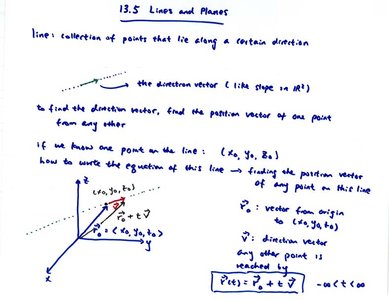
A line in space can be described using a point and a direction vector.
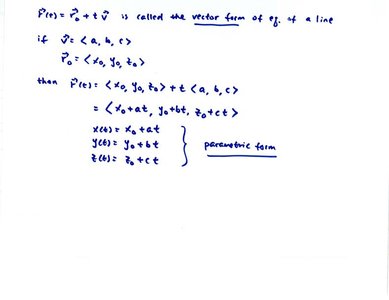
Vector Form: \( \vec{P}(t) = \vec{r}_0 + t \vec{v} \), where \( \vec{r}_0 \) is a position vector to a point on the line, \( \vec{v} \) is the direction vector, and t is a real parameter.
Parametric Form: If \( \vec{v} = \langle a, b, c \rangle \), \( \vec{r}_0 = \langle x_0, y_0, z_0 \rangle \): \( x(t) = x_0 + a t \) \( y(t) = y_0 + b t \) \( z(t) = z_0 + c t \)
Example: Line Through Two Points
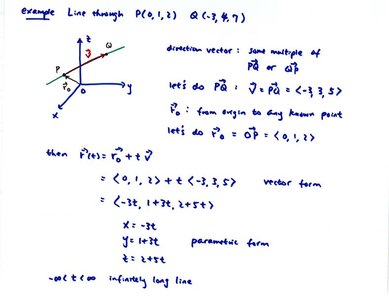
To find the equation of a line through points P and Q, use the vector from P to Q as the direction vector.
Direction Vector: \( \vec{PQ} \) or any multiple
Vector Form: \( \vec{P}(t) = \vec{r}_0 + t \vec{v} \)
Parametric Form: Express each coordinate as a function of t
Example: P = (0, 1, 2), Q = (3, 4, 7): \( \vec{v} = \langle 3, 3, 5 \rangle \), \( \vec{r}_0 = \langle 0, 1, 2 \rangle \) \( \vec{P}(t) = \langle 0, 1, 2 \rangle + t \langle 3, 3, 5 \rangle \)
Line Segment Between Two Points
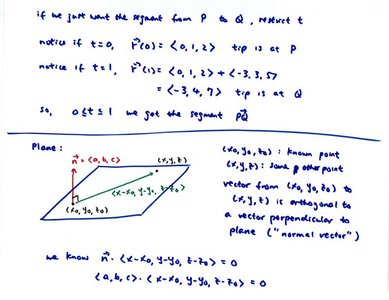
To describe the segment from P to Q, restrict t to [0, 1].
At t = 0: Point is at P
At t = 1: Point is at Q
Segment: \( 0 \leq t \leq 1 \)
Equation of a Plane
A plane in space can be defined by a point and a normal vector.
General Form: \( a(x-x_0) + b(y-y_0) + c(z-z_0) = 0 \), where \( \vec{n} = \langle a, b, c \rangle \) is the normal vector.
Normal Vector: Perpendicular to the plane
Point: \( (x_0, y_0, z_0) \) lies on the plane
Example: Plane Through Vectors and a Point
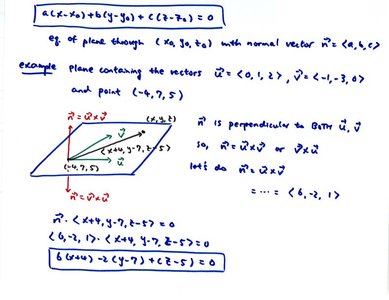
To find the equation of a plane containing two vectors and a point, use the cross product to find the normal vector.
Normal Vector: \( \vec{n} = \vec{u} \times \vec{v} \)
Equation: Substitute the normal vector and point into the general form
Example: \( \vec{u} = \langle 0, 1, 2 \rangle \), \( \vec{v} = \langle -1, -3, 0 \rangle \), point = (-4, 7, 5): \( \vec{n} = \langle 6, -2, 1 \rangle \) \( 6(x+4) - 2(y-7) + (z-5) = 0 \)
Relationships Between Lines and Planes
Skew Lines
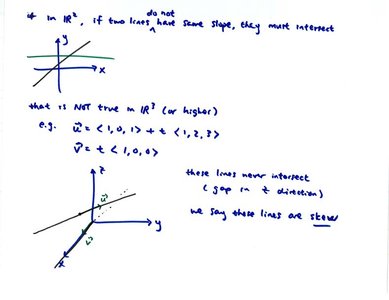
In three dimensions, lines with the same direction do not necessarily intersect.
Skew Lines: Lines that do not intersect and are not parallel
Example: \( \vec{u}(t) = \langle 1, 0, 1 \rangle + t \langle 1, 2, 3 \rangle \), \( \vec{v}(t) = t \langle 1, 0, 0 \rangle \)
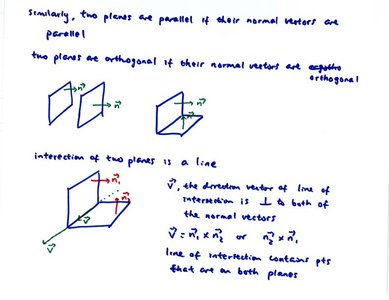
Parallel and Orthogonal Planes
Planes are parallel if their normal vectors are parallel, and orthogonal if their normal vectors are perpendicular.
Parallel Planes: \( \vec{n}_1 \) and \( \vec{n}_2 \) are parallel
Orthogonal Planes: \( \vec{n}_1 \cdot \vec{n}_2 = 0 \)
Intersection: The intersection of two planes is a line whose direction vector is the cross product of their normal vectors
Supplemental Example: Intersection of Lines
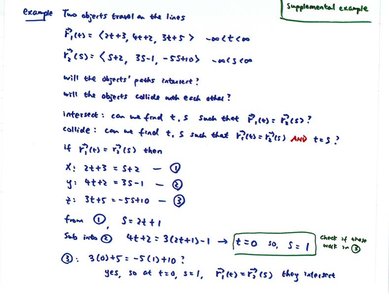
To determine if two objects traveling along lines will intersect, solve for parameters t and s such that their position vectors are equal.
Set Equations Equal: \( \vec{P}_1(t) = \vec{P}_2(s) \)
Solve for t and s: Find values where all coordinates match
Example: \( \vec{P}_1(s) = \langle 2+3s, 4+s, 3+5s \rangle \), \( \vec{P}_2(t) = \langle 5+2t, 3+5t, -5+10t \rangle \)