Back
Vectors, Lines, and Planes in Three-Dimensional Space
Study Guide - Smart Notes
 Tailored notes based on your materials, expanded with key definitions, examples, and context.
Vectors and Their Products
Dot Product
The dot product is a fundamental operation on vectors in two or three dimensions, measuring the extent to which two vectors point in the same direction.
Definition: For vectors u and v, the dot product is given by: , where is the angle between u and v, .
Component Formula: For and ,
Orthogonality: If and neither vector is zero, then u and v are orthogonal (perpendicular).
Projection of a Vector
The projection of vector u onto vector v is the component of u in the direction of v.
Formula:
Scalar Component:
Cross Product
The cross product of two vectors in three dimensions produces a vector orthogonal to both.
Formula: For and ,
Geometric Meaning: The magnitude equals the area of the parallelogram spanned by u and v.
Example: Area of a Triangle
Given points , , and , the area of triangle is:
Let and .
Area
Equations of Lines in Space
Vector and Parametric Equations
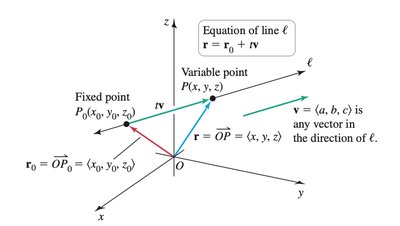
A line in three-dimensional space can be described using a point and a direction vector.
Vector Equation: , where is a position vector to a point on the line, is a direction vector, and is a real parameter.
Parametric Equations: for .
Example: Line Through Two Points
Given and , the direction vector is . The line is:
Vector form:
Parametric: , ,
Distance from a Point to a Line
The shortest distance from a point to a line is:
, where is any point on the line.
Equations of Planes in Space
Standard and General Forms
A plane in is determined by a point and a normal vector.
Standard Form: , where is a point on the plane and is a normal vector.
General Form: , where .
Examples
Plane through the origin:
xy-plane: (normal vector )
Given normal and point :
Finding a Plane from Three Points
Given three points, the normal vector can be found by taking the cross product of two vectors in the plane.
Let and , then
Equation: (if the plane passes through the origin)
Intersections and Relationships Between Planes
Parallel and Orthogonal Planes
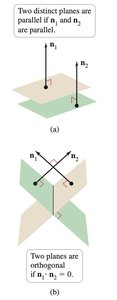
Planes in space can be classified by the relationship between their normal vectors.
Parallel Planes: Normal vectors are scalar multiples of each other.
Orthogonal Planes: Normal vectors are orthogonal, i.e., .
Intersection of Two Planes
The intersection of two non-parallel planes is a line. To find the intersection, solve the system of plane equations.
Example: For and , solve for , , and in terms of a parameter to get the line of intersection.
Geometric Interpretation of Vector Products
Area and Orientation
The cross product not only gives a vector orthogonal to two vectors but also encodes the area of the parallelogram they span and the orientation (right-hand rule).