 Back
Volumes of Solids of Revolution: Disk and Washer Methods
Study Guide - Smart Notes
 Tailored notes based on your materials, expanded with key definitions, examples, and context.
Applications of Definite Integrals
Volumes of Solids of Revolution
One important application of definite integrals in calculus is finding the volume of a solid formed by revolving a region around an axis. This process is commonly used in engineering and physics to determine the volume of objects with rotational symmetry.
Solid of Revolution: A three-dimensional figure obtained by rotating a two-dimensional region about a line (axis).
Disk Method: Used when the region is revolved around an axis and the cross-sections perpendicular to the axis are disks (circles).
Washer Method: Used when the cross-sections are washers (disks with holes), typically when revolving a region bounded by two curves.
Disk Method
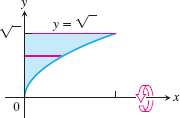
The disk method is used when the solid has no hole in the middle. The volume is calculated by integrating the area of each circular cross-section perpendicular to the axis of revolution.
Formula: If the region under the curve y = f(x) from x = a to x = b is revolved about the x-axis, the volume is:
Example: Revolving y = \sqrt{x} from x = 0 to x = 1 about the x-axis forms a solid whose volume can be found using the disk method.
Washer Method
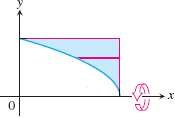
The washer method is used when the solid has a hole in the middle, i.e., when revolving a region bounded by two curves about an axis. The volume is found by subtracting the volume of the inner solid from the outer solid.
Formula: If the region between y = f(x) and y = g(x) (where f(x) \geq g(x)) from x = a to x = b is revolved about the x-axis, the volume is:
Example: Revolving the region between two curves about the x-axis forms a solid with a central hole, calculated using the washer method.
Cross-Sectional Area and Slices
Both methods rely on the concept of slicing the solid perpendicular to the axis of revolution. Each slice is either a disk or a washer, and the sum (integral) of their areas gives the total volume.
Disk: Area =
Washer: Area = , where R is the outer radius and r is the inner radius.
As the thickness of each slice approaches zero, the sum becomes an integral.
Visualizing the Solid of Revolution
When a region is revolved about an axis, the resulting solid can be visualized as a stack of disks or washers. The following images show the cross-sectional shapes formed during the revolution:
Disk cross-section:











Washer cross-section:











Additional info: The images of disks and washers illustrate the cross-sectional areas used in the integration process for finding volumes. The alternating images show the difference between a solid disk and a washer with a central hole.
