 Back
BackWTW 134 Calculus Study Guide – University of Pretoria
Study Guide - Smart Notes
 Tailored notes based on your materials, expanded with key definitions, examples, and context.
Theme 1 – Functions and Change
Unit 1.1: What is a Function?
A function is a rule that assigns to each element in a set (the domain) exactly one element in another set (the range). Understanding functions is foundational in calculus, as they model relationships between varying quantities.
Domain: The set of all possible input values (x-values) for which the function is defined.
Range: The set of all possible output values (y-values) the function can produce.
Function Values: The output of a function for a given input, denoted as f(x).
Intercepts: Vertical intercept is where the graph crosses the y-axis (set x = 0), and horizontal intercept is where it crosses the x-axis (set f(x) = 0).
Increasing/Decreasing: A function is increasing on an interval if its values rise as x increases, and decreasing if its values fall.
Concavity:
Concave up: All tangent lines lie below the graph on the interval.
Concave down: All tangent lines lie above the graph on the interval.
Linear functions are neither concave up nor down.
Example: For f(x) = x2, the function is increasing for x > 0, decreasing for x < 0, and concave up everywhere.
Unit 1.2: Types of Functions
There are several fundamental types of functions, each with characteristic formulas and graphs. Recognizing these types is essential for sketching and analyzing functions.
Linear:
Quadratic:
Exponential:
Logarithmic: or
Power:
Root:
For each, the domain and range can be represented using interval notation.
Example: The function is an exponential decay function with domain and range .
Unit 1.3: New Functions from Old Functions
Functions can be transformed by shifting, stretching, or reflecting their graphs. Composite functions are formed by applying one function to the result of another.
Vertical shift:
Horizontal shift:
Vertical stretch/shrink:
Reflection about x-axis:
Reflection about y-axis:
Composite function:
Example: If and , then .
Unit 1.4: Linear Functions
A linear function has the form , where is the slope (rate of change) and is the y-intercept. The symbol denotes change (e.g., is the change in x).
Equation of a line:
Recognizing linearity: If the rate of change between any two points is constant, the function is linear.
Example: For points (1,2) and (3,6), the slope is .
Unit 1.5: Rates of Change
The average rate of change of a function over an interval is the change in the function value divided by the change in x:
Relative change:
Velocity: If is position, then average velocity over is
Example: If , the average velocity from to is .
Unit 1.6: Continuity, Rate of Change, and the Derivative
A function is continuous on an interval if its graph has no breaks, holes, or jumps. The derivative at a point gives the instantaneous rate of change (the slope of the tangent line at that point).
Estimating the derivative: Use average rates of change over small intervals near the point.
Equation of tangent line:
Example: For , at , , so the tangent line is .
Unit 1.7: The Derivative Function
The derivative function gives the rate of change of at every point where it is defined. The sign of indicates whether is increasing (), decreasing (), or constant ().
If is not continuous at , then does not exist.
If the graph has a corner at , then does not exist.
Example: For , the derivative does not exist at (corner point).
Theme 2 – Differentiation
Unit 2.1: Differentiation Formulas and Rules
Differentiation is the process of finding the derivative of a function. There are standard formulas and rules for differentiation:
Power Rule:
Constant Rule:
Constant Multiple Rule:
Sum Rule:
Product Rule:
Quotient Rule:
Chain Rule:
Example:
Unit 2.2: The Chain Rule, Product Rule, and Quotient Rule
These rules are used to differentiate more complex functions:
Chain Rule: For composite functions ,
Product Rule:
Quotient Rule:
Example: If , then
Unit 2.3: Interpretations of the Derivative
The derivative can be interpreted as a rate of change, with units depending on the context (e.g., meters per second for velocity). The tangent line approximation uses the derivative to estimate function values near a point.
Relative rate of change:
Example: If is population at time , then is the rate of population growth at time .
Unit 2.4: The Second Derivative
The second derivative gives information about the concavity of a function:
If , the function is concave up on that interval.
If , the function is concave down on that interval.
Example: For , , so the function is concave up for and concave down for .
Theme 3 – Exponential, Logarithmic, Absolute Value, and Trigonometric Functions
Unit 3.1: Exponential Functions
An exponential function has the form , where . Exponential growth occurs when , and exponential decay when .
Growth/Decay Rate: Determined by the base .
Derivative:
Example: doubles as increases by 1.
Unit 3.2: Compound Interest and the Number e
Compound interest is calculated when interest is added to the principal at regular intervals. The number is the base for continuous compounding.
Compound n times/year:
Continuous compounding:
Effective annual rate: or
Example: compounded monthly for 1 year:
Unit 3.3: The Natural Logarithm
The natural logarithm is the inverse of the exponential function . It is used to solve equations involving exponentials.
Properties: , ,
Domain:
Example: Solve
Unit 3.4: Exponential Growth and Decay
Exponential growth and decay are modeled by , where for growth and for decay.
Doubling time:
Half-life:
Example: If , doubling time is units.
Unit 3.5: Absolute Value Functions
The absolute value of is if , if . The graph of reflects the negative part of above the x-axis.
Solving equations: has solutions or .
Solving inequalities: means .
Example: has solutions or .
Unit 3.6: Periodic Functions
A periodic function repeats its values in regular intervals. The sine and cosine functions are periodic with period .
General form: or
Amplitude:
Period:
Example: has amplitude 3 and period .
Theme 4 – Using the Derivative
Unit 4.1: Local Extremes of a Function
Local extremes are local maxima or minima. Critical points occur where or is undefined. The First Derivative Test and Second Derivative Test are used to classify these points.
First Derivative Test: Analyze sign changes of around critical points.
Second Derivative Test: If , local minimum at ; if , local maximum.
Example: For , , so is a minimum.
Unit 4.2: Inflection Points
An inflection point is where the function changes concavity. It occurs where and the sign of changes.
Example: For , , so is an inflection point.
Unit 4.3: Global Extremes of a Function
Global extremes are the highest or lowest values of a function on a given interval. For continuous functions on closed intervals, check endpoints and critical points.
Evaluate at all critical points and endpoints to find global maximum and minimum.
Example: For on , maximum at , minimum at and .
Theme 5 – Integration
Unit 5.1: Accumulated Change
Total change is visualized as the area under the graph of the rate of change function. Left-hand and right-hand sums estimate this area.
Left-hand sum: Uses left endpoints of subintervals.
Right-hand sum: Uses right endpoints of subintervals.
Estimate: Average of left- and right-hand sums.
Unit 5.2: The Definite Integral
The definite integral represents the net area under from to . The integrand is , and , are the limits of integration.
Estimate using tables, graphs, or formulas.
Unit 5.3: Antiderivatives
An antiderivative of is a function such that . The indefinite integral represents all antiderivatives of .
Basic integrals: (for )
Unit 5.4: The Fundamental Theorem of Calculus
The Fundamental Theorem links differentiation and integration:
If is an antiderivative of , then
Theme 6 – Using the Definite Integral
Unit 6.1: The Definite Integral as Area
Definite integrals can be used to calculate the area between a function and the x-axis, or between two functions.
Area between and from to is
Unit 6.2: Interpretations of the Definite Integral
The definite integral can represent total change, with units determined by the context (e.g., total distance, total cost).
Use the Fundamental Theorem to compute total change.
Unit 6.3: Average Value
The average value of a function on is:
Theme 7 – Function and Economics
Unit 7.1: Applications of Functions to Economics
Functions model economic quantities such as cost, revenue, profit, and depreciation.
Cost function: , total cost for producing units.
Revenue function: , total revenue from selling units.
Profit function:
Depreciation function: Value loss over time.
Fixed costs: Costs that do not change with production level.
Variable costs: Costs that change with production level.
Supply and demand curves: Model the relationship between price and quantity supplied/demanded.
Equilibrium: Where supply equals demand.
Unit 7.2: Marginal Cost and Revenue
Marginal cost is the derivative of the cost function, representing the cost of producing one more unit. Marginal revenue is the derivative of the revenue function.
Marginal analysis uses derivatives to optimize profit, cost, or revenue.
Unit 7.3: Maximizing Profit, Cost, and Revenue
To maximize profit, cost, or revenue, set the derivative equal to zero and solve for the critical points. The relationship between marginal revenue and marginal cost determines the maximum profit point.
Maximum profit occurs where marginal revenue equals marginal cost.
Unit 7.4: Finding Total Cost
Total cost can be found by integrating the marginal cost function and adding fixed costs. Similarly, total revenue is found by integrating the marginal revenue function.
Linear Algebra (Summary)
Unit 1.1: Matrix Addition and Scalar Multiplication
Matrix: An array of numbers.
Matrix addition: Add corresponding entries.
Scalar multiplication: Multiply every entry by the scalar.
Unit 1.2: Matrix Multiplication
Product of and matrices is .
Unit 1.3: Systems of Linear Equations
Use row operations to solve systems.
Classify as consistent (unique or infinite solutions) or inconsistent (no solution).
Appendix: Visual Aids
The following image illustrates the sign of the leading term of polynomials based on their end behavior:
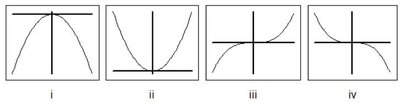
Explanation: The sign of the leading term determines the end behavior of the polynomial's graph. For example, if the leading coefficient is positive and the degree is even, both ends rise; if negative and even, both ends fall; if positive and odd, left falls and right rises; if negative and odd, left rises and right falls.
