Skip to main content
Cell Biology
My Course
Learn
Exam Prep
AI Tutor
Study Guides
Flashcards
Explore
Try the app
My Course
Learn
Exam Prep
AI Tutor
Study Guides
Flashcards
Explore
Try the app
Back
Acids, Bases, and Buffers definitions
You can tap to flip the card.
Acid
You can tap to flip the card.
👆
Acid
Substance that increases hydrogen ion concentration in solution, often leading to a lower pH and greater reactivity in cellular environments.
Track progress
Control buttons has been changed to "navigation" mode.
1/15
Related flashcards
Related practice
Recommended videos
Acids, Bases, and Buffers quiz
Acids, Bases, and Buffers
15 Terms
Acids, Bases, and Buffers
2. Chemical Components of Cells
7 problems
Topic
Four Classes of Macromolecules
2. Chemical Components of Cells
7 problems
Topic
2. Chemical Components of Cells
5 topics
14 problems
Chapter
Guided course
06:25
Acids, Bases, and Buffers
551
views
7
rank
Terms in this set (15)
Hide definitions
Acid
Substance that increases hydrogen ion concentration in solution, often leading to a lower pH and greater reactivity in cellular environments.
Base
Substance that accepts hydrogen ions, often increasing hydroxide ion concentration and resulting in a higher pH in solution.
Hydrogen Ion
Positively charged particle released by acids, responsible for increasing solution acidity and influencing cellular reactions.
Hydroxide Ion
Negatively charged particle associated with bases, capable of combining with hydrogen ions to form water.
Hydronium Ion
Formed when a hydrogen ion interacts with water, contributing to the measurement of acidity in solutions.
Strong Acid
Substance that completely dissociates in solution, releasing all its hydrogen ions and creating a highly acidic environment.
Weak Acid
Substance that only partially dissociates in solution, releasing some hydrogen ions and resulting in moderate acidity.
Strong Base
Substance that fully associates in solution, efficiently accepting hydrogen ions and raising the solution's pH.
Weak Base
Substance that partially associates in solution, accepting some hydrogen ions and causing a mild increase in pH.
pH Scale
Logarithmic measurement system ranging from 0 to 14, indicating the concentration of hydrogen ions in a solution.
Neutral pH
Condition where the concentration of hydrogen and hydroxide ions is balanced, typically represented by a pH of 7.
Buffer
Solution containing weak acids and bases that minimizes pH changes by absorbing or releasing hydrogen ions.
Cytosol
Cellular compartment with a near-neutral pH, providing an optimal environment for most cellular processes.
Lysosome
Organelle with a highly acidic interior, specialized for breaking down and destroying cellular materials.
Carbonic Acid
Weak acid in blood that, together with its conjugate base, helps stabilize pH and maintain physiological balance.
 BackBack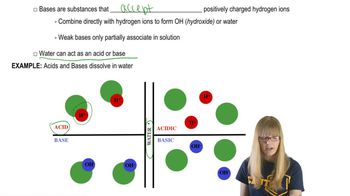
 06:25
06:25