Skip to main content
Cell Biology
My Course
Learn
Exam Prep
AI Tutor
Study Guides
Flashcards
Explore
Try the app
My Course
Learn
Exam Prep
AI Tutor
Study Guides
Flashcards
Explore
Try the app
Back
Complex Protein Structures quiz
You can tap to flip the card.
What allows proteins to interact with each other to form complex structures?
You can tap to flip the card.
👆
What allows proteins to interact with each other to form complex structures?
Proteins interact through binding sites, which are regions on the polypeptide chain that enable interaction with other chains or proteins.
Track progress
Control buttons has been changed to "navigation" mode.
1/15
Related flashcards
Related practice
Recommended videos
Complex Protein Structures definitions
Complex Protein Structures
15 Terms
Complex Protein Structures
6. Proteins
7 problems
Topic
Enzymes and Protein Binding
6. Proteins
7 problems
Topic
6. Proteins - Part 1 of 2
3 topics
9 problems
Chapter
6. Proteins - Part 2 of 2
3 topics
9 problems
Chapter
Guided course
04:19
Complex Protein Structures
703
views
1
rank
Terms in this set (15)
Hide definitions
What allows proteins to interact with each other to form complex structures?
Proteins interact through binding sites, which are regions on the polypeptide chain that enable interaction with other chains or proteins.
How do multi-protein complexes respond to cellular signals?
They are dynamic and can assemble or disassemble in response to different cellular signals.
What is the primary covalent bond that stabilizes protein complexes?
Disulfide bonds are the primary covalent bonds that stabilize protein complexes.
Besides covalent bonds, what other types of bonds help hold protein structures together?
Non-covalent bonds also help link polypeptide chains and stabilize protein structures.
What is a common shape formed by protein complexes due to its energetic favorability?
Helices are a common shape because they are the most energetically favorable way to link repetitive subunits.
Where are fibrous protein shapes commonly found in the body?
Fibrous protein shapes are commonly found in the skin and the extracellular matrix.
What is the function of unstructured regions in protein complexes?
Unstructured regions provide flexibility to protein complexes.
What is an example of a protein complex involved in DNA synthesis?
Multi-protein complexes involved in DNA synthesis are examples of such structures.
How many proteins make up the exosome protein complex mentioned in the lesson?
The exosome protein complex is made up of six proteins.
What is the role of elastin in the body?
Elastin is a protein important for providing elasticity in the skin.
Can proteins in a multi-protein complex have different functions?
Yes, each polypeptide chain in a complex usually has a different, even if slight, function.
What types of shapes can multi-protein complexes form?
They can form helices, elongated fibrous shapes, compact globular shapes, and even linear or circular shapes.
How do protein complexes contribute to cellular functions?
They are involved in crucial functions like DNA synthesis, RNA processing, and ATP creation.
What enables the diversity of protein structures and functions in biological systems?
The assembly of proteins into multi-protein complexes with different shapes and functions enables this diversity.
How can protein complexes be cross-linked to form meshworks?
They can be covalently cross-linked, as seen with proteins like elastin in the extracellular matrix.
 BackBack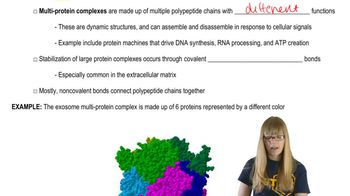
 04:19
04:19