Skip to main content
Cell Biology
My Course
Learn
Exam Prep
AI Tutor
Study Guides
Flashcards
Explore
Try the app
My Course
Learn
Exam Prep
AI Tutor
Study Guides
Flashcards
Explore
Try the app
Back
Control of Cell Size definitions
You can tap to flip the card.
Mitogen
You can tap to flip the card.
👆
Mitogen
Extracellular molecule that removes cell cycle inhibitors, enabling progression through G1 and S phases to stimulate division.
Track progress
Control buttons has been changed to "navigation" mode.
1/15
Related flashcards
Related practice
Recommended videos
Control of Cell Size quiz #1
Control of Cell Size
10 Terms
Control of Cell Size
16. Cell Division
7 problems
Topic
Control of Cell Death
16. Cell Division
7 problems
Topic
16. Cell Division - Part 1 of 2
5 topics
14 problems
Chapter
16. Cell Division - Part 2 of 2
5 topics
13 problems
Chapter
Guided course
07:26
Cell Size Control
439
views
5
rank
1
comments
Terms in this set (15)
Hide definitions
Mitogen
Extracellular molecule that removes cell cycle inhibitors, enabling progression through G1 and S phases to stimulate division.
Growth Factor
Extracellular signal that enhances protein synthesis and reduces degradation, leading to increased cellular mass.
Survival Factor
Extracellular agent that suppresses apoptosis, ensuring continued cell viability.
Apoptosis
Regulated process of programmed cell death, crucial for removing unnecessary or damaged cells.
Cell Proliferation
Increase in cell number due to repeated rounds of division, distinct from individual cell growth.
G1 CDK
Intracellular enzyme complex activated by mitogens, driving the cell from G1 phase toward DNA synthesis.
E2F Transcription Factor
Protein activated by mitogens and growth factors, promoting gene expression for S phase entry.
Retinoblastoma Protein
Cell cycle regulator that inhibits transcription factors, preventing uncontrolled progression and growth.
RAS MAPK Signaling Pathway
Intracellular cascade that activates transcription factors to support cell growth and division.
PI3KAKT Pathway
Signaling route involved in cell growth, survival, and DNA damage repair by modulating intracellular proteins.
Cell Cycle
Ordered sequence of events enabling cell growth, DNA replication, and division.
DNA Damage Repair
Cellular process that detects and corrects genetic errors, often pausing the cycle to maintain integrity.
Cyclin
Regulatory protein that partners with CDKs to control progression through different cell cycle phases.
Inhibitor
Molecule that blocks cell cycle progression, ensuring division only occurs under proper conditions.
S Phase
Cell cycle stage where DNA synthesis occurs, preparing the cell for division.
 BackBack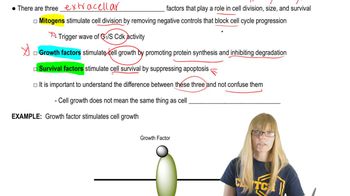
 07:26
07:26