Skip to main content
Cell Biology
My Course
Learn
Exam Prep
AI Tutor
Study Guides
Flashcards
Explore
Try the app
My Course
Learn
Exam Prep
AI Tutor
Study Guides
Flashcards
Explore
Try the app
Back
Cytokinesis definitions
You can tap to flip the card.
Cytokinesis
You can tap to flip the card.
👆
Cytokinesis
Final stage of cell division where the cytoplasm splits, resulting in two distinct daughter cells.
Track progress
Control buttons has been changed to "navigation" mode.
1/15
Related flashcards
Related practice
Recommended videos
Cytokinesis quiz #1
Cytokinesis
40 Terms
Cytokinesis
16. Cell Division
7 problems
Topic
Control of Cell Size
16. Cell Division
7 problems
Topic
16. Cell Division - Part 1 of 2
5 topics
14 problems
Chapter
16. Cell Division - Part 2 of 2
5 topics
13 problems
Chapter
Guided course
04:03
Cytokinesis
491
views
7
rank
1
comments
Terms in this set (15)
Hide definitions
Cytokinesis
Final stage of cell division where the cytoplasm splits, resulting in two distinct daughter cells.
Mitotic Spindle
Cellular structure that positions the division site before disassembling at the end of mitosis.
Cleavage Furrow
Indentation of the plasma membrane marking where the cell will divide during the last step of mitosis.
Contractile Ring
Structure composed of actin and myosin that generates force to physically separate two daughter cells.
Actin
Cytoskeletal protein forming part of the contractile ring, essential for generating the force needed for cell separation.
Myosin
Motor protein in the contractile ring that interacts with actin to constrict the cell membrane during division.
Rho A
GTPase protein that initiates the assembly of the contractile ring by hydrolyzing GTP.
Symmetrical Division
Process where both daughter cells receive equal portions of organelles and chromosomes after division.
Asymmetrical Division
Process where daughter cells receive unequal cellular contents, often to support specialized cell functions.
Daughter Cell
One of the two new cells formed after the cytoplasm divides, each inheriting half the original cell's contents.
Phragmoplast
Plant cell structure composed of microtubules that guides the formation of the new cell wall during division.
Cell Plate
Precursor structure to the plant cell wall, assembled at the division site before the wall fully forms.
Microtubule
Cytoskeletal filament involved in positioning the division site and assembling the phragmoplast in plant cells.
Plasma Membrane
Cell boundary that puckers inward at the cleavage furrow, ultimately separating the two new cells.
Organelle
Intracellular structure that must be evenly distributed between daughter cells during cytokinesis.
 BackBack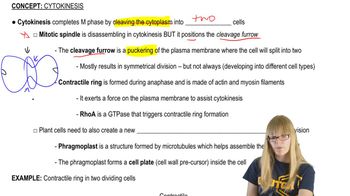
 04:03
04:03