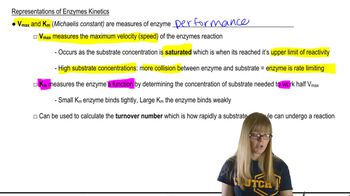
Enzyme kinetics measures the activity of an enzyme, specifically the relationship between substrate concentration and the speed of enzyme reactions.
At low substrate concentrations, what limits the speed of an enzyme-catalyzed reaction?
At low substrate concentrations, the substrate is rate limiting because there are fewer collisions between enzyme and substrate.
What happens when substrate concentration is high in an enzyme reaction?
When substrate concentration is high, the enzyme becomes rate limiting because all enzyme active sites are occupied.
What is Vmax in enzyme kinetics?
Vmax is the maximum velocity of an enzyme-catalyzed reaction when the substrate is saturated and all enzyme active sites are filled.
What does the Michaelis constant (Km) represent?
Km represents the substrate concentration needed to reach half of Vmax in an enzyme-catalyzed reaction.
How does a small Km value relate to enzyme-substrate binding?
A small Km value indicates that the enzyme binds tightly to the substrate, requiring less substrate to reach half Vmax.
What does a large Km value suggest about enzyme efficiency?
A large Km value suggests weak binding between enzyme and substrate, meaning the enzyme is less efficient.
When is Vmax measured during an enzyme reaction?
Vmax is measured when all enzyme molecules are bound to substrate, reflecting the fastest possible reaction rate.
Why is enzyme kinetics typically measured before any product is formed?
It is measured before product formation to accurately assess the initial reaction speed without interference from product buildup.
What is the turnover number in enzyme kinetics?
The turnover number is how rapidly a substrate molecule can undergo a reaction catalyzed by an enzyme.
How does substrate concentration affect reaction velocity in enzyme kinetics?
As substrate concentration increases, reaction velocity increases until the enzyme becomes saturated and Vmax is reached.
What does it mean if the substrate concentration needed for half Vmax is low?
It means the enzyme binds substrate tightly and is efficient at catalyzing the reaction.
What does it mean if the substrate concentration needed for half Vmax is high?
It means the enzyme binds substrate loosely and is less efficient at catalyzing the reaction.
What are the two main values used to measure enzyme performance?
The two main values are Vmax (maximum velocity) and Km (Michaelis constant).
How can the relationship between Vmax, Km, and substrate concentration be used?
This relationship helps assess enzyme efficiency and performance by showing how quickly an enzyme can convert substrate to product under different conditions.
 Back
Back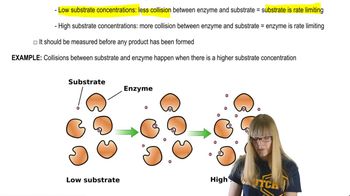
 02:16
02:16