Pearson+ LogoPearson+ Logo

ER Processing and Transport quiz #1 Flashcards

Back
ER Processing and Transport quiz #1
Control buttons has been changed to "navigation" mode.
1/15
  • What is the main structural difference between rough ER and smooth ER?

    The rough ER is studded with ribosomes on its cytoplasmic surface, giving it a 'rough' appearance, while the smooth ER lacks ribosomes and appears smooth.
  • What is the primary function of the rough endoplasmic reticulum (rough ER)?

    The rough ER is primarily responsible for the synthesis and initial processing of proteins, especially those destined for secretion, membranes, or specific organelles.
  • Why does the rough ER appear 'rough' under a microscope?

    The rough ER appears rough because it is covered with ribosomes on its cytoplasmic surface.
  • What is the main function of the smooth endoplasmic reticulum (smooth ER)?

    The smooth ER is involved in lipid synthesis, detoxification, and calcium storage, and does not participate in protein synthesis.
  • Which part of the cell is responsible for transporting newly synthesized proteins?

    The endoplasmic reticulum (ER), particularly the rough ER, is responsible for transporting newly synthesized proteins.
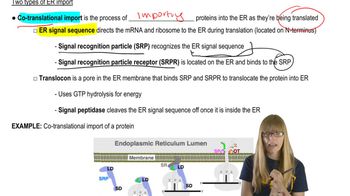
  • How are proteins imported into the ER during co-translational import?

    During co-translational import, proteins with an ER signal sequence are directed to the ER, where the signal recognition particle (SRP) binds the sequence and guides the ribosome to the ER membrane. The protein is then translocated into the ER lumen as it is being synthesized.
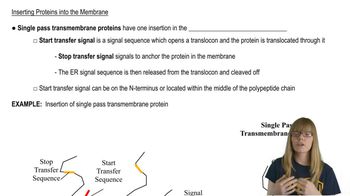
  • What role do start and stop transfer sequences play in membrane protein insertion in the ER?

    Start and stop transfer sequences determine where and how many times a protein spans the membrane, allowing for the insertion of single-pass or multi-pass transmembrane proteins.
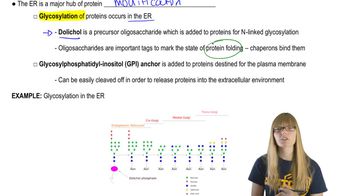
  • What is glycosylation and where does it occur in the cell?

    Glycosylation is the addition of sugar molecules to proteins, and it occurs in the endoplasmic reticulum (ER).
  • What is the function of the chaperone protein BIP in ER protein import?

    BIP assists in pulling unfolded proteins into the ER during post-translational import and helps refold them once inside.
  • What is the unfolded protein response in the ER?

    The unfolded protein response is a quality control mechanism in the ER that detects misfolded proteins and directs them to the cytosol for degradation, aided by ERAD proteins.
  • What is the role of GPI anchors in protein modification within the ER?

    GPI anchors are added to proteins in the ER to attach them to the plasma membrane, allowing for their eventual release into the extracellular environment.
  • How does the ER retain proteins that are meant to stay within it?

    Proteins meant to remain in the ER have an ER retention signal on their C-terminus, which keeps them localized within the ER.
  • What is the difference between single-pass and multi-pass transmembrane proteins?

    Single-pass transmembrane proteins span the membrane once, using one start and one stop transfer sequence, while multi-pass proteins span the membrane multiple times, using multiple start and stop transfer sequences.
  • What happens to misfolded proteins detected in the ER?

    Misfolded proteins in the ER are recognized by ERAD proteins, transported to the cytosol, and degraded.
  • What is the function of protein disulfide isomerase in the ER?

    Protein disulfide isomerase helps form disulfide bonds in proteins, which stabilize their structure.