Control buttons has been changed to "navigation" mode.
1/10
Terms in this set (10)
What structure surrounds an individual muscle cell and provides support and connection to other cells in animal tissues?
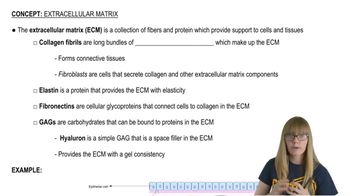
The extracellular matrix (ECM) surrounds individual muscle cells, providing structural support and connecting them to other cells through components such as collagen, elastin, fibronectins, glycosaminoglycans, and integrins.
Which cell type is responsible for producing collagen in the extracellular matrix?
Fibroblasts are the cells that produce collagen in the extracellular matrix. These collagen molecules then form fibrils that connect cells together.
What role does elastin play in the extracellular matrix of animal cells?
Elastin provides elasticity to tissues, allowing them to stretch and return to their original shape. This is especially important in tissues like skin that require flexibility.
How do fibronectins contribute to the structure of the extracellular matrix?
Fibronectins are glycoproteins that connect collagen fibers to cells within the extracellular matrix. They help organize and stabilize the association between cells and matrix components.
What is the function of glycosaminoglycans (GAGs) such as hyaluron in the extracellular matrix?
Glycosaminoglycans like hyaluron bind elements together and fill space within the extracellular matrix. They add consistency and help maintain the matrix's structure.
Describe the structural composition of integrins found in animal cells.
Integrins are transmembrane proteins composed of two alpha and two beta subunits. They exist in active and inactive conformations, allowing them to mediate cell-ECM interactions.
What is the difference between active and inactive integrin conformations?
Active integrins are upright and interact with the extracellular matrix, connecting the cell to its surroundings. Inactive integrins are bent and do not bind to the matrix.
Why is anchorage-dependent growth important for animal cells?
Anchorage-dependent growth requires cells to attach to the extracellular matrix via integrins to proliferate. This process ensures proper tissue development and cellular communication.
How do integrins facilitate cell signaling within the extracellular matrix?
Integrins transmit signals between the extracellular matrix and the cell's cytoskeleton. This signaling regulates cell growth, movement, and survival.
What is the main purpose of the extracellular matrix in animal tissues?
The extracellular matrix provides structural support and connects cells together, forming strong and organized tissues. It also enables communication and coordinated growth among cells.