Skip to main content
Cell Biology
My Course
Learn
Exam Prep
AI Tutor
Study Guides
Flashcards
Explore
Try the app
My Course
Learn
Exam Prep
AI Tutor
Study Guides
Flashcards
Explore
Try the app
Back
Genomic Comparison definitions
You can tap to flip the card.
Genomic Sequence
You can tap to flip the card.
👆
Genomic Sequence
A complete order of nucleotides in an organism’s DNA, used to compare evolutionary relationships between species.
Track progress
Control buttons has been changed to "navigation" mode.
1/13
Related flashcards
Related practice
Recommended videos
Genomic Comparison quiz
Genomic Comparison
15 Terms
Genomic Comparison
4. DNA, Chromosomes, and Genomes
7 problems
Topic
Human Genetic Variation
4. DNA, Chromosomes, and Genomes
5 problems
Topic
4. DNA, Chromosomes, and Genomes - Part 1 of 2
5 topics
14 problems
Chapter
4. DNA, Chromosomes, and Genomes - Part 2 of 2
5 topics
13 problems
Chapter
Guided course
06:15
Genomic Comparison
287
views
Terms in this set (13)
Hide definitions
Genomic Sequence
A complete order of nucleotides in an organism’s DNA, used to compare evolutionary relationships between species.
Purifying Selection
A process where harmful mutations in essential genes are eliminated, preserving gene function across species.
Conserved Sequence
A stretch of DNA that remains nearly unchanged across distantly related organisms, indicating a vital biological role.
Chromosome
A structure composed of DNA and proteins, carrying genetic information and gene order within cells.
Synteny
The preservation of gene order on chromosomes between different species, reflecting functional importance.
Genomic Size
The total amount of DNA, measured in base pairs, within an organism’s genome, not directly linked to complexity.
Gene
A segment of DNA encoding information for a specific function or trait, sometimes highly conserved across species.
Phylogenetic Tree
A branching diagram constructed from DNA data to illustrate evolutionary relationships among organisms.
Intron
A non-coding region within a gene that mutates more rapidly than essential coding sequences.
Base Pair
A unit of DNA consisting of two nucleotides bonded together, used to measure genome length.
Mutation
A change in the DNA sequence, which can be eliminated by selection if it disrupts critical gene function.
Evolutionary Change
Alterations in genomic sequences over time, reflecting divergence from common ancestors.
Genomic Complexity
A concept referring to the functional and organizational intricacy of an organism’s genome, not determined by size.
 BackBack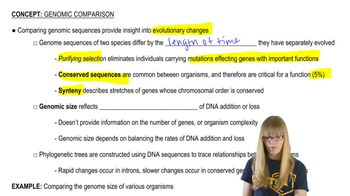
 06:15
06:15