Skip to main content
Cell Biology
My Course
Learn
Exam Prep
AI Tutor
Study Guides
Flashcards
Explore
Try the app
My Course
Learn
Exam Prep
AI Tutor
Study Guides
Flashcards
Explore
Try the app
Back
Light Independent Reactions definitions
You can tap to flip the card.
Calvin Cycle
You can tap to flip the card.
👆
Calvin Cycle
A series of reactions in plants that use ATP and NADPH to convert CO2 into sugars, occurring mainly in C3 plants.
Track progress
Control buttons has been changed to "navigation" mode.
1/15
Related flashcards
Related practice
Recommended videos
Light Independent Reactions quiz
Light Independent Reactions
15 Terms
Light Independent Reactions
12. Photosynthesis
7 problems
Topic
Light Dependent Reactions
12. Photosynthesis
7 problems
Topic
12. Photosynthesis
4 topics
12 problems
Chapter
Guided course
07:37
C4 and CAM Plants
449
views
1
comments
Guided course
03:56
Calvin Cycle
520
views
Terms in this set (15)
Hide definitions
Calvin Cycle
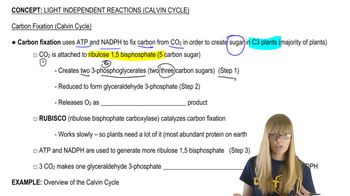
A series of reactions in plants that use ATP and NADPH to convert CO2 into sugars, occurring mainly in C3 plants.
Carbon Fixation
The process of incorporating inorganic carbon from CO2 into organic molecules, forming the basis for sugar production in plants.
RuBisCO
An abundant, slow-working enzyme responsible for attaching CO2 to a five-carbon sugar, enabling sugar synthesis in plants.
Ribulose-1,5-bisphosphate
A five-carbon sugar that acts as the initial CO2 acceptor in the first step of the Calvin cycle.
Phosphoglycerate
A three-carbon molecule produced after CO2 is fixed to a five-carbon sugar during the Calvin cycle.
ATP
A molecule generated in light-dependent reactions, providing energy for the synthesis of sugars in the Calvin cycle.
NADPH
A reducing agent produced in light-dependent reactions, supplying electrons for sugar formation in the Calvin cycle.
C3 Plants
Plants that use the Calvin cycle directly for carbon fixation, representing the majority of plant species.
C4 Plants
Plants that spatially separate carbon fixation and the Calvin cycle into different cell types to minimize photorespiration.
CAM Plants
Plants that temporally separate carbon fixation and the Calvin cycle, fixing CO2 at night and storing it as malate.
Photorespiration
A wasteful process where RuBisCO uses oxygen instead of CO2, leading to energy loss in plants, especially under hot conditions.
Stomata
Pores in plant leaves that regulate gas exchange, closing in hot conditions to conserve water but limiting CO2 intake.
Mesophyll Cells
Cells in C4 plants where initial CO2 fixation occurs, producing malate for transfer to other cell types.
Bundle Sheath Cells
Cells in C4 plants where the Calvin cycle operates, receiving CO2 from malate to avoid oxygen buildup.
Malate
A four-carbon compound that temporarily stores fixed CO2 in C4 and CAM plants, facilitating efficient sugar production.
 BackBack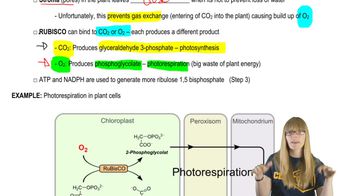
 07:37
07:37