Pearson+ LogoPearson+ Logo
Back

Mitochondria quiz #4

Control buttons has been changed to "navigation" mode.
1/40
  • Which organelle is responsible for the majority of the cell's energy production via the mitochondrial partial self-sufficiency?

    The mitochondrion is responsible for the majority of the cell's energy production and is partially self-sufficient due to its own DNA and ribosomes.
  • Which organelle is responsible for the majority of the cell's energy production via the mitochondrial dependence on nuclear genes?

    The mitochondrion is responsible for the majority of the cell's energy production but depends on nuclear genes for some proteins.
  • Which organelle is responsible for the majority of the cell's energy production via the mitochondrial import of large proteins?

    The mitochondrion is responsible for the majority of the cell's energy production and imports large proteins with special codes.
  • Which organelle is responsible for the majority of the cell's energy production via the mitochondrial selective permeability?

    The mitochondrion is responsible for the majority of the cell's energy production and has selective permeability in its membranes.
  • Which organelle is responsible for the majority of the cell's energy production via the mitochondrial specialized transport proteins?

    The mitochondrion is responsible for the majority of the cell's energy production and uses specialized transport proteins in the inner membrane.
  • Which organelle is responsible for the majority of the cell's energy production via the mitochondrial hydrogen ion gradient?

    The mitochondrion is responsible for the majority of the cell's energy production via the hydrogen ion gradient across the inner membrane.
  • Which organelle is responsible for the majority of the cell's energy production via the mitochondrial ATP synthase activity?

    The mitochondrion is responsible for the majority of the cell's energy production via ATP synthase activity in the inner membrane.
  • Which organelle is responsible for the majority of the cell's energy production via the mitochondrial electron transport chain proteins?

    The mitochondrion is responsible for the majority of the cell's energy production via electron transport chain proteins in the inner membrane.
  • Which organelle is responsible for the majority of the cell's energy production via the mitochondrial impermeability to ions?

    The mitochondrion is responsible for the majority of the cell's energy production due to the inner membrane's impermeability to ions.
  • Which organelle is responsible for the majority of the cell's energy production via the mitochondrial specialized channels?

    The mitochondrion is responsible for the majority of the cell's energy production via specialized channels in the outer membrane.
  • Which organelle is responsible for the majority of the cell's energy production via the mitochondrial aqueous intermembrane space?

    The mitochondrion is responsible for the majority of the cell's energy production, with an aqueous intermembrane space similar to the cytosol.
  • Which organelle is responsible for the majority of the cell's energy production via the mitochondrial storage of important ions?

    The mitochondrion is responsible for the majority of the cell's energy production and stores important ions in granules.
  • Which organelle is responsible for the majority of the cell's energy production via the mitochondrial presence in both plant and animal cells?

    The mitochondrion is responsible for the majority of the cell's energy production and is present in both plant and animal cells.
  • Which organelle is responsible for the majority of the cell's energy production via the mitochondrial presence in high-energy cells?

    The mitochondrion is responsible for the majority of the cell's energy production and is present in higher numbers in high-energy cells.
  • Which organelle is responsible for the majority of the cell's energy production via the mitochondrial abundance in muscle cells?

    The mitochondrion is responsible for the majority of the cell's energy production and is abundant in muscle cells.
  • Which organelle is responsible for the majority of the cell's energy production via the mitochondrial abundance in sperm cells?

    The mitochondrion is responsible for the majority of the cell's energy production and is abundant in sperm cells.
  • Which organelle is responsible for the majority of the cell's energy production via the mitochondrial abundance in active cells?

    The mitochondrion is responsible for the majority of the cell's energy production and is abundant in active cells.
  • Which organelle is responsible for the majority of the cell's energy production via the mitochondrial abundance in metabolically active tissues?

    The mitochondrion is responsible for the majority of the cell's energy production and is abundant in metabolically active tissues.
  • Which organelle is responsible for the majority of the cell's energy production via the mitochondrial abundance in cells with high ATP demand?

    The mitochondrion is responsible for the majority of the cell's energy production and is abundant in cells with high ATP demand.
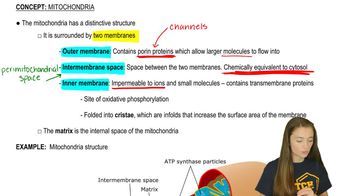
  • How many membranes does a mitochondrion have?

    A mitochondrion has two membranes: an outer membrane and an inner membrane.
  • What is the function of the two membranes in mitochondria?

    The outer membrane allows certain molecules to enter, while the inner membrane is the site of the electron transport chain and ATP synthesis.
  • What is the function of the mitochondrial granules?

    Mitochondrial granules are storage areas for important ions and molecules needed for the electron transport chain.
  • What is the function of mitochondrial fusion?

    Mitochondrial fusion allows mitochondria to exchange resources and information, increasing efficiency in ATP production.
  • What is the function of mitochondrial mobility?

    Mitochondrial mobility allows mitochondria to move to areas of the cell where energy demand is highest.
  • What is the function of mitochondrial protein import?

    Mitochondria import some proteins from the cytosol that are encoded by nuclear DNA and synthesized in the cytoplasm.
  • What is the function of mitochondrial resource sharing?

    Mitochondrial resource sharing through fusion helps distribute substances needed for ATP production among mitochondria.
  • What is the function of mitochondrial information exchange?

    Mitochondrial information exchange through fusion allows sharing of genetic and metabolic resources.
  • What is the function of mitochondrial networks?

    Mitochondrial networks formed by fusion enhance efficiency in ATP production and resource distribution.
  • What is the function of mitochondrial selective permeability?

    Selective permeability of mitochondrial membranes regulates the entry and exit of molecules, maintaining conditions for ATP production.
  • What is the function of mitochondrial specialized transport proteins?

    Specialized transport proteins in the inner membrane facilitate the movement of ions and molecules necessary for ATP synthesis.
  • What is the function of the hydrogen ion gradient in mitochondria?

    The hydrogen ion gradient across the inner membrane drives ATP synthesis by ATP synthase.
  • What is the function of the electron transport chain proteins in mitochondria?

    Electron transport chain proteins transfer electrons and pump protons to create a gradient for ATP synthesis.
  • What is the function of the impermeability of the inner mitochondrial membrane?

    The impermeability of the inner membrane is essential for maintaining the proton gradient required for ATP production.
  • What is the function of the aqueous intermembrane space in mitochondria?

    The aqueous intermembrane space allows for the accumulation of protons during electron transport, contributing to the proton gradient.
  • What is the function of the mitochondrial storage granules?

    Mitochondrial storage granules store ions and molecules important for mitochondrial function.
  • What is the function of the mitochondrial presence in both plant and animal cells?

    The presence of mitochondria in both plant and animal cells enables ATP production through cellular respiration in both cell types.
  • What is the function of the mitochondrial abundance in high-energy cells?

    High-energy cells have more mitochondria to meet their increased ATP demands.
  • What is the function of the mitochondrial abundance in muscle cells?

    Muscle cells have abundant mitochondria to supply the energy needed for contraction.
  • What is the function of the mitochondrial abundance in sperm cells?

    Sperm cells have abundant mitochondria to provide energy for motility.
  • What is the function of the mitochondrial abundance in active cells?

    Active cells have more mitochondria to support their higher metabolic activity.