Pearson+ LogoPearson+ Logo

Model Organisms quiz #1 Flashcards

Back
Model Organisms quiz #1
Control buttons has been changed to "navigation" mode.
1/10
  • Why is the whitefish commonly used to study mitosis in cell biology research?

    The whitefish is used to study mitosis because its cells divide rapidly and synchronously, making it easier to observe and analyze the different stages of mitosis under a microscope. Model organisms like the whitefish are chosen for their rapid cell division and suitability for laboratory study, which facilitates the investigation of fundamental cellular processes such as mitosis.
  • What feature of zebrafish embryos makes them particularly useful for studying developmental biology?

    Zebrafish embryos are transparent during the first two weeks of development, allowing researchers to observe internal structures and changes easily. This transparency facilitates gene injection and visualization of developmental processes.
  • How does genetic redundancy complicate studies using model organisms?

    Genetic redundancy means multiple versions of a gene can compensate for each other, so mutating one gene may not produce an observable effect. This makes it challenging to determine the function of individual genes in model organisms.
  • Why are yeast cells advantageous for genetic screens in laboratory research?

    Yeast cells have a small genome, divide quickly, and are easy to genetically manipulate. These features allow researchers to efficiently mutagenize and screen for specific phenotypes.
  • What is unique about the cell lineage mapping in C. elegans?

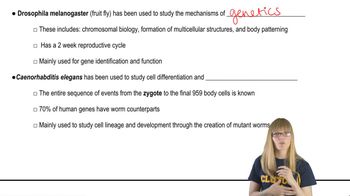
    The entire sequence of cell divisions from the zygote to the final 959 cells in C. elegans is fully known. This complete mapping enables precise studies of cell differentiation and development.
  • How do retroviruses facilitate genetic studies in cell biology?

    Retroviruses can integrate their genetic material into the host cell's chromosome, allowing scientists to insert specific genes or mutations. This enables detailed analysis of gene function and expression in cells.
  • What is the main reason mice are used to study human diseases in research?

    Mice share 99% of their protein-coding genes and have similar immune systems to humans. This genetic and physiological similarity makes them ideal for modeling human diseases caused by genetic mutations.
  • What is the difference between in vitro and in vivo studies in cell biology?

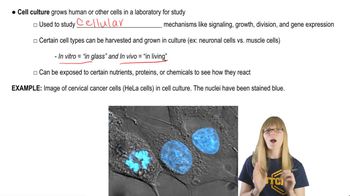
    In vitro studies are performed outside living organisms, typically in glass or plastic dishes, while in vivo studies occur within living organisms. Cell culture is generally considered in vitro, but some debate exists since the cells are alive.
  • Why is Arabidopsis thaliana a preferred model organism for plant genetics?

    Arabidopsis thaliana is easy to grow indoors, produces many offspring quickly, and has a gene count similar to humans. Its genetic features make it valuable for studying plant development and gene organization.
  • How can E. coli be used to produce proteins for experimental use?

    Scientists can manipulate E. coli to replicate DNA and express proteins of interest. These proteins can then be extracted from the bacteria for use in various experiments.