Pearson+ LogoPearson+ Logo
Back

Passive Transport: Diffusion and Osmosis quiz #1

Control buttons has been changed to "navigation" mode.
1/40
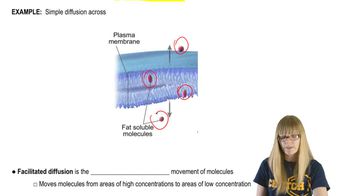
  • What is the difference between simple diffusion and facilitated diffusion in passive transport across cell membranes?

    Simple diffusion involves the unassisted movement of small, uncharged, non-polar molecules from high to low concentration, while facilitated diffusion requires transport proteins (channel or carrier proteins) to help larger or polar molecules cross the membrane, still moving down their concentration gradient without energy input.
  • How do channel proteins and carrier proteins differ in their roles during facilitated diffusion?

    Channel proteins provide a passageway for molecules to move across the membrane, while carrier proteins bind to the molecule and undergo a conformational change to transport it across the membrane.
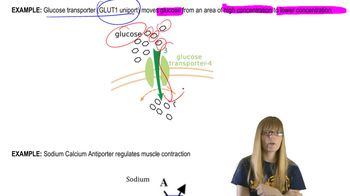
  • Describe the three types of transport proteins involved in facilitated diffusion and give an example of each.

    Uniport transports one molecule at a time (e.g., GLUT1 glucose transporter), symport moves two molecules in the same direction, and antiport moves two molecules in opposite directions (e.g., sodium-calcium antiporter).
  • What is osmosis, and how does it relate to solute concentration across a semipermeable membrane?

    Osmosis is the diffusion of water across a semipermeable membrane from an area of low solute concentration (high water concentration) to high solute concentration (low water concentration).
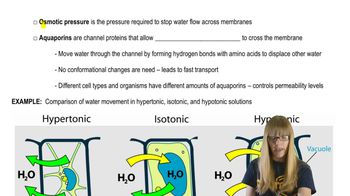
  • What role do aquaporins play in osmosis, and how do they facilitate water movement?

    Aquaporins are channel proteins that allow rapid water transport across membranes by forming hydrogen bonds with water molecules, enabling fast movement without conformational changes.
  • How do cells respond to hypertonic, hypotonic, and isotonic solutions in terms of water movement?

    In a hypertonic solution, water leaves the cell causing it to shrink; in a hypotonic solution, water enters the cell causing it to swell; in an isotonic solution, water movement is balanced and the cell remains the same size.
  • What is osmotic pressure and what does it indicate in the context of osmosis?

    Osmotic pressure is the pressure required to stop the flow of water across a semipermeable membrane, and it is determined by the solute concentration difference across the membrane.
  • What is the main difference between simple diffusion and facilitated diffusion in passive transport across cell membranes?

    Simple diffusion allows small, uncharged, non-polar molecules to move directly across the membrane, while facilitated diffusion requires transport proteins to help larger or polar molecules cross the membrane without energy input.
  • How do channel proteins and carrier proteins differ in their mechanisms during facilitated diffusion?

    Channel proteins provide a passageway for molecules to move through the membrane, whereas carrier proteins bind to the molecule and undergo a conformational change to transport it across.
  • What is osmosis and how does it relate to solute concentration across a semipermeable membrane?

    Osmosis is the diffusion of water across a semipermeable membrane from an area of low solute concentration (high water concentration) to high solute concentration (low water concentration).
  • How can osmosis be defined in cell biology?

    Osmosis is the diffusion of water across a semipermeable membrane from an area of low solute concentration (high water concentration) to an area of high solute concentration (low water concentration).
  • In which direction does water move via osmosis?

    Water moves via osmosis from an area of low solute concentration (high water concentration) to an area of high solute concentration (low water concentration).
  • What is the difference between diffusion and facilitated diffusion?

    Diffusion is the passive movement of molecules from high to low concentration without assistance, while facilitated diffusion requires transport proteins to help molecules cross the membrane.
  • How does simple diffusion differ from facilitated diffusion?

    Simple diffusion involves unassisted movement of small, uncharged, non-polar molecules across the membrane, while facilitated diffusion requires transport proteins to assist larger or charged molecules.
  • What type of solution causes a red blood cell to undergo hemolysis?

    A red blood cell will undergo hemolysis in a hypotonic solution, where water enters the cell causing it to swell and burst.
  • Does facilitated diffusion require energy input from the cell?

    No, facilitated diffusion does not require energy; it is a passive transport process.
  • How is facilitated diffusion different from simple diffusion?

    Facilitated diffusion uses transport proteins to move molecules across the membrane, while simple diffusion does not require any assistance.
  • What distinguishes diffusion from facilitated diffusion?

    Diffusion occurs without assistance, while facilitated diffusion requires transport proteins for molecules that cannot cross the membrane on their own.
  • Is facilitated diffusion considered active or passive transport?

    Facilitated diffusion is a passive transport process.
  • What does a reverse osmosis device remove from water?

    A reverse osmosis device removes solutes from water by forcing water through a semipermeable membrane, leaving solutes behind.
  • What is the force driving simple diffusion?

    The force driving simple diffusion is the concentration gradient.
  • What is the principal force driving movement in diffusion?

    The principal force driving movement in diffusion is the concentration gradient.
  • What is the difference between facilitated diffusion and simple diffusion?

    Facilitated diffusion requires transport proteins to move molecules across the membrane, while simple diffusion does not.
  • What happens to a red blood cell placed in pure water?

    A red blood cell placed in pure water (a hypotonic solution) will swell and may burst due to water entering the cell.
  • Water moves via osmosis in which direction?

    Water moves via osmosis from an area of high water concentration (low solute) to an area of low water concentration (high solute).
  • What is the difference between simple and facilitated diffusion?

    Simple diffusion does not require assistance, while facilitated diffusion uses transport proteins to help molecules cross the membrane.
  • How does simple diffusion differ from facilitated diffusion?

    Simple diffusion is unassisted, while facilitated diffusion requires channel or carrier proteins.
  • How does the concentration gradient affect the rate of diffusion?

    The greater the concentration gradient, the faster the rate of diffusion.
  • During osmosis, in which direction does water move?

    During osmosis, water moves from an area of low solute concentration to an area of high solute concentration.
  • What is the difference between simple and facilitated diffusion?

    Simple diffusion is unassisted, while facilitated diffusion requires transport proteins.
  • What happens to a red blood cell placed in a hypertonic medium?

    A red blood cell placed in a hypertonic medium will shrink as water leaves the cell.
  • How does facilitated diffusion differ from simple diffusion?

    Facilitated diffusion uses transport proteins, while simple diffusion does not.
  • What happens to a cell in an isotonic solution?

    In an isotonic solution, a cell maintains its normal shape as water moves equally in and out.
  • Which process is not a form of passive transport?

    Active transport is not a form of passive transport.
  • How is osmosis best defined?

    Osmosis is the movement of water across a semipermeable membrane from low solute concentration to high solute concentration.
  • In osmosis, water moves from an area of what concentration?

    In osmosis, water moves from an area of high water concentration (low solute) to low water concentration (high solute).
  • Is diffusion an example of passive transport?

    Yes, diffusion is an example of passive transport.
  • What is the principal force driving movement in diffusion?

    The concentration gradient is the principal force driving movement in diffusion.
  • Which process is a passive transport process?

    Diffusion, facilitated diffusion, and osmosis are passive transport processes.
  • How are simple diffusion and facilitated diffusion related?

    Both are passive transport processes that move molecules from high to low concentration.