Skip to main content
Cell Biology
My Course
Learn
Exam Prep
AI Tutor
Study Guides
Flashcards
Explore
Try the app
My Course
Learn
Exam Prep
AI Tutor
Study Guides
Flashcards
Explore
Try the app
Back
Passive Transport: Diffusion and Osmosis quiz #2
You can tap to flip the card.
What is an example of passive transport?
You can tap to flip the card.
👆
What is an example of passive transport?
Diffusion, osmosis, and facilitated diffusion are examples of passive transport.
Track progress
Control buttons has been changed to "navigation" mode.
1/39
Related flashcards
Related practice
Recommended videos
Passive Transport: Diffusion and Osmosis quiz #1
Passive Transport: Diffusion and Osmosis
40 Terms
Passive Transport: Diffusion and Osmosis quiz #3
Passive Transport: Diffusion and Osmosis
40 Terms
Passive Transport: Diffusion and Osmosis quiz #4
Passive Transport: Diffusion and Osmosis
16 Terms
Passive Transport: Diffusion and Osmosis
9. Transport Across Membranes
7 problems
Topic
Transporters
9. Transport Across Membranes
7 problems
Topic
9. Transport Across Membranes
5 topics
15 problems
Chapter
Guided course
02:29
GLUT1 Transporter
763
views
9
rank
2
comments
Guided course
04:12
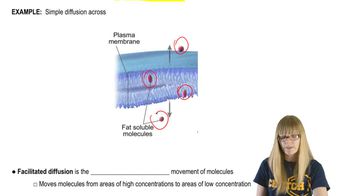
Diffusion
1153
views
11
rank
Guided course
03:15
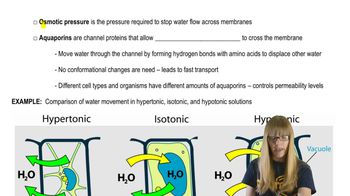
Osmosis
860
views
10
rank
1
comments
Terms in this set (39)
Hide definitions
What is an example of passive transport?
Diffusion, osmosis, and facilitated diffusion are examples of passive transport.
How does temperature affect the rate of diffusion?
Increasing temperature increases the rate of diffusion.
What happens to a cell in a hypertonic solution?
A cell in a hypertonic solution will shrink as water leaves the cell.
What does simple diffusion require?
Simple diffusion requires a concentration gradient but no energy or assistance.
Osmosis is a membrane passage process pertaining to which molecule?
Osmosis pertains to the movement of water molecules.
What is an example of passive transport?
Osmosis is an example of passive transport.
Osmosis refers to the movement of which molecule?
Osmosis refers to the movement of water molecules.
Osmosis is best defined as the movement of what?
Osmosis is best defined as the movement of water across a semipermeable membrane.
What are two variables that affect the rate of diffusion?
Temperature and concentration gradient affect the rate of diffusion.
During osmosis, how does water move?
During osmosis, water moves from low solute concentration to high solute concentration.
Describe how water moves during osmosis.
Water moves across a semipermeable membrane from an area of high water concentration to low water concentration.
When does passive transport occur?
Passive transport occurs when molecules move down their concentration gradient without energy input.
How does temperature affect the rate of diffusion?
Higher temperature increases the rate of diffusion.
Crenation takes place when a cell is placed in what type of solution?
Crenation occurs when a cell is placed in a hypertonic solution.
What happens to an Elodea cell in a hypertonic solution?
An Elodea cell in a hypertonic solution will lose water and shrink.
How do simple and facilitated diffusion differ?
Simple diffusion is unassisted, while facilitated diffusion requires transport proteins.
When does passive transport occur?
Passive transport occurs when molecules move down their concentration gradient without energy input.
What happens to an animal cell in a hypertonic solution?
An animal cell in a hypertonic solution will shrink as water leaves the cell.
How can temperature affect the rate of diffusion?
Increasing temperature increases the rate of diffusion.
The movement of water by osmosis is always from a region of what concentration?
The movement of water by osmosis is always from a region of high water concentration (low solute) to low water concentration (high solute).
Osmosis is defined as the movement of what?
Osmosis is defined as the movement of water across a semipermeable membrane.
Does temperature affect the rate of diffusion?
Yes, higher temperature increases the rate of diffusion.
Is facilitated diffusion active or passive?
Facilitated diffusion is passive.
Does osmosis refer to the diffusion of molecules across a membrane?
Osmosis refers specifically to the diffusion of water molecules across a semipermeable membrane.
What is the definition of osmosis?
Osmosis is the movement of water across a semipermeable membrane from low solute concentration to high solute concentration.
How does temperature affect the rate of diffusion?
Increasing temperature increases the rate of diffusion.
As temperature increases, what happens to the rate of diffusion?
As temperature increases, the rate of diffusion increases.
Which way will water molecules move during osmosis?
Water molecules move from an area of high water concentration to low water concentration during osmosis.
Which is an example of passive transport?
Osmosis is an example of passive transport.
What are examples of passive transport?
Diffusion, facilitated diffusion, and osmosis are examples of passive transport.
What is an example of osmosis?
Water moving across a semipermeable membrane from low solute to high solute concentration is an example of osmosis.
Which process requires no energy from the cell?
Passive transport processes such as diffusion, facilitated diffusion, and osmosis require no energy from the cell.
Which way does water move in osmosis?
Water moves from an area of high water concentration to low water concentration in osmosis.
What is the best definition of osmosis?
Osmosis is the movement of water across a semipermeable membrane from low solute concentration to high solute concentration.
Osmosis is what type of transport?
Osmosis is a passive transport process.
What process allows water to move across a cell membrane?
Osmosis allows water to move across a cell membrane.
What must water pass through during osmosis?
Water passes through aquaporin channel proteins during osmosis.
What is the diffusion of water called?
The diffusion of water is called osmosis.
What determines the direction of diffusion?
The concentration gradient determines the direction of diffusion.
 BackBack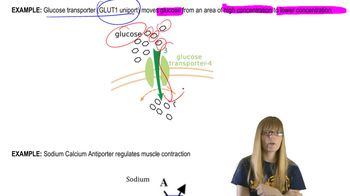
 02:29
02:29