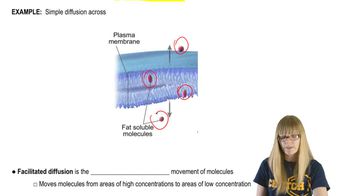
Diffusion is driven by the concentration gradient.
During osmosis, which molecules do not move across the membrane?
Solute molecules do not move across the membrane during osmosis; only water moves.
What is an example of passive transport?
Facilitated diffusion is an example of passive transport.
What is a passive transport process?
A passive transport process is one that moves molecules down their concentration gradient without energy input, such as diffusion, facilitated diffusion, or osmosis.
What is required for diffusion to occur?
A concentration gradient is required for diffusion to occur.
What two conditions must be present for osmosis to occur?
A semipermeable membrane and a difference in solute concentration across the membrane must be present for osmosis to occur.
In what direction does diffusion move?
Diffusion moves molecules from an area of high concentration to an area of low concentration.
What is crenation of a cell?
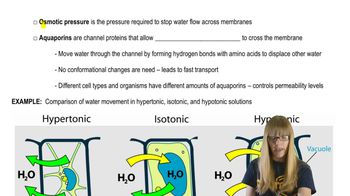
Crenation is the shrinking of a cell due to water loss when placed in a hypertonic solution.
Which organelle pumps out excess water in some cells?
The contractile vacuole pumps out excess water in some cells.
What is the driving force of diffusion?
The concentration gradient is the driving force of diffusion.
Osmosis is the movement of what molecule?
Osmosis is the movement of water molecules.
What happens to a cell in a hypotonic solution?
A cell in a hypotonic solution will swell as water enters the cell.
What is diffusion in biology?
Diffusion is the passive movement of molecules from high to low concentration.
What is the difference between osmosis and diffusion?
Osmosis is the diffusion of water across a semipermeable membrane, while diffusion refers to the movement of any molecules from high to low concentration.
What happens during osmosis?
During osmosis, water moves across a semipermeable membrane from low solute concentration to high solute concentration.
What are the types of passive transport?
The types of passive transport are simple diffusion, facilitated diffusion, and osmosis.
What are three types of passive transport?
Three types of passive transport are simple diffusion, facilitated diffusion, and osmosis.
What is passive transport?
Passive transport is the movement of molecules across a membrane without energy input, driven by concentration gradients.
What is diffusion?
Diffusion is the passive movement of molecules from an area of high concentration to an area of low concentration.
What is one example of diffusion?
Oxygen moving into a cell from high to low concentration is an example of diffusion.
What is facilitated diffusion?
Facilitated diffusion is the passive movement of molecules across a membrane with the help of transport proteins.
How is osmosis similar to simple diffusion?
Both osmosis and simple diffusion are passive processes that move molecules down their concentration gradient without energy input.
How does temperature affect diffusion?
Higher temperature increases the rate of diffusion.
How does surface area affect the rate of diffusion?
Increasing surface area increases the rate of diffusion.
How does CO2 cross the cell membrane?
CO2 crosses the cell membrane by simple diffusion.
How does water enter the cell?
Water enters the cell via osmosis through aquaporin channels.
How does molecular weight affect diffusion?
Higher molecular weight decreases the rate of diffusion.
How is osmosis different from simple diffusion?
Osmosis is the movement of water across a semipermeable membrane, while simple diffusion involves unassisted movement of small, non-polar molecules.
How are simple and facilitated diffusion different?
Simple diffusion is unassisted, while facilitated diffusion requires transport proteins.
How are simple and facilitated diffusion similar?
Both are passive processes that move molecules from high to low concentration.
How is osmosis different from diffusion?
Osmosis is specific to water movement across a semipermeable membrane, while diffusion refers to any molecule moving from high to low concentration.
How does diffusion work?
Diffusion works by molecules moving from an area of high concentration to low concentration until equilibrium is reached.
How does oxygen cross into the cell?
Oxygen crosses into the cell by simple diffusion.
How does surface area affect diffusion?
Greater surface area increases the rate of diffusion.
Facilitated diffusion is used to transport which types of molecules?
Facilitated diffusion is used to transport larger or charged molecules that cannot cross the membrane by simple diffusion.
What do diffusion and osmosis have in common?
Both are passive transport processes that move molecules down their concentration gradient without energy input.
What is the similarity between simple diffusion and facilitated diffusion?
Both move molecules from high to low concentration without energy input.
What do osmosis and diffusion have in common?
Both are passive processes that move substances down their concentration gradient.
Which best describes the difference between osmosis and diffusion?
Osmosis is the movement of water across a semipermeable membrane, while diffusion is the movement of any molecules from high to low concentration.
What is diffusion?
Diffusion is the passive movement of molecules from high to low concentration.
 Back
Back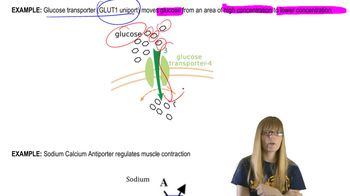
 02:29
02:29