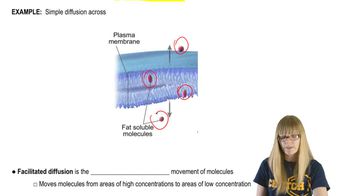
Facilitated diffusion requires transport proteins but does not require energy input.
Which choice describes diffusion?
Diffusion is the movement of molecules from high to low concentration without energy input.
What is osmosis?
Osmosis is the movement of water across a semipermeable membrane from low solute concentration to high solute concentration.
What is osmosis?
Osmosis is the passive movement of water across a semipermeable membrane.
How are osmosis and diffusion alike?
Both are passive transport processes that move substances down their concentration gradient.
How does water enter and exit a cell?
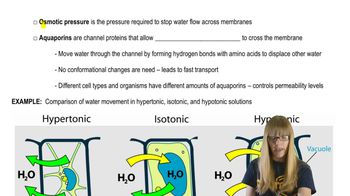
Water enters and exits a cell via osmosis through aquaporin channels.
How are osmosis and diffusion alike?
Both are passive processes that do not require energy and move substances down their concentration gradient.
How does distance affect the rate of diffusion?
Increasing distance decreases the rate of diffusion.
How does concentration gradient affect the rate of diffusion?
A steeper concentration gradient increases the rate of diffusion.
How are simple diffusion and facilitated diffusion similar?
Both are passive processes that move molecules from high to low concentration.
How can distance affect the rate of diffusion?
Greater distance slows the rate of diffusion.
What is passive transport?
Passive transport is the movement of molecules across a membrane without energy input, driven by concentration gradients.
What does passive transport mean?
Passive transport means moving substances across a membrane without energy input.
What are three types of passive transport?
Three types of passive transport are simple diffusion, facilitated diffusion, and osmosis.
What happens to a cell if it takes in too much water?
If a cell takes in too much water, it may swell and burst (hemolysis).
Why is diffusion important to cells?
Diffusion is important to cells because it allows for the passive movement of essential molecules like oxygen and nutrients into the cell and waste products out.
 Back
Back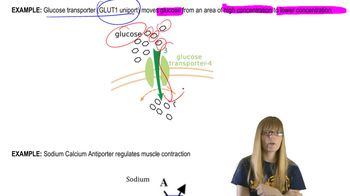
 02:29
02:29