Pearson+ LogoPearson+ Logo

Properties of the Cell quiz #1 Flashcards

Back
Properties of the Cell quiz #1
Control buttons has been changed to "navigation" mode.
1/40
  • How did the diversity of life on Earth arise from a single ancestral cell, and what are the three domains of life that resulted from this evolution?

    The diversity of life arose from a single ancestral cell through mutations in DNA, which drove evolution. This led to the formation of three domains: Archaea, Bacteria, and Eukarya.
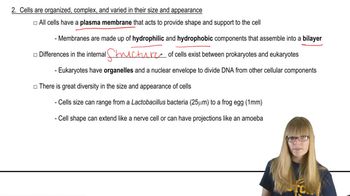
  • What structural feature is common to all cells, and how do prokaryotic and eukaryotic cells differ in their internal organization?

    All cells have a plasma membrane. Prokaryotic cells lack internal organelles and a nuclear envelope, while eukaryotic cells have organelles and a nuclear envelope that separates DNA from the rest of the cell.
  • What is the central dogma of molecular biology, and how do cells control gene expression to create different cell types in multicellular organisms?

    The central dogma is the process where DNA is transcribed to RNA and then translated to protein. Cells control gene expression by regulating which genes are transcribed and translated, allowing different cell types to arise from the same genome.
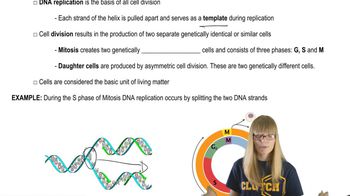
  • Why is cell replication important, and what are the two main processes by which cells divide?

    Cell replication is essential for growth and reproduction. The two main processes are mitosis, which produces genetically identical cells, and meiosis, which produces genetically diverse cells.
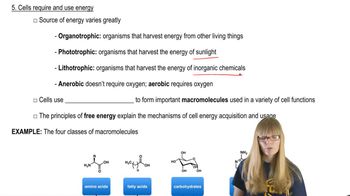
  • What are the main ways cells obtain energy, and why is energy necessary for the synthesis of macromolecules?

    Cells obtain energy as organotrophs (from organic molecules), phototrophs (from sunlight), or lithotrophs (from inorganic chemicals). Energy is required to synthesize macromolecules like proteins and nucleic acids.
  • What is metabolism, and what role does ATP play in cellular metabolic processes?

    Metabolism is the sum of all chemical reactions in a cell. ATP acts as the main energy storage molecule, providing energy for metabolic pathways and enzyme-catalyzed reactions.
  • How do cells transport materials and maintain appropriate size, and what is the significance of the surface area to volume ratio?

    Cells transport materials via diffusion and membrane proteins. The surface area to volume ratio is important because as cells grow, their volume increases faster than surface area, affecting transport efficiency and limiting cell size.
  • How do cells respond to external stimuli, and what role do membrane receptors play in this process?

    Cells respond to external stimuli using receptors on their plasma membrane, which detect signals and trigger internal chemical reactions necessary for survival.
  • What is self-regulation in cells, and how does feedback circuitry contribute to cellular stability?

    Self-regulation is the ability of cells to maintain internal stability. Feedback circuitry helps regulate chemical reactions by adjusting them based on the levels of signaling molecules, ensuring proper cellular function.
  • How did the diversity of life on Earth arise from a single ancestral cell, and what are the three domains of life that resulted from this evolution?

    The diversity of life arose from a single ancestral cell through mutations in DNA, which drove evolution. This led to the formation of three domains: Archaea, Bacteria, and Eukarya.
  • What are the three major parts of a typical cell?

    The three major parts of a cell are the plasma membrane, the cytoplasm, and the nucleus.
  • What is the jelly-like substance found inside cells called?

    The jelly-like substance inside cells is called cytoplasm.
  • What is the term for everything inside the cell, including the nucleus?

    Everything inside the cell, including the nucleus, is referred to as protoplasm.
  • True or false: All cells have a cell membrane.

    True. All cells have a plasma membrane (cell membrane).
  • A fertilized egg cell is considered what type of cell?

    A fertilized egg cell is considered a zygote.
  • What are multicellular heterotrophs without a cell wall called?

    Multicellular heterotrophs without a cell wall are animals.
  • What is the fluid portion of the cell outside the nucleus called?

    The fluid portion of the cell outside the nucleus is called cytoplasm.
  • What is the liquid portion of the cell called?

    The liquid portion of the cell is called cytoplasm.
  • What is the clear gel inside a cell called?

    The clear gel inside a cell is called cytoplasm.
  • What is the largest cell in the human body?

    The largest cell in the human body is the egg cell (ovum).
  • What is the main component of the cell wall in fungi?

    The cell wall of fungi is mainly made up of chitin.
  • List the three major parts of a cell.

    The three major parts of a cell are the plasma membrane, cytoplasm, and nucleus.
  • What is the main function of the cell wall?

    The main function of the cell wall is to provide structural support and protection to the cell.
  • What is the gel-like substance in a cell called?

    The gel-like substance in a cell is called cytoplasm.
  • What is the semifluid medium within a cell called?

    The semifluid medium within a cell is called cytoplasm.
  • What is the watery material that contains cell organelles?

    The watery material that contains cell organelles is cytoplasm.
  • What is the biggest cell in the human body?

    The biggest cell in the human body is the egg cell (ovum).
  • What subatomic particles are found in the nucleus of an atom?

    The nucleus of an atom contains protons and neutrons.
  • What are the two major parts of a cell?

    The two major parts of a cell are the plasma membrane and the cytoplasm (sometimes the nucleus is considered the third major part).
  • What is the largest cell?

    The largest cell in animals is the egg cell (ovum); in general, some single-celled organisms like frog eggs are also very large.
  • What happens when a cell lyses?

    When a cell lyses, its plasma membrane ruptures, causing the contents of the cell to spill out.
  • What do you call the gooey liquid in a cell?

    The gooey liquid in a cell is called cytoplasm.
  • What is the purpose of the cell wall?

    The purpose of the cell wall is to provide structural support and protection to the cell.
  • What are the cell walls of fungi made of?

    The cell walls of fungi are made of chitin.
  • What is the shape of a red blood cell?

    A red blood cell has a biconcave disc shape.
  • What composes the cell wall of fungi?

    The cell wall of fungi is composed of chitin.
  • What makes up the cell wall of fungi?

    The cell wall of fungi is made up of chitin.
  • What are two major parts of the cell?

    The two major parts of the cell are the plasma membrane and the cytoplasm (the nucleus is often considered the third part).
  • What is the lifespan of a red blood cell?

    The average lifespan of a red blood cell is about 120 days.
  • What are fungal cell walls made of?

    Fungal cell walls are made of chitin.