Skip to main content
Cell Biology
My Course
Learn
Exam Prep
AI Tutor
Study Guides
Flashcards
Explore
Try the app
My Course
Learn
Exam Prep
AI Tutor
Study Guides
Flashcards
Explore
Try the app
Back
Stem Cells definitions
You can tap to flip the card.
Stem Cell
You can tap to flip the card.
👆
Stem Cell
An undifferentiated cell with the ability to self-renew and generate specialized cell types required for tissue growth and repair.
Track progress
Control buttons has been changed to "navigation" mode.
1/14
Related flashcards
Related practice
Recommended videos
Stem Cells quiz #1
Stem Cells
17 Terms
Stem Cells
19. Stem Cells
6 problems
Topic
19. Stem Cells
1 topic
3 problems
Chapter
Guided course
09:49
Stem Cells
500
views
6
rank
1
comments
Terms in this set (14)
Hide definitions
Stem Cell
An undifferentiated cell with the ability to self-renew and generate specialized cell types required for tissue growth and repair.
Differentiated Cell
A cell with a specific structure and function, such as a skin or retinal cell, formed from the process of specialization.
Self-Renewal
A process where a cell divides to produce one identical cell and one specialized cell, maintaining the stem cell pool.
Niche
A specialized microenvironment within tissues where undifferentiated cells reside and maintain their unique properties.
Embryonic Stem Cell
A pluripotent cell derived from an embryo, capable of forming any cell type within the developing organism.
Pluripotency
The capacity of a cell to differentiate into nearly all cell types of the body, excluding extraembryonic tissues.
Totipotency
The ability of a cell to generate all cell types, including both embryonic and placental tissues.
Zygote
The initial cell formed by the fusion of egg and sperm, possessing the potential to develop into an entire organism.
Induced Pluripotent Stem Cell
A cell reprogrammed from an adult state to a pluripotent state using specific proteins, enabling tissue regeneration.
Progenitor Cell
A partially specialized cell with limited potential, giving rise to a few related cell types within a tissue.
Hematopoietic Stem Cell
A progenitor cell located in bone marrow, responsible for generating all types of blood cells.
Neuronal Stem Cell
A progenitor cell dedicated to producing neurons, supporting nervous system development and repair.
Mitosis
A cell division process resulting in two daughter cells, crucial for self-renewal and tissue maintenance.
Somatic Cell
A non-reproductive cell of the body, such as a skin cell, which can be reprogrammed into a pluripotent state.
 BackBack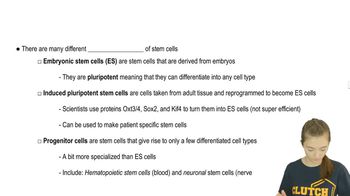
 09:49
09:49