Back

Mitochondria Structure and Function

Control buttons has been changed to "navigation" mode.
1/17
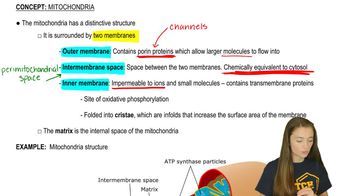
  • How many membranes surround the mitochondria?

    two membranes: an outer membrane and an inner membrane.

  • What is the function of the outer mitochondrial membrane?

    contains porin proteins which allow larger molecules to flow into the mitochondria.

  • What is the intermembrane space in mitochondria?

    is the space between the two membranes and is chemically equivalent to the cytosol.

  • What are the characteristics of the inner mitochondrial membrane?

    is impermeable to ions and small molecules and contains transmembrane proteins. It is the site of oxidative phosphorylation.

  • What are cristae in mitochondria?

    infolds of the inner membrane that increase the surface area of the membrane.

  • What is the mitochondrial matrix?

    is the internal space of the mitochondria.

  • Where does oxidative phosphorylation occur in mitochondria?

    occurs at the inner mitochondrial membrane.

  • Can mitochondria move within the cell?

    Yes, mitochondria can remain fixed or move throughout the cell by traveling on microtubules.
  • Can mitochondria fuse together?

    Yes, mitochondria can fuse to form long tubular networks.
  • Do mitochondria have their own DNA?

    Yes, mitochondria have their own circular DNA genome encoding 13 polypeptides, 22 tRNAs, and 2 rRNAs.
  • What kind of ribosomes do mitochondria have?

    Mitochondria have their own ribosomes located within the mitochondrial matrix.
  • Match the outer membrane with its definition.

    Contains porin proteins which allow larger molecules to flow into the mitochondria.
  • Match the intermembrane space with its definition.

    Space between the two membranes, chemically equivalent to cytosol.
  • Match the inner membrane with its definition.

    Impermeable to ions and small molecules; site of oxidative phosphorylation.
  • Match cristae with its definition.

    Infolds of the inner membrane that increase surface area.
  • Match the matrix with its definition.

    Internal space of the mitochondria.
  • True or False: Mitochondria always exist as distinct organelles and never fuse.

    False. Mitochondria can fuse together to form tubular networks.