 Back
BackCH 1 - A Preview of Cell Biology: Foundations, Microscopy, and the Emergence of Modern Cell Biology
Study Guide - Smart Notes
 Tailored notes based on your materials, expanded with key definitions, examples, and context.
Overview of Cell Biology
Cell biology is the study of cells, the fundamental units of life. This discipline explores the structure, function, and dynamic changes of cells, integrating knowledge from cytology, genetics, and biochemistry. Advances in microscopy and molecular techniques have propelled cell biology into a central position in modern biological sciences.
The Historical Foundations of Cell Biology
Early Microscopy and the Discovery of Cells
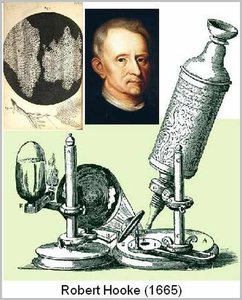
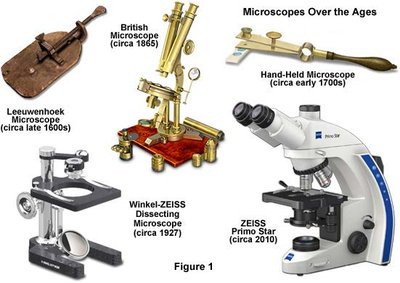
The invention and refinement of the microscope were pivotal in the development of cell biology. In 1665, Robert Hooke observed cork tissue and coined the term "cell" to describe the box-like structures he saw. Early progress in cell biology was limited by the resolution and resolving power of available microscopes, but by the 1830s, compound microscopes enabled the visualization of structures as small as 1 micrometer.
The Cell Theory
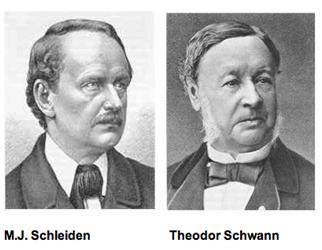
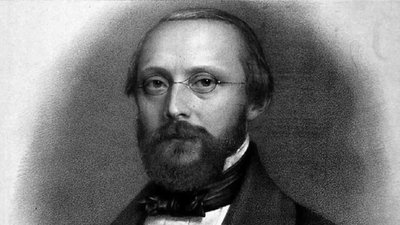
The cell theory, formulated in the 19th century, is a cornerstone of biology. German scientists Matthias Schleiden and Theodor Schwann proposed that all organisms are composed of one or more cells and that the cell is the basic unit of structure for all organisms. Later, Rudolf Virchow added that all cells arise from preexisting cells. This theory applies universally to all living organisms.
Principle 1: All living things are composed of cells.
Principle 2: The cell is the basic unit of structure and function in living things.
Principle 3: All cells arise from preexisting cells.
Modern Cell Biology: Three Interwoven Strands
Modern cell biology integrates three major strands of inquiry: cytology (cell structure), biochemistry (cellular chemistry), and genetics (heredity and information flow). These disciplines have converged to provide a comprehensive understanding of cellular processes.
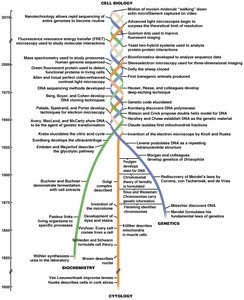
Cytology: The Study of Cellular Structure
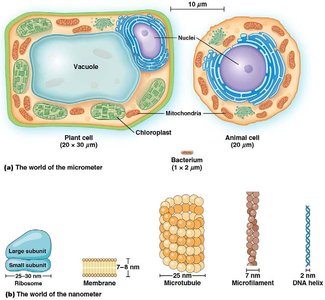
Cytology focuses on the structure and organization of cells. It involves measuring cellular dimensions and using various microscopy techniques to visualize cells and their components.
Micrometer (μm): 10-6 meters; used for measuring cells.
Nanometer (nm): 10-9 meters; used for subcellular organelles.
Angstrom (Å): 0.1 nm; used for molecules like DNA, RNA, and proteins.
Microscopy Techniques in Cytology
Microscopy is essential for studying cells. Key developments include:
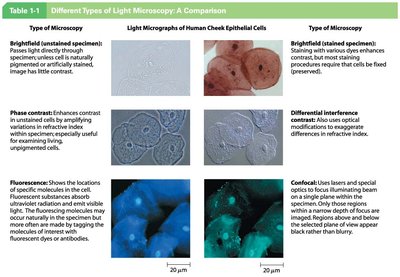
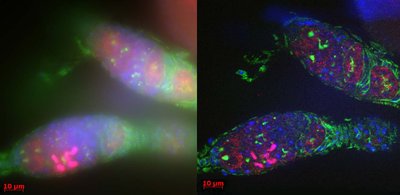
Light Microscopy: Uses visible light to observe cells; includes brightfield, phase-contrast, differential interference contrast, fluorescence, and confocal microscopy.
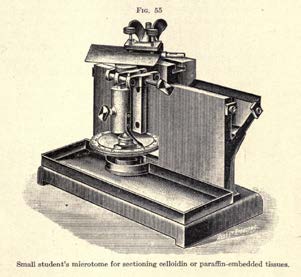
Microtome: Device for slicing thin sections of specimens for microscopy.
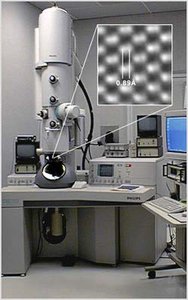
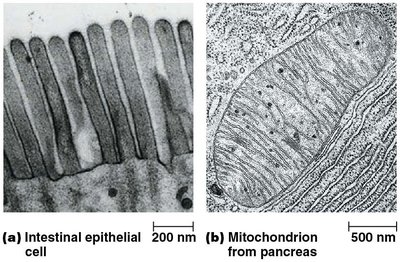
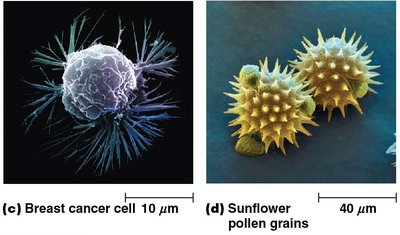
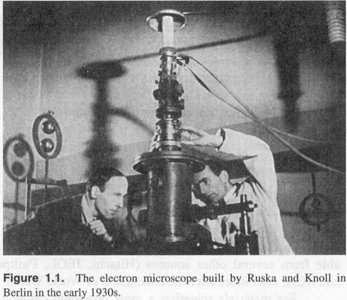
Electron Microscopy: Uses electron beams for much higher resolution than light microscopy. Includes transmission electron microscopy (TEM) and scanning electron microscopy (SEM).
Biochemistry: The Chemistry of Life
Biochemistry examines the chemical processes within cells, including the structure and function of biological molecules and the pathways of cellular metabolism. Key historical milestones include the synthesis of urea, the discovery of fermentation, and the elucidation of metabolic pathways.
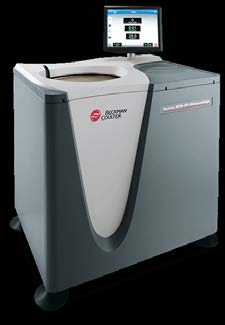
Subcellular Fractionation: Uses centrifugation to separate cellular components.
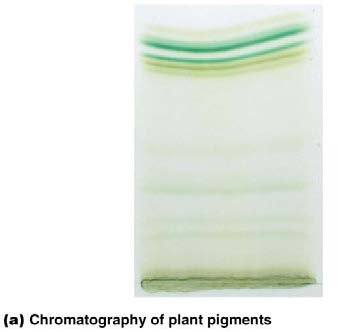
Chromatography: Separates molecules based on size, charge, or affinity.
Electrophoresis: Separates proteins, DNA, or RNA by size and charge in an electric field.
Mass Spectrometry: Determines the size and composition of proteins.
Genetics: Information Flow and Heredity
Genetics explores how hereditary information is transmitted and expressed. Classical genetics began with Mendel's work on inheritance, followed by the discovery of chromosomes and the chromosome theory of heredity. Molecular genetics advanced with the discovery of DNA's structure and the central dogma of molecular biology.
Chromosome Theory: Genes are located on chromosomes.
Central Dogma: Information flows from DNA to RNA to protein.
Key Techniques: Recombinant DNA technology, DNA sequencing, and bioinformatics (including transcriptomics, proteomics, metabolomics, etc.).
Scientific Method and Model Systems in Cell Biology
The scientific method underpins discoveries in cell biology. Model systems, such as cell cultures and well-characterized organisms, are essential for experimental studies. These systems allow researchers to investigate cellular processes, disease mechanisms, and genetic functions in controlled environments.
Summary Table: Major Microscopy Techniques
Type of Microscopy | Principle | Application |
|---|---|---|
Brightfield | Light passes through specimen | General cell observation |
Phase-contrast | Enhances contrast in unstained cells | Live cell imaging |
Fluorescence | Uses fluorescent dyes or proteins | Localization of specific molecules |
Confocal | Laser scanning for optical sections | High-resolution, 3D imaging |
Electron (TEM/SEM) | Electron beams for high resolution | Ultrastructure of cells and organelles |
Key Terms and Concepts
Cell: The basic structural and functional unit of life.
Microscopy: Techniques for visualizing cells and their components.
Biochemistry: Study of chemical processes in living organisms.
Genetics: Study of heredity and information flow in cells.
Model Organism: A species extensively studied to understand biological processes.
