 Back
BackActive Transport and Energetics of Membrane Transport in Cells
Study Guide - Smart Notes
 Tailored notes based on your materials, expanded with key definitions, examples, and context.
Active Transport: Protein-Mediated Movement Up the Gradient
Overview of Active Transport
Active transport is a fundamental cellular process that enables the movement of solutes against their concentration gradients, away from equilibrium. Unlike facilitated diffusion, which only allows movement down a gradient, active transport requires energy and exhibits intrinsic directionality.
Facilitated diffusion: Moves molecules down a concentration gradient, toward equilibrium.
Active transport: Moves solutes up a concentration gradient, away from equilibrium, requiring energy input.
Diffusion: Nondirectional; active transport: Directional.
Coupling of Active Transport to Energy Sources
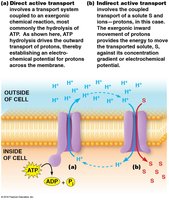
Active transport can be directly or indirectly coupled to energy sources. Direct active transport uses ATP hydrolysis, while indirect active transport relies on ion gradients established by primary pumps.
Direct active transport: Driven by ATP hydrolysis.
Indirect active transport: Driven by ion gradients (e.g., Na+ or H+).
Types of Transport ATPases
Classification of Transport ATPases
Four major types of transport ATPases are responsible for direct active transport, each with distinct structure, mechanism, and cellular roles.
P-type ATPases: Includes the Na+/K+ pump.
V-type ATPases: Proton pumps in organelles (vacuoles, lysosomes, etc.).
F-type ATPases: Proton pumps, includes ATP synthases; reversible.
ABC-type ATPases: Diverse substrate transporters.
V-Type ATPases
V-type ATPases pump protons into organelles, maintaining acidic environments necessary for cellular function. They consist of an integral membrane component and a peripheral component.
Found in vacuoles, vesicles, lysosomes, endosomes, and Golgi complex.
Two multisubunit components: membrane-embedded and peripheral.
Direct Active Transport: The Na+/K+ Pump
Maintaining Electrochemical Ion Gradients
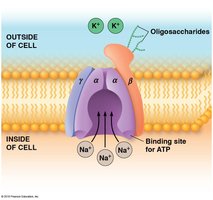
The Na+/K+ ATPase is essential for maintaining ion gradients across the plasma membrane of animal cells, which are crucial for nerve impulse transmission and coupled transport.
Typical mammalian neuron: [K+] inside/[K+] outside ≈ 30:1; [Na+] inside/[Na+] outside ≈ 0.08:1.
Electrochemical potentials drive coupled transport and nerve impulses.
Energy is required to pump both Na+ and K+ against their gradients.
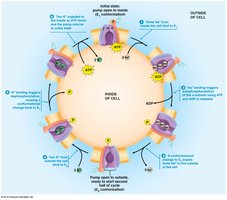
Na+/K+ ATPase uses ATP hydrolysis to drive transport.
Allosteric Nature of the Na+/K+ Pump
The Na+/K+ pump alternates between two conformational states, E1 and E2, each with distinct ion affinities.
E1 conformation: Open to the inside, high affinity for Na+.
E2 conformation: Open to the outside, high affinity for K+.
Indirect Active Transport (Secondary Active Transport)
Mechanism and Importance
Indirect active transport utilizes ion gradients, often established by primary pumps, to drive the uptake of other molecules against their gradients. This process is not directly powered by ATP hydrolysis.
Inward transport of molecules is coupled to inward movement of Na+ (animals) or H+ (plants, fungi, bacteria).
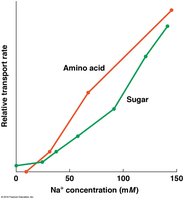
High extracellular Na+ concentration drives uptake of sugars and amino acids.
ATP is indirectly involved via the primary pump maintaining the ion gradient.
Sodium Symport and Glucose Uptake
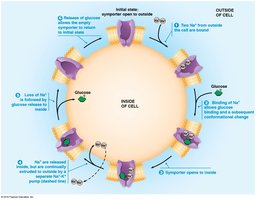
Some cells, such as those lining the intestine, use Na+/glucose symporters to import glucose and amino acids even when their concentrations are lower outside the cell.
Na+/glucose symporter couples glucose uptake to Na+ influx.
Allows cells to accumulate glucose against its concentration gradient.
The Energetics of Transport
Energy Transactions in Transport
Every transport event in the cell is an energy transaction. The free energy change (ΔG) determines whether transport is energetically favorable or requires input.
For uncharged solutes: Only concentration gradient matters.
For charged solutes: Both concentration gradient and electrical potential are relevant.
ΔG for Uncharged Solutes
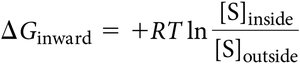
The free energy change for inward transport of uncharged solutes depends solely on the concentration gradient across the membrane.
If [S] inside < [S] outside, ΔG is negative (exergonic).
If [S] inside > [S] outside, ΔG is positive (endergonic).
Formula:
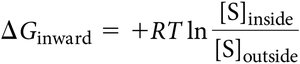
Example: Lactose Uptake in Bacteria
Calculating the energy requirement for inward transport of lactose when internal concentration is 10 mM and external is 0.20 mM.
ΔG for Charged Solutes: Electrochemical Potential
Role of Membrane Potential
For charged solutes, the membrane potential (Vm) must be considered in addition to the concentration gradient. Vm is usually negative, favoring inward movement of cations and opposing their outward movement.
Effect of electrical potential calculated as .
z = charge of solute; F = Faraday constant; Vm = membrane potential.
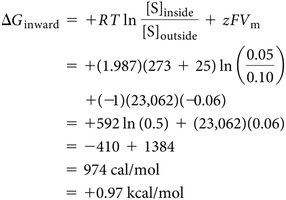
Formula:

Example: Chloride Ion Uptake
For a nerve cell with [Cl–] inside = 50 mM, [Cl–] outside = 100 mM, and Vm = –60 mV, both concentration and charge gradients must be considered to determine energy requirement for import.
Summary Table: Types of Active Transport
Type | Energy Source | Example | Mechanism |
|---|---|---|---|
Direct Active Transport | ATP hydrolysis | Na+/K+ pump | ATPase directly moves ions |
Indirect Active Transport | Ion gradient (Na+, H+) | Na+/glucose symporter | Coupled transport using ion gradient |
Additional info: The notes above expand on the original content by providing definitions, formulas, and examples, ensuring completeness and academic quality for cell-biology students.
