 Back
Aerobic Respiration and Energy Metabolism in Eukaryotic Cells
Study Guide - Smart Notes
 Tailored notes based on your materials, expanded with key definitions, examples, and context.
Aerobic Respiration: Overview
The Fate of Pyruvate
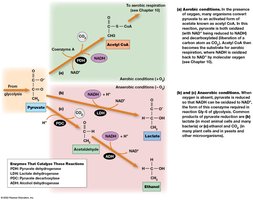
Pyruvate, the end product of glycolysis, has different metabolic fates depending on the presence or absence of oxygen. In aerobic conditions, pyruvate is transported into the mitochondria and converted to acetyl-CoA, entering the citric acid cycle. In anaerobic conditions, pyruvate undergoes fermentation to regenerate NAD+ for glycolysis.
Aerobic conditions: Pyruvate is oxidized to acetyl-CoA, producing NADH and CO2.
Anaerobic conditions: Pyruvate is reduced to lactate (in animals) or ethanol (in yeast), regenerating NAD+.
Energy yield: Aerobic respiration yields much more ATP than fermentation due to complete oxidation of glucose.
What Is Aerobic Respiration?
Definition and Key Features
Aerobic respiration is the complete oxidation of glucose to CO2 and H2O using oxygen as the final electron acceptor. This process occurs in the mitochondria of eukaryotic cells and involves several integrated metabolic pathways.
External electron acceptor: Oxygen (O2).
By-product: Water (H2O).
Stages of Aerobic Respiration
Major Steps
Aerobic respiration consists of five main stages, each contributing to the efficient extraction of energy from glucose.
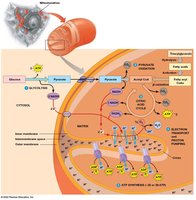
Glycolysis: Breakdown of glucose to pyruvate in the cytosol.
Generation of Acetyl CoA: Pyruvate is converted to acetyl-CoA in the mitochondrial matrix.
Krebs Cycle (Citric Acid Cycle): Acetyl-CoA is oxidized, producing NADH, FADH2, and CO2.
Electron Transport Chain (ETC): Electrons from NADH and FADH2 are transferred through protein complexes, creating a proton gradient.
Oxidative Phosphorylation: ATP is synthesized as protons flow back into the matrix through ATP synthase.
Cellular Location of Aerobic Respiration
Mitochondrial Structure and Function
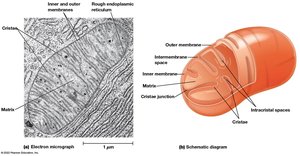
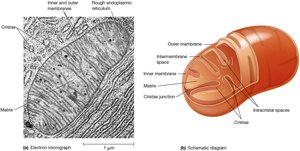
The mitochondrion is the site of aerobic respiration in eukaryotic cells. Its double-membrane structure creates distinct compartments for different metabolic processes.
Outer membrane: Permeable to small molecules.
Inner membrane: Contains the electron transport chain and ATP synthase; highly folded into cristae to increase surface area.
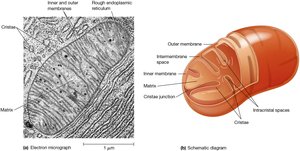
Matrix: Contains enzymes for the citric acid cycle, mitochondrial DNA, and ribosomes.
Mitochondrial Inner Membrane
The inner membrane is the site of the electron transport chain and oxidative phosphorylation. Its extensive folding (cristae) increases the surface area for these processes.
Mitochondrial Matrix
Contents and Functions
The matrix contains the enzymes of the citric acid cycle, mitochondrial DNA, ribosomes, and other molecules necessary for energy metabolism and mitochondrial gene expression.
Transport into the Mitochondria
Protein Import Mechanisms
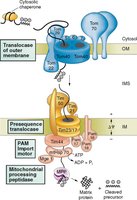
Proteins destined for the mitochondria are synthesized in the cytosol and imported via specialized translocase complexes.
Transit sequences/peptides: Direct proteins to mitochondria.
TOM complex: Translocase of the outer membrane.
TIM complex: Translocase of the inner membrane.
Comparison: Eukaryotic vs. Prokaryotic Respiration
Respiration in Bacteria
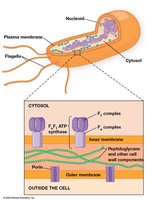
In bacteria, aerobic respiration occurs across the plasma membrane, as they lack mitochondria. The principles of electron transport and ATP synthesis are conserved.
Conversion of Pyruvate to Acetyl CoA
Oxidative Decarboxylation
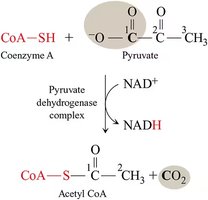
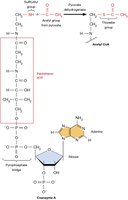
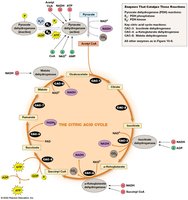
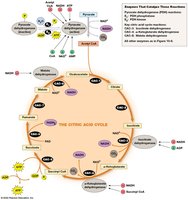
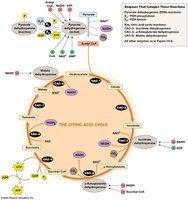
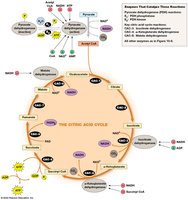
Pyruvate is converted to acetyl-CoA by the pyruvate dehydrogenase complex, producing NADH and CO2. This reaction links glycolysis to the citric acid cycle.
Coenzyme A: Contains pantothenic acid (vitamin B5) and a reactive thiol group that forms thioester bonds with acyl groups.
The Citric Acid Cycle (Krebs Cycle)
Overview and Steps
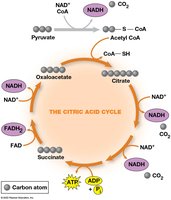
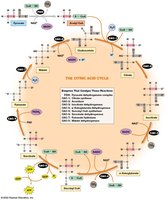
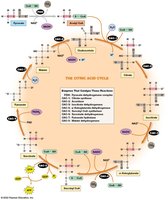
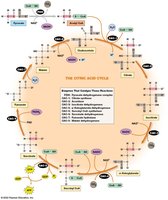
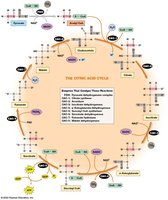
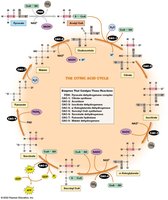
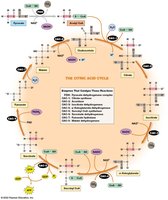
The citric acid cycle is a series of enzyme-catalyzed reactions that oxidize acetyl-CoA to CO2, generating NADH, FADH2, and GTP/ATP. It occurs in the mitochondrial matrix.
Start: Acetyl-CoA (2C) combines with oxaloacetate (4C) to form citrate (6C).
Key products per turn: 3 NADH, 1 FADH2, 1 GTP/ATP, 2 CO2.
Regeneration: Oxaloacetate is regenerated at the end of the cycle.
Key Reactions and Regulation
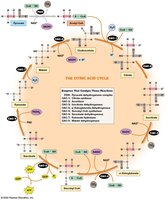
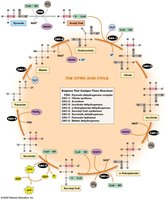
Oxidative decarboxylations: Steps that release CO2 and reduce NAD+ to NADH.
Substrate-level phosphorylation: Direct generation of GTP/ATP.
Regulation: Allosteric control of key enzymes (e.g., isocitrate dehydrogenase, α-ketoglutarate dehydrogenase).
Summary Table: Citric Acid Cycle Products
Step | Product(s) |
|---|---|
Glycolysis | 2 ATP, 2 NADH |
Pyruvate Decarboxylation | 2 NADH |
Citric Acid Cycle (per glucose) | 2 ATP/GTP, 6 NADH, 2 FADH2 |
Regulation of the Citric Acid Cycle
Allosteric Regulation
The citric acid cycle is tightly regulated by allosteric effectors and covalent modification of key enzymes.
Pyruvate dehydrogenase: Inhibited by acetyl-CoA, NADH, ATP; activated by CoA, NAD+, AMP.
Isocitrate dehydrogenase: Inhibited by NADH; activated by ADP.
α-Ketoglutarate dehydrogenase: Inhibited by NADH, succinyl-CoA.
Malate dehydrogenase: Regulated by NADH/NAD+ ratio.
Other Sources of Energy: Fats and Proteins
Fatty Acid Oxidation (Beta-Oxidation)
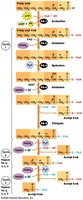
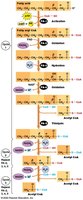
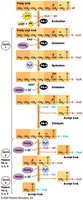
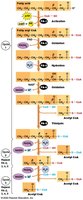
Fatty acids are broken down in the mitochondria by beta-oxidation, generating acetyl-CoA, NADH, and FADH2. Glycerol from fats enters glycolysis.
Protein Catabolism
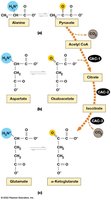
Proteins are hydrolyzed to amino acids, which are deaminated and converted to intermediates of glycolysis or the citric acid cycle.
Electron Transport Chain (ETC) and Oxidative Phosphorylation
Coenzyme Oxidation and Electron Carriers
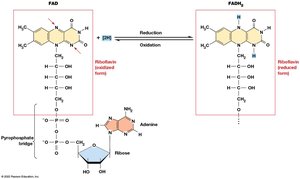
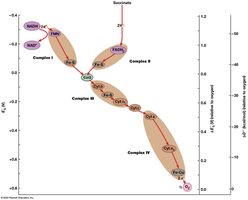
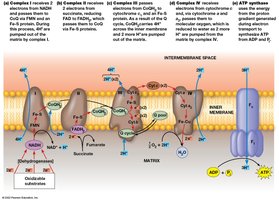
Electrons from NADH and FADH2 are transferred through a series of protein complexes in the inner mitochondrial membrane, ultimately reducing oxygen to water. This process pumps protons into the intermembrane space, creating a proton gradient.
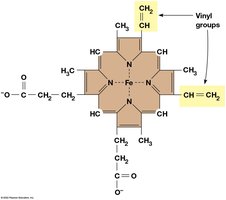
Electron carriers: Include flavoproteins, iron-sulfur proteins, coenzyme Q (ubiquinone), and cytochromes.
Reduction potential: Determines the direction of electron flow; electrons move from lower to higher reduction potential.
Organization and Function of the ETC
The ETC consists of four main complexes (I-IV) and two mobile carriers (CoQ and cytochrome c). Electron flow through these complexes is coupled to proton pumping.
Complex I: NADH to CoQ, pumps 4 protons.
Complex II: FADH2 to CoQ, no protons pumped.
Complex III: CoQ to cytochrome c, pumps 4 protons.
Complex IV: Cytochrome c to O2, pumps 2 protons.
ATP Synthesis: Chemiosmotic Coupling
Proton Motive Force and ATP Synthase
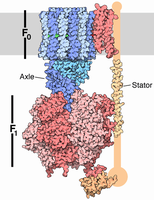
The proton gradient generated by the ETC drives ATP synthesis via ATP synthase, a complex enzyme with F0 (membrane-embedded) and F1 (matrix-facing) components.
F0: Forms a proton channel, rotates as protons flow through.
F1: Catalyzes ATP synthesis from ADP and Pi.
ATP Yield from Aerobic Respiration
Summary Table: ATP Production
Process | ATP Yield (per glucose) |
|---|---|
Glycolysis | 2 |
Citric Acid Cycle | 2 |
Oxidative Phosphorylation (from NADH/FADH2) | ~34 |
Total | ~38 |
Key Equations
Overall reaction for aerobic respiration:
ATP yield from NADH and FADH2:
Free energy change for electron transfer:
where = number of electrons transferred, = Faraday constant, = change in reduction potential.
Conclusion
Aerobic respiration is a highly efficient process for extracting energy from glucose, involving coordinated pathways in the mitochondria. The integration of glycolysis, the citric acid cycle, and oxidative phosphorylation allows cells to maximize ATP production, supporting cellular activities and life processes.
