 Back
BackCh 10a: Aerobic Respiration: Chemotropic Energy Metabolism in Eukaryotic Cells
Study Guide - Smart Notes
 Tailored notes based on your materials, expanded with key definitions, examples, and context.
Chapter 10: Chemotropic Energy Metabolism – Aerobic Respiration
Learning Objectives
Describe the structure and function of mitochondria in eukaryotic cells and compare with prokaryotic respiration.
Explain the steps of aerobic respiration: glycolysis, pyruvate oxidation, the citric acid cycle, electron transport, proton pumping, and ATP synthesis.
Discuss the role of the electron transport chain and chemiosmosis in ATP production.
Quantify ATP yield at each stage and distinguish between substrate-level and oxidative phosphorylation.
Describe the creation and function of the proton gradient in mitochondria.
Cellular Respiration: Maximizing ATP Yields
Overview of Aerobic Respiration
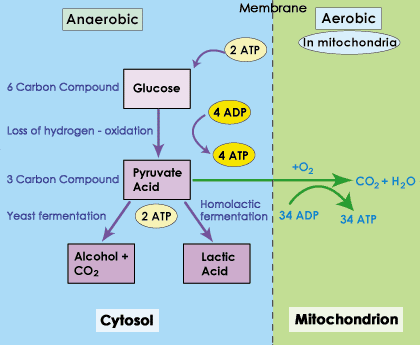
Aerobic respiration enables cells to extract maximal free energy from organic substrates (such as glucose, fats, and proteins) by using molecular oxygen as the terminal electron acceptor. This process is far more efficient than fermentation, allowing for the complete oxidation of glucose to carbon dioxide and water.
Fermentation yields only a small amount of ATP per glucose molecule.
Aerobic respiration yields much more ATP due to the complete oxidation of substrates.
Oxygen acts as the final electron acceptor in the electron transport chain (ETC).
The Mitochondrion: Structure and Function
Mitochondrial Structure
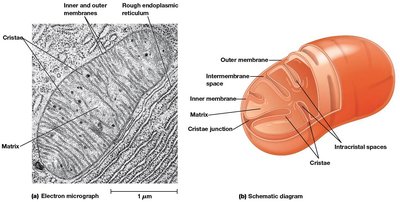
Mitochondria are the primary sites of aerobic respiration in eukaryotic cells. They are especially abundant in cells with high energy demands. Mitochondria may exist as discrete organelles or as interconnected networks.
Surrounded by a double membrane: an outer membrane (freely permeable due to porins) and an inner membrane (selectively permeable, containing specific transporters).
The inner membrane is highly folded into cristae, increasing surface area for respiratory complexes and ATP synthase.
The matrix contains enzymes for the citric acid cycle and fatty acid oxidation.
Transport and Protein Import in Mitochondria
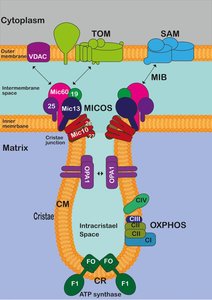
Many mitochondrial proteins are encoded by nuclear DNA, synthesized in the cytosol, and imported into mitochondria via translocator complexes (TOMs and TIMs). These proteins often have an N-terminal transit sequence for targeting.
Stages of Aerobic Respiration
Glycolysis and Pyruvate Oxidation
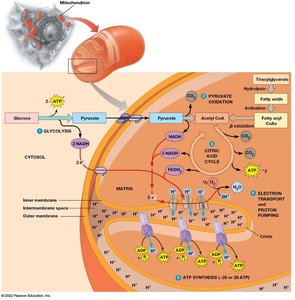
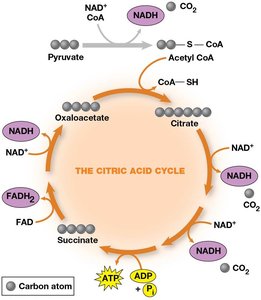
Glycolysis occurs in the cytosol, breaking down glucose into pyruvate. Pyruvate is transported into the mitochondrial matrix, where it is oxidatively decarboxylated to acetyl CoA, releasing CO2 and generating NADH.
Glycolysis: Glucose (6C) → 2 Pyruvate (3C) + 2 ATP + 2 NADH
Pyruvate oxidation: Pyruvate → Acetyl CoA + CO2 + NADH
The Citric Acid Cycle (TCA/Krebs Cycle)
Acetyl CoA enters the citric acid cycle, where it is fully oxidized to CO2. The cycle generates NADH, FADH2, and ATP (or GTP), and provides intermediates for other metabolic pathways.
Key steps: Acetyl CoA + Oxaloacetate → Citrate → Succinate → Oxaloacetate
Products per turn: 3 NADH, 1 FADH2, 1 ATP (or GTP), 2 CO2
Regulation: NADH, ATP, and acetyl CoA inhibit; NAD+, AMP, ADP, and CoA activate.
Catabolism of Fats and Proteins
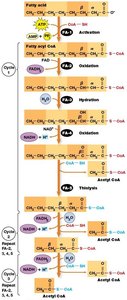
Fats are broken down by β-oxidation in the mitochondrial matrix, generating acetyl CoA for the citric acid cycle. Proteins are degraded to amino acids, which are converted to intermediates of glycolysis or the citric acid cycle.
Anabolic Roles of the Citric Acid Cycle
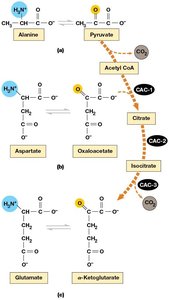
Several citric acid cycle intermediates serve as precursors for biosynthetic pathways, including amino acid and heme synthesis. In plants, acetyl CoA from stored fats can be converted to carbohydrates via the glyoxylate cycle.
Electron Transport Chain (ETC) and Oxidative Phosphorylation
Electron Transport Chain Structure and Function
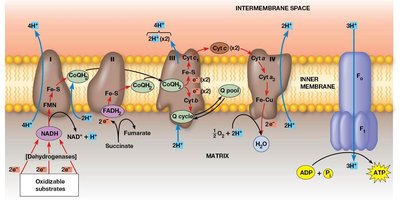
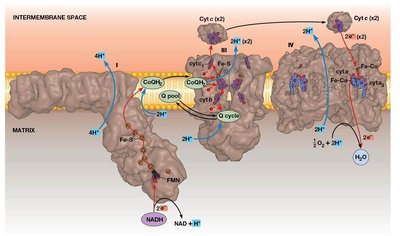
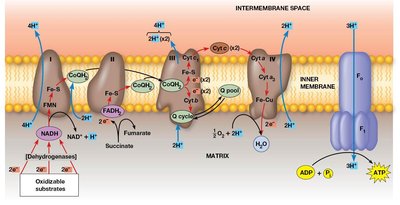
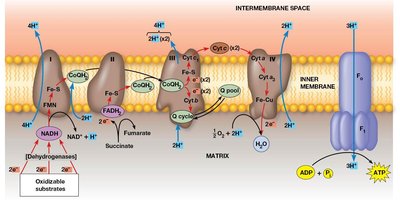
The ETC consists of four main respiratory complexes (I-IV) embedded in the inner mitochondrial membrane. Electrons from NADH and FADH2 are transferred through these complexes to oxygen, the final electron acceptor, forming water.
Key mobile carriers: Coenzyme Q (ubiquinone) and cytochrome c
Respiratory complexes can assemble into supercomplexes called respirasomes.
Proton Gradient and Chemiosmosis
As electrons move through complexes I, III, and IV, protons are pumped from the matrix to the intermembrane space, creating an electrochemical proton gradient (proton-motive force). This gradient drives ATP synthesis as protons flow back into the matrix through ATP synthase (FoF1 complex).
Proton pumping is coupled to electron transfer.
The proton gradient stores potential energy used for ATP synthesis.
ATP Synthesis by ATP Synthase
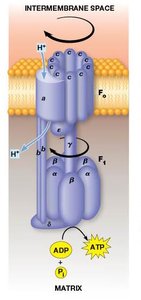
ATP synthase (FoF1 complex) synthesizes ATP from ADP and inorganic phosphate as protons flow through its membrane-embedded Fo portion, causing conformational changes in the F1 catalytic domain.
ATP synthesis is an example of oxidative phosphorylation.
ATP and the proton gradient are interconvertible forms of stored energy.
ATP Yield from Aerobic Respiration
Theoretical and Actual ATP Yield
The complete oxidation of one glucose molecule yields a theoretical maximum of 38 ATP in prokaryotes and up to 36 ATP in eukaryotes (due to the cost of shuttling electrons from cytosolic NADH into mitochondria). The actual yield is typically lower (30–32 ATP) due to proton leak, use of intermediates for biosynthesis, and other cellular processes.
Stage | ATP Produced | Type of Phosphorylation |
|---|---|---|
Glycolysis | 2 | Substrate-level |
Citric Acid Cycle | 2 | Substrate-level |
Electron Transport/Oxidative Phosphorylation | ~26–34 | Oxidative |
Overall Equation for Aerobic Respiration
The overall chemical equation for aerobic respiration is:
Summary Table: ATP Yield from Glucose Oxidation
Process | NADH Produced | FADH2 Produced | ATP Produced |
|---|---|---|---|
Glycolysis | 2 | 0 | 2 |
Pyruvate Oxidation | 2 | 0 | 0 |
Citric Acid Cycle | 6 | 2 | 2 |
Oxidative Phosphorylation | - | - | ~26–34 |
Additional info: The actual ATP yield varies depending on cell type, shuttle systems, and metabolic demands.
