 Back
Back25
Study Guide - Smart Notes
 Tailored notes based on your materials, expanded with key definitions, examples, and context.
Cancer Cells
Overview
Cancer is a major cause of mortality worldwide and is characterized by the uncontrolled proliferation of abnormal cells. Understanding the cellular and molecular basis of cancer is essential for cell biology students, as it integrates knowledge of cell cycle regulation, gene expression, and cellular signaling.
Cancer refers to a group of diseases involving abnormal cell growth with the potential to invade or spread to other parts of the body.
It is the second leading cause of death in the United States, accounting for approximately 20% of all deaths.
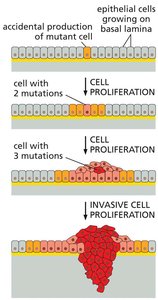
Most cancers arise from somatic mutations in a single cell, leading to clonal expansion and tumor formation.
The Key Behaviors of Cancer Cells
Cancer cells exhibit several behaviors that distinguish them from normal cells, primarily related to their ability to proliferate uncontrollably and invade other tissues.
Uncontrolled Proliferation: Cancer cells divide without the normal regulatory signals that control cell growth.
Invasion and Metastasis: Malignant tumors can invade surrounding tissues and spread to distant sites in the body.
Reduced Dependence on Extracellular Signals: Cancer cells often acquire mutations in genes involved in cell signaling pathways, allowing them to proliferate even in the absence of external growth signals.
Example: Mutations in the Ras gene can produce a hyperactive Ras protein, found in 25-30% of human cancers, leading to continuous cell division.
Tumors and Cancer Classification
Benign vs. Malignant Tumors
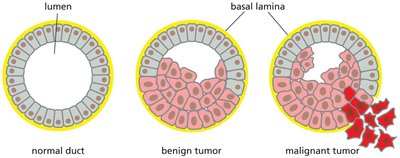
Tumors are masses of abnormal cells resulting from uncontrolled cell division. They are classified based on their ability to invade and spread.
Benign Tumors: Grow in a confined area and do not invade surrounding tissues.
Malignant Tumors (Cancers): Invade other tissues and can metastasize to distant organs.
Classification of Cancers
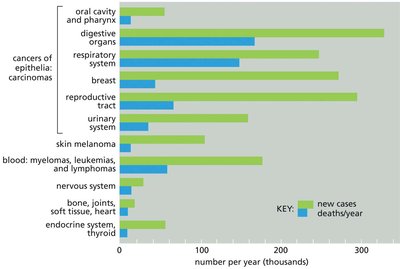
Cancers are classified based on the tissue or cell type from which they originate.
Carcinomas: (~80% of all cancers) Arise from epithelial cells (e.g., lung, breast, colon).
Sarcomas: Originate from supporting tissues such as bone, cartilage, fat, connective tissue, and muscle.
Lymphomas and Leukemias: Develop from cells of blood and lymphatic origin. Leukemias primarily involve cancer cells in the bloodstream.
Cancer Type | Origin | Examples |
|---|---|---|
Carcinoma | Epithelial cells | Lung, breast, colon |
Sarcoma | Supporting tissues | Bone, muscle |
Lymphoma/Leukemia | Blood/lymphatic cells | Leukemia, lymphoma |
Growth and Progression of Tumors
Tumor Growth Dynamics
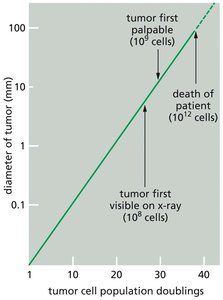
The growth of a tumor is a multistep process involving the accumulation of genetic mutations and clonal evolution. Tumors become clinically detectable only after many rounds of cell division.
Clonal Evolution: Tumor progression involves the sequential accumulation of mutations, each conferring a selective growth advantage.
Detection Thresholds: Tumors are first visible on X-ray at about 108 cells, palpable at 109 cells, and can be fatal at around 1012 cells.
Clonal Evolution and Mutation Accumulation
Multiple mutations are required for a normal cell to become cancerous. Each mutation increases the cell's proliferative and invasive potential.
Stepwise Progression: Initial mutations may cause increased proliferation; additional mutations can lead to invasive behavior.
Invasive Cell Proliferation: The final stage involves cells acquiring the ability to invade surrounding tissues.
Causes and Epidemiology of Cancer
Age and Cancer Prevalence
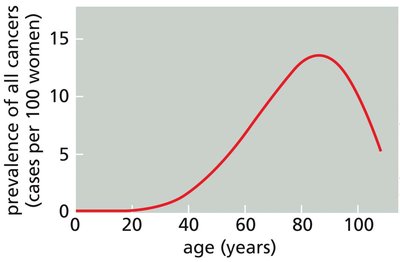
Cancer is primarily a disease of old age, with prevalence increasing significantly with age due to the accumulation of mutations over time.
Prevalence: The risk of developing cancer increases with age, peaking in the elderly population.
Lifestyle Factors: Smoking and Cancer
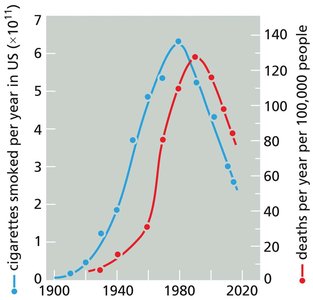
Lifestyle choices, such as tobacco use, are significant risk factors for certain cancers, particularly lung cancer. Epidemiological data show a strong correlation between cigarette consumption and lung cancer mortality.
Smoking: Increases the risk of lung cancer and is reflected in the parallel trends of cigarette consumption and lung cancer deaths over time.
Cancer-Critical Genes
Genetic Basis of Cancer
Cancer arises from mutations in specific genes that regulate cell growth and division. These include proto-oncogenes, tumor suppressor genes, and DNA repair genes.
Proto-oncogenes: Normal genes that promote cell growth; mutations can convert them into oncogenes, driving uncontrolled proliferation.
Tumor Suppressor Genes: Genes that inhibit cell division or promote apoptosis; loss-of-function mutations remove these restraints.
DNA Repair Genes: Maintain genomic integrity; mutations increase the overall mutation rate in cells.
Example: The Ras gene is a proto-oncogene; a single-point mutation can create a hyperactive Ras protein, leading to continuous cell division.
Summary Table: Key Features of Cancer Cells
Feature | Normal Cells | Cancer Cells |
|---|---|---|
Growth Control | Regulated by extracellular signals | Often independent of signals |
Invasion | Do not invade other tissues | Can invade and metastasize |
Genetic Stability | Stable genome | Genomic instability |
Clonal Origin | Polyclonal | Often monoclonal (from a single cell) |
Additional info: Cancer biology integrates knowledge from cell cycle regulation, gene expression, and signal transduction, making it a central topic in cell biology courses. Understanding the molecular mechanisms underlying cancer is essential for developing effective diagnostic and therapeutic strategies.
