 Back
Back24: Cell Cycle Control and Mitosis: Key Mechanisms and Regulatory Proteins
Study Guide - Smart Notes
 Tailored notes based on your materials, expanded with key definitions, examples, and context.
Cell Cycle Control and Regulation
Overview of the Cell Cycle
The cell cycle is a highly regulated series of events that leads to cell division and replication. It consists of interphase (G1, S, G2) and the M phase (mitosis and cytokinesis). Proper control ensures that DNA is replicated once per cycle and that chromosomes are accurately segregated.
Control of Chromosome Duplication
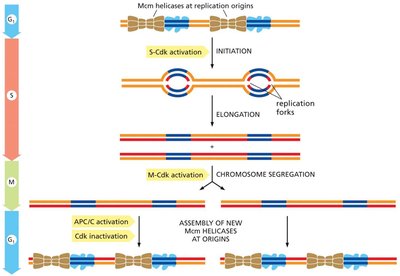
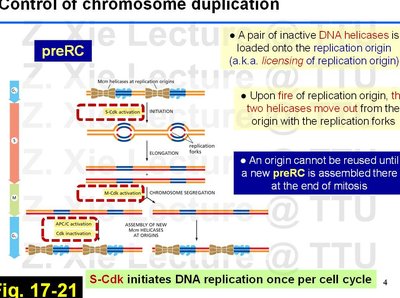
Chromosome duplication is tightly regulated to ensure that each segment of DNA is replicated only once per cell cycle. This process involves the assembly and activation of pre-replicative complexes (preRC) at replication origins.
Licensing of Replication Origins: Inactive DNA helicases are loaded onto replication origins during G1 phase, forming the preRC.
Initiation: S-Cdk (S-phase cyclin-dependent kinase) activation triggers the initiation of DNA replication, allowing helicases to move with replication forks.
Prevention of Re-replication: Origins cannot be reused until a new preRC is assembled at the end of mitosis, ensuring one round of replication per cycle.
Control of the Initiation of DNA Replication
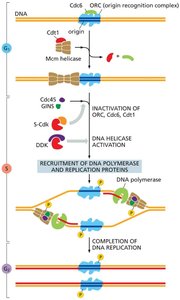
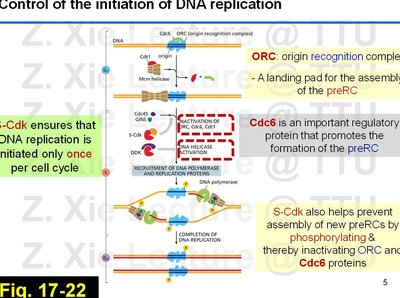
The initiation of DNA replication is regulated by several protein complexes and kinases to ensure precise timing and fidelity.
ORC (Origin Recognition Complex): Serves as a landing pad for preRC assembly at replication origins.
Cdc6: A regulatory protein that promotes preRC formation.
S-Cdk: Initiates DNA replication and prevents reassembly of new preRCs by phosphorylating and inactivating ORC and Cdc6.
Cyclin-Cdk Complexes and Cell Cycle Control
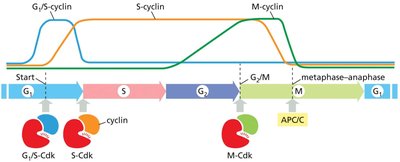
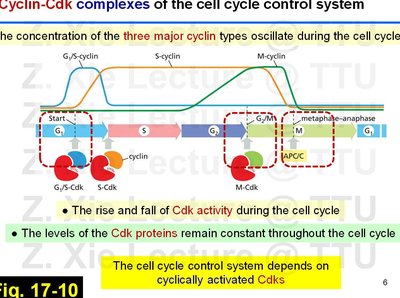
Cyclin-dependent kinases (Cdks) are central to cell cycle regulation. Their activity is controlled by association with cyclins, whose concentrations oscillate during the cell cycle.
Major Cyclin Types: G1/S-cyclin, S-cyclin, and M-cyclin.
Cdk Activity: Rises and falls with cyclin levels, while Cdk protein levels remain constant.
APC/C (Anaphase-Promoting Complex/Cyclosome): Triggers cyclin degradation, ensuring cell cycle progression.
Mitosis: Stages and Key Events
Principal Stages of M Phase (Mitosis and Cytokinesis)
Mitosis is the process by which replicated chromosomes are separated into two daughter cells. It is divided into distinct stages, each with specific events and structural changes.
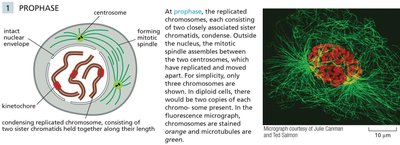
1. Prophase
Chromosomes condense and become visible as paired sister chromatids.
The mitotic spindle begins to form outside the nucleus.
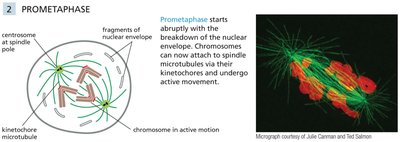
2. Prometaphase
Nuclear envelope breaks down.
Chromosomes attach to spindle microtubules via kinetochores.
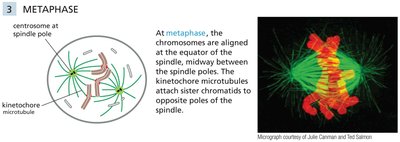
3. Metaphase
Chromosomes align at the metaphase plate (equator of the spindle).
Kinetochore microtubules attach sister chromatids to opposite spindle poles.
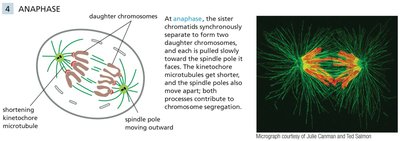
4. Anaphase
Sister chromatids separate and move toward opposite spindle poles.
Microtubules shorten, and spindle poles move apart.
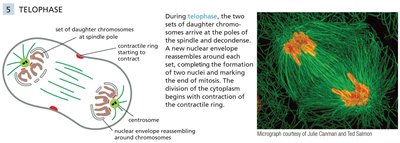
5. Telophase
Chromosomes arrive at spindle poles and decondense.
Nuclear envelopes re-form around each set of chromosomes.
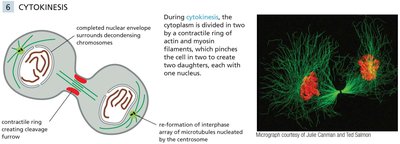
6. Cytokinesis
Cytoplasm divides by a contractile ring of actin and myosin, forming two daughter cells.
Reformation of interphase microtubule array.
Regulation of M-Cdk and Positive Feedback Loops
Activation of M-Cdk
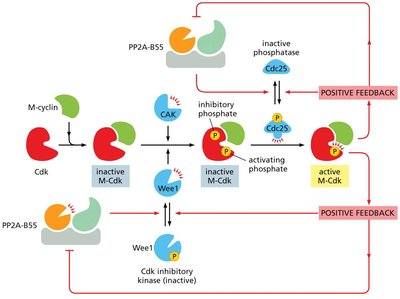
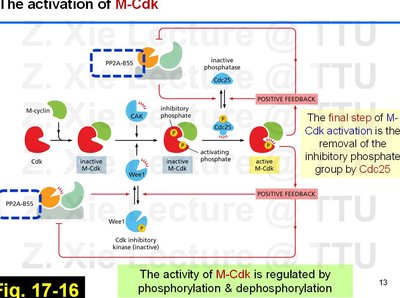
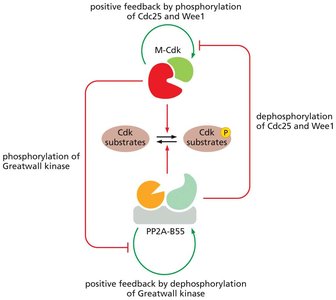
M-Cdk (mitotic cyclin-dependent kinase) is a key regulator of mitosis. Its activation is controlled by phosphorylation and dephosphorylation events, involving several regulatory proteins.
CAK (Cdk-activating kinase): Adds an activating phosphate to M-Cdk.
Wee1 kinase: Adds an inhibitory phosphate to M-Cdk.
Cdc25 phosphatase: Removes the inhibitory phosphate, activating M-Cdk.
PP2A-B55: A phosphatase that counteracts Cdk activity.
Protein Phosphatases and Feedback Regulation
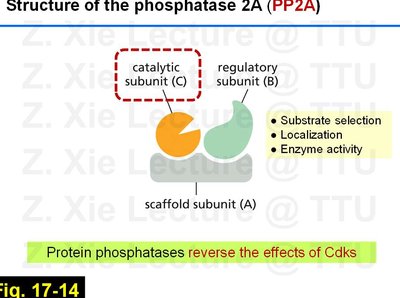
Protein phosphatases, such as PP2A, reverse the effects of Cdks by removing phosphate groups from target proteins. The interplay between kinases and phosphatases creates feedback loops that ensure robust cell cycle transitions.
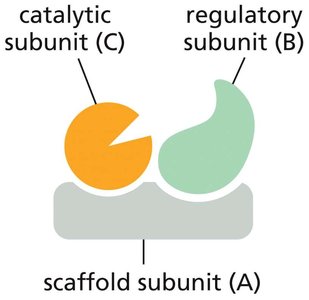
PP2A Structure: Composed of catalytic, regulatory, and scaffold subunits, determining substrate specificity and localization.
Feedback Loops: M-Cdk and PP2A-B55 mutually inhibit and activate each other, forming an integrated regulatory circuit.
Cohesin Complex and Chromosome Segregation
Cohesin Structure and Function
Cohesin is a multi-subunit protein complex that holds sister chromatids together after DNA replication, ensuring accurate chromosome segregation during mitosis.
SMC Proteins: Structural maintenance of chromosomes proteins form the core of cohesin.
ATPase Activity: Cohesin's ATPase domains are essential for its loading and release from DNA.
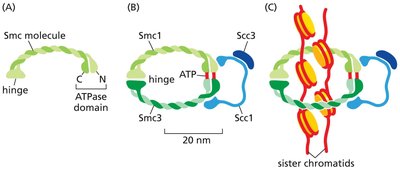
Table: Nobel Prize Topics Related to Cell Biology
The following table summarizes selected Nobel Prize-winning discoveries relevant to cell biology, as presented in the course.
SN | First Name | Last Name | Chosen Topic | Nobel Prize |
|---|---|---|---|---|
1 | Dylan | Luong | The green fluorescent protein (GFP) | Chemistry, 2008 |
2 | Diya | Kapoor | Ubiquitin-mediated protein degradation | Chemistry, 2004 |
3 | Mika | Reddy-Mazzitello | Ubiquitin-mediated protein degradation | Chemistry, 2004 |
4 | Kevin | Vega | Invention of the polymerase chain reaction (PCR) method | Chemistry, 1993 |
5 | Kyunghoon | Yeom | Invention of the polymerase chain reaction (PCR) method | Chemistry, 1993 |
6 | Sarwesh | Karna | Catalytic properties of RNA | Chemistry, 1989 |
7 | Bailee (Jade) | Jordan | Molecular mechanisms controlling the circadian rhythm | Physiology or Medicine, 2017 |
Additional info: The above topics highlight the importance of molecular tools (e.g., GFP, PCR), protein degradation pathways, and regulatory mechanisms in cell biology research and their impact on our understanding of cellular processes.
