 Back
BackCell Signaling: Principles, Pathways, and Receptors
Study Guide - Smart Notes
 Tailored notes based on your materials, expanded with key definitions, examples, and context.
Cell Signaling
Introduction to Cell Signaling
Cell signaling is the process by which cells sense and respond to their environment, coordinating their behaviors in multicellular organisms. This communication is essential for development, homeostasis, and adaptation to external stimuli.
Signal transduction refers to the conversion of an extracellular signal into a specific cellular response.
Signaling cells produce extracellular signal molecules that are detected by receptors on target cells.
Receptors initiate intracellular signaling cascades that alter cell behavior.
General Principles of Cell Signaling
Signals can be proteins, peptides, amino acids, nucleotides, steroids, fatty acid derivatives, or dissolved gases.
Communication can occur over long or short distances and by various mechanisms:
Endocrine signaling: Hormones are secreted into the bloodstream and act on distant cells.
Paracrine signaling: Local mediators diffuse to nearby cells.
Neuronal signaling: Neurotransmitters are released at synapses for rapid, specific communication.
Contact-dependent signaling: Direct physical contact between cells via membrane-bound molecules.
Extracellular Signals and Receptors
Types of Receptors
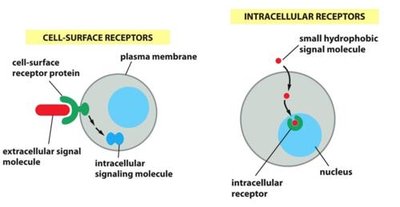
Cells respond to signals only if they possess the appropriate receptor. Receptors are classified based on their location and the nature of the signal molecule.
Cell surface receptors: Bind hydrophilic signal molecules that cannot cross the plasma membrane.
Intracellular receptors: Bind small, hydrophobic signal molecules that diffuse across the membrane.
Classes of Cell Surface Receptors
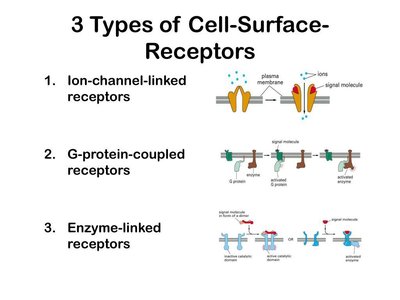
Ion-channel-coupled receptors: Change membrane permeability to ions, altering membrane potential.
G-protein-coupled receptors (GPCRs): Activate trimeric GTP-binding proteins, which then regulate enzymes or ion channels.
Enzyme-coupled receptors: Either act as enzymes or associate with enzymes inside the cell.
Signal Transduction Pathways
Intracellular Signaling Pathways
Once a receptor is activated, it initiates a cascade of intracellular signaling events. These pathways can relay, amplify, integrate, and distribute signals, often involving feedback regulation.
Molecular switches: Proteins that toggle between active and inactive states, often regulated by phosphorylation or GTP binding.
Ion-Channel-Coupled Receptors
These receptors mediate rapid synaptic signaling by converting chemical signals (neurotransmitters) into electrical signals (ion flux).
Examples: Na+, K+, or Ca2+ channels in neurons.
G-Protein-Coupled Receptors (GPCRs)
GPCRs are the largest family of cell surface receptors, mediating responses to a wide variety of signals. They share a common structure of seven transmembrane α-helices.
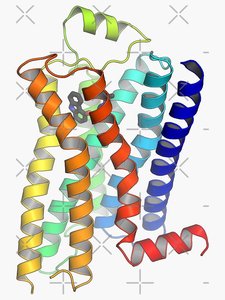
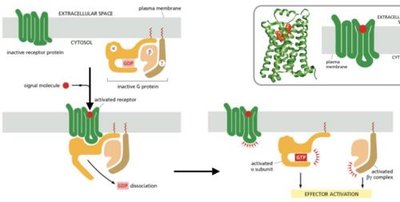
Upon ligand binding, GPCRs activate heterotrimeric G proteins (α, β, γ subunits).
Activation involves exchange of GDP for GTP on the α subunit, leading to dissociation and activation of downstream effectors.
G Protein Signaling Pathways
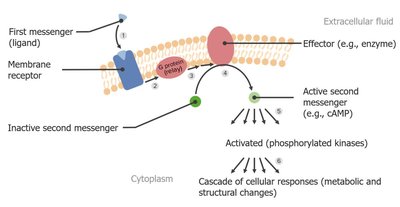
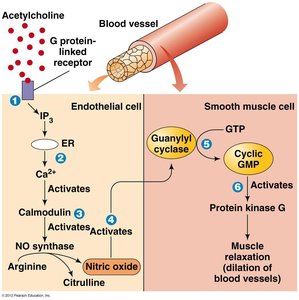
G proteins can activate membrane-bound enzymes such as adenylyl cyclase (produces cAMP) and phospholipase C (produces IP3 and DAG).
cAMP Pathway
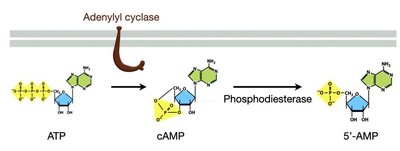
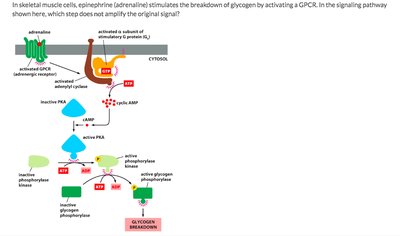
Adenylyl cyclase converts ATP to cyclic AMP (cAMP), a second messenger.
cAMP activates protein kinase A (PKA), which phosphorylates target proteins to elicit cellular responses.
Inositol Phospholipid Pathway
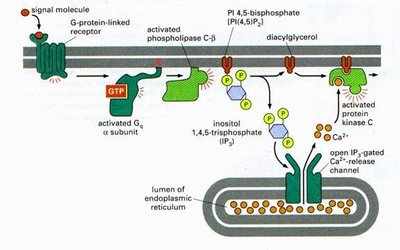
Phospholipase C cleaves a membrane inositol phospholipid to generate IP3 and DAG.
IP3 triggers Ca2+ release from the endoplasmic reticulum; DAG activates protein kinase C (PKC).
Role of Ca2+ in Cell Signaling
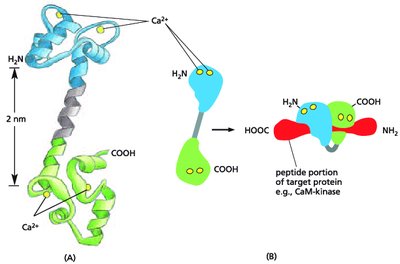
Calcium ions act as ubiquitous intracellular messengers, triggering processes such as muscle contraction, secretion, and fertilization. The cytosolic concentration of Ca2+ is tightly regulated by pumps and channels.
Calmodulin is a major Ca2+-binding protein that mediates many Ca2+-dependent processes.
Signaling by Nitric Oxide (NO)
Some GPCR pathways generate small, diffusible molecules like nitric oxide (NO), which acts as a local mediator. NO diffuses into neighboring cells and activates guanylyl cyclase, increasing cyclic GMP and causing smooth muscle relaxation.
NO is involved in processes such as blood vessel dilation and neurotransmission.
Enzyme-Coupled Receptors
Receptor Tyrosine Kinases (RTKs)
Enzyme-coupled receptors, especially RTKs, play key roles in regulating cell growth, proliferation, differentiation, and survival. Ligand binding induces dimerization and autophosphorylation of tyrosine residues, creating docking sites for intracellular signaling proteins.
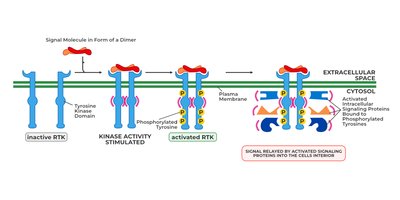
RTKs initiate complex signaling cascades that control diverse cellular processes.
Summary Table: Major Classes of Cell Surface Receptors
Receptor Class | Mechanism | Example Ligands | Key Features |
|---|---|---|---|
Ion-channel-coupled | Directly open/close ion channels | Neurotransmitters | Rapid, electrical signaling |
G-protein-coupled (GPCRs) | Activate G proteins, which regulate enzymes/channels | Hormones, neurotransmitters, local mediators | Amplification, diverse responses |
Enzyme-coupled (RTKs) | Ligand binding activates intrinsic or associated enzyme activity | Growth factors, cytokines | Regulate cell growth, differentiation |
Additional info: This guide integrates foundational concepts and mechanisms of cell signaling, with emphasis on receptor types, second messengers, and key signaling pathways relevant to cell biology.
