 Back
Cell Structures and Organelles: Functions in Prokaryotic and Eukaryotic Cells
Study Guide - Smart Notes
 Tailored notes based on your materials, expanded with key definitions, examples, and context.
Structures and Organelles in Cells
Overview of Cell Biology
Cells are the fundamental units of life, with specialized structures called organelles that perform essential functions. Eukaryotic cells contain membrane-bound organelles, while prokaryotic cells lack these structures. Understanding the organization and function of these organelles is crucial for comprehending cell biology.
Cell Types and Their Structures
Prokaryotic vs. Eukaryotic Cells
Prokaryotic cells (such as bacteria) do not have membrane-bound organelles, whereas eukaryotic cells (including plant and animal cells) possess a variety of organelles that compartmentalize cellular functions.
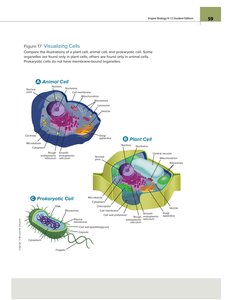
Prokaryotic Cells: DNA, ribosomes, cytoplasm, cell membrane, cell wall (peptidoglycan), capsule, flagella.
Plant Cells: Nucleus, nucleolus, endoplasmic reticulum, central vacuole, mitochondrion, ribosomes, microtubules, cytoplasm, chloroplast, cell membrane, cell wall (cellulose), Golgi apparatus, vesicle.
Animal Cells: Nucleus, nucleolus, nuclear pore, centriole, microtubule, cytoplasm, endoplasmic reticulum, cell membrane, mitochondrion, ribosomes, lysosome, vesicle, Golgi apparatus.
Cytoskeleton and Cell Movement
Components of the Cytoskeleton
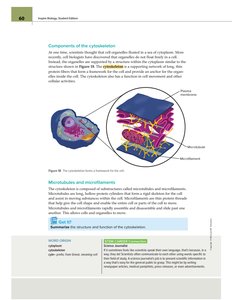
The cytoskeleton is a network of protein fibers that provides structural support, anchors organelles, and enables cell movement. It consists of microtubules and microfilaments.
Microtubules: Long, hollow cylinders that form a rigid skeleton and assist in moving substances within the cell.
Microfilaments: Thin protein threads that help maintain cell shape and enable movement.
Centrioles
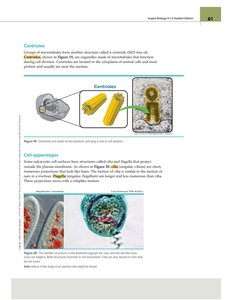
Centrioles are organelles made of microtubules, important for cell division. They are found in animal cells and most protists, usually near the nucleus.
Cell Appendages: Cilia and Flagella
Cilia and flagella are projections from the cell surface that aid in locomotion and feeding. Cilia are short and numerous, moving like oars, while flagella are longer and less numerous, moving with a whiplike motion.
Microtubule Configuration
Cilia and flagella are composed of microtubules arranged in a 9+2 configuration, providing structural support and movement capability.
Prokaryotic cilia and flagella: Contain cytoplasm and are enclosed by the plasma membrane, made of complex proteins.
Cell Walls
Plant Cell Wall
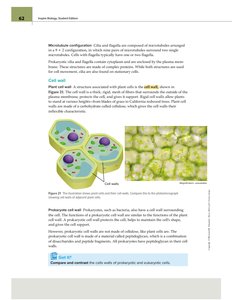
The plant cell wall is a thick, rigid mesh of fibers made of cellulose, providing support and protection. It allows plants to stand at various heights.
Prokaryotic Cell Wall
Prokaryotic cell walls are made of peptidoglycan, a combination of disaccharides and peptide fragments. They protect the cell, maintain shape, and provide support.
Controlling Cell Activities
The Nucleus
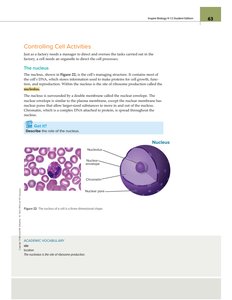
The nucleus is the control center of the cell, containing most of the cell's DNA. It directs cell processes, stores genetic information, and is the site of ribosome production (nucleolus).
Nuclear envelope: Double membrane with nuclear pores for transport.
Chromatin: Complex of DNA and protein spread throughout the nucleus.
Processing Energy
Mitochondria
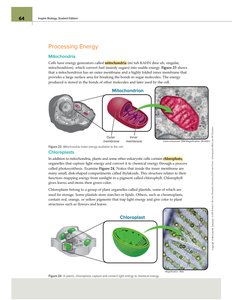
Mitochondria are energy generators that convert sugars into usable energy through cellular respiration. They have an outer membrane and a highly folded inner membrane for efficient energy production.
Chloroplasts
Chloroplasts are organelles in plants and some protists that capture light energy and convert it to chemical energy via photosynthesis. They contain thylakoids and the pigment chlorophyll.
Manufacturing Proteins
Ribosomes
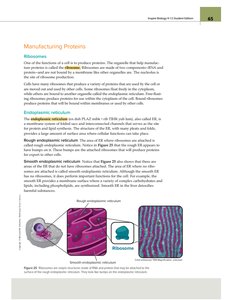
Ribosomes are the site of protein synthesis, composed of RNA and protein. They can be free-floating in the cytoplasm or bound to the endoplasmic reticulum.
Endoplasmic Reticulum (ER)
Rough ER: Has ribosomes attached, synthesizes proteins for export.
Smooth ER: Lacks ribosomes, synthesizes lipids and carbohydrates, detoxifies substances.
Processing, Transporting, and Storing Molecules
Golgi Apparatus
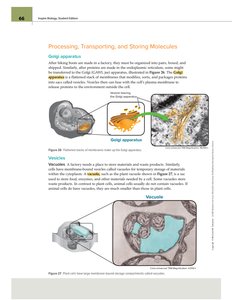
The Golgi apparatus modifies, sorts, and packages proteins into vesicles for transport within or outside the cell.
Vesicles and Vacuoles
Vesicles are membrane-bound sacs for temporary storage and transport. Vacuoles, especially large in plant cells, store food, enzymes, and waste products.
Lysosomes
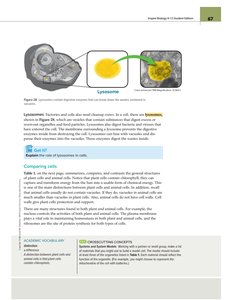
Lysosomes are vesicles containing digestive enzymes that break down excess or worn-out organelles, food particles, and invading bacteria or viruses. Their membrane prevents enzymes from damaging the cell.
Comparing Plant and Animal Cells
Summary Table of Cell Structures
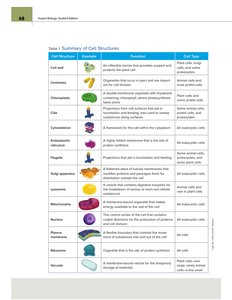
The following table summarizes the main cell structures, their functions, and the cell types in which they are found.
Cell Structure | Function | Cell Type |
|---|---|---|
Cell wall | Support and protection | Plant cells, fungi, some prokaryotes |
Centrioles | Cell division | Animal cells, most protists |
Chloroplasts | Photosynthesis | Plant cells, some protists |
Cilia | Locomotion, feeding | Some animal cells, protists, prokaryotes |
Cytoskeleton | Framework, movement | All eukaryotic cells |
Endoplasmic reticulum | Protein synthesis | All eukaryotic cells |
Flagella | Locomotion, feeding | Some animal cells, prokaryotes, some plant cells |
Golgi apparatus | Protein modification, packaging | All eukaryotic cells |
Lysosome | Digestive enzymes | Animal cells, rare in plant cells |
Mitochondria | Energy production | All eukaryotic cells |
Nucleus | Control center, genetic information | All eukaryotic cells |
Plasma membrane | Boundary, transport | All cells |
Ribosome | Protein synthesis | All cells |
Vacuole | Storage | Plant cells (large), animal cells (small, rare) |
Organelles at Work: Integration of Cell Functions
Coordination of Cell Processes
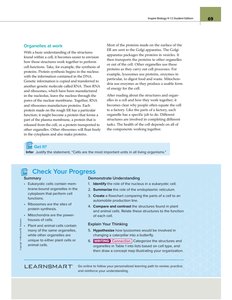
Cell organelles work together to perform complex functions. Protein synthesis begins in the nucleus, where DNA is transcribed to RNA. RNA and ribosomes exit the nucleus, and proteins are synthesized on the rough ER. These proteins are sent to the Golgi apparatus for packaging and distribution. Lysosomes use enzymes to digest waste, while mitochondria produce energy for cellular activities. The health of the cell depends on the coordinated function of all organelles.
Key Points for Exam Preparation
Eukaryotic cells contain membrane-bound organelles; prokaryotic cells do not.
Ribosomes are the sites of protein synthesis in all cells.
Mitochondria are the powerhouses of cells, producing energy.
Plant and animal cells share many organelles, but some are unique to each type (e.g., chloroplasts in plants, centrioles in animals).
